

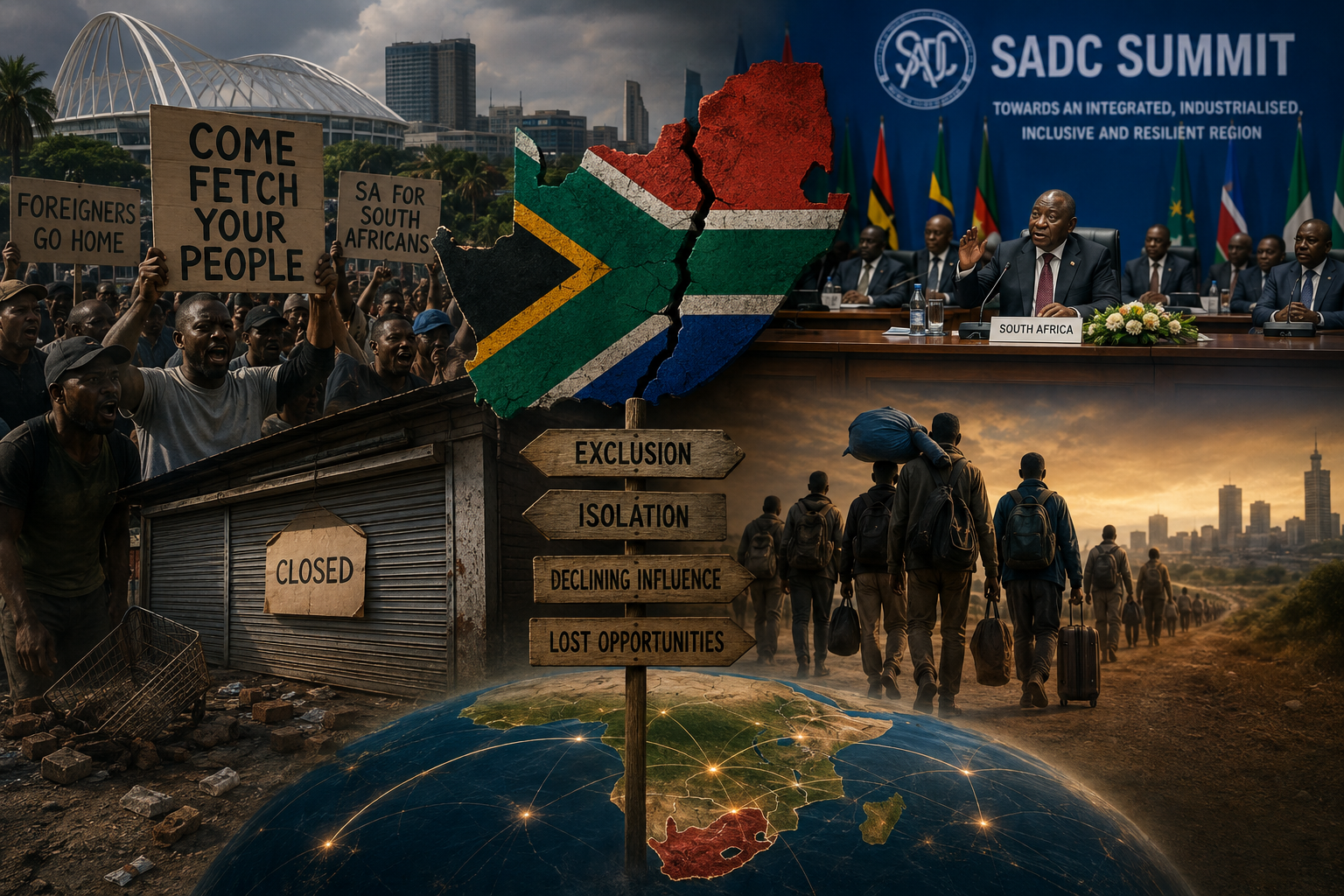
The 46th Southern African Development Community (SADC) Summit ended in Durban this week with an uncomfortable contradiction outside its doors. While regional leaders met to advance integration, industrialisation and shared prosperity, anti-immigration protesters marched nearby carrying placards demanding that neighbouring countries ‘come fetch your people’. Some foreign-owned shops were forced to close during the protest. The demonstration took place as South Africa assumed the SADC chairmanship for 2026/27.
SADC Summit’s communiqué called for regional dialogue on migration governance and comprehensive responses to its causes. What happens to South Africa over the next decade if foreigners increasingly conclude that they are unwanted?
By 2036, four possible versions of South Africa could emerge. The first is a more orderly South Africa with fewer migrants. Government could improve border management, process immigration applications faster and enforce employment and immigration laws consistently.
Still, those concerns become harder to resolve when foreigners are treated as one group rather than distinguishing between legal residents, asylum seekers and people without documentation.
The second possibility is a poorer and more inward-looking South Africa. Foreign migrants are not simply users of public services. They are workers, consumers, traders, employers and entrepreneurs. They are found in agriculture, construction, hospitality, transport, retail and informal businesses. If large numbers leave, South Africa may discover that removing migrants does not automatically create jobs for citizens. Some sectors could lose workers, businesses could lose customers and entrepreneurs could take capital and commercial relationships elsewhere.
History provides a warning. Uganda’s expulsion of its Asian population in 1972 removed thousands of business owners, professionals and families. Businesses were disrupted and economic networks that had developed over generations were broken.
South Africa is not Uganda, but the lesson is worth remembering: People carry skills, capital, knowledge and relationships. When they leave, those assets can leave with them.
The consequences would reach beyond immigration. South Africa’s neighbours watch closely because migration is woven into the region’s history. With consequences felt in Harare, Maputo, Mbabane and elsewhere, the challenge is to prevent migration from becoming a permanent source of political division. If South Africa’s response is seen as collective punishment, resentment may deepen among governments and citizens in the region.
If it is based on clear laws applied fairly, the country can regain confidence while addressing domestic concerns.
The third possibility is a South Africa with diminished regional influence.
South Africa’s companies operate across Africa, its universities attract students from neighbouring countries and Johannesburg remains a continental business centre. Nonetheless, influence is built on relationships as much as money. The SADC Summit made that clear. Inside the venue, leaders discussed regional integration and shared prosperity. Outside, protesters told Africans from neighbouring countries to go home. SADC’s programme places regional integration at the centre of its work, while the summit theme called for inclusive industrialisation.
That contrast matters. How convincing is a message of regional integration when people from the same region are publicly portrayed as intruders? SADC leaders raised migration during the summit, and President Cyril Ramaphosa reportedly apologised for the treatment of foreign nationals, saying South Africa was ashamed of recent events. Desmond Tutu once said: “My humanity is bound up in yours, for we can only be human together.”
The fourth possibility is the most troubling: Exclusion becomes politically normal.
Once foreigners become convenient explanations for unemployment, crime, housing shortages or failing services, removing them can become an attractive political message. The danger is that the definition of who is unwanted keeps expanding.
Today it may be undocumented Zimbabweans or Mozambicans. Tomorrow it could include legal migrants, foreign-owned businesses or naturalised South Africans whose families have lived there for decades. History offers several warnings. Spain’s expulsion of Jews in 1492 and the later expulsion of the Moriscos removed established communities with economic and cultural roles. Uganda’s Asian expulsion showed the damage that can follow when political exclusion overrides economic interests.
Kwame Nkrumah warned: “The independence of Ghana is meaningless unless it is linked up with the total liberation of the African continent.”
South Africa cannot separate its future easily from that of its neighbours. Its companies depend on African consumers. Its economy depends on regional trade. Its diplomacy depends on African partnerships. Its leadership of SADC depends on cooperation with countries whose citizens are being told to leave. Violently so, at that.














Leave a comment