

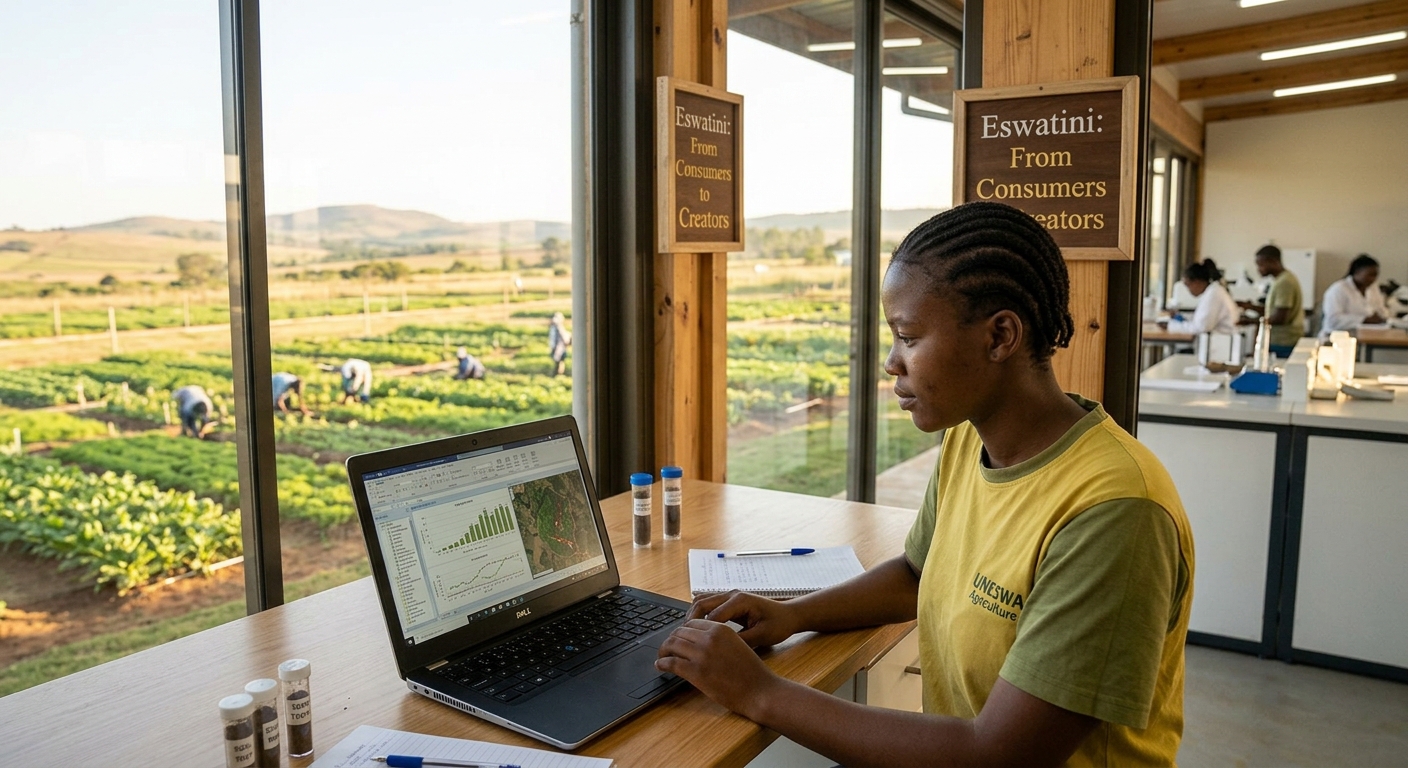
… from consumers to creators
Madam,
Part I – Eswatini has made important progress in food security, healthcare, education and technology. Across Africa, governments, universities, farmers, scientists and young innovators are also working to address some of the continent’s biggest challenges.
But we must be honest about where we are. We have made progress, yet we remain dependent on external systems, products, knowledge, technology and financing.
The question is not whether international assistance is useful. It clearly can be. The more important question is: Are our partnerships progressively making us more capable of doing things for ourselves?
That is the conversation Eswatini and Africa need to have.
Where does Eswatini stand?
In agriculture, Eswatini has recognised food sovereignty and self-sufficiency as national priorities. Government has been pursuing irrigation development, climate-smart agriculture, agricultural transformation and measures to improve domestic food production.
These are positive steps. However, our food system remains vulnerable to climate variability, production shocks, food prices and dependence on external supplies.
The challenge is therefore no longer simply producing food. It is building a resilient food system with stronger domestic capabilities.
We need greater investment in seed development, irrigation, agricultural research, mechanisation, storage, processing, cold-chain infrastructure and reliable markets. Instead of exporting raw agricultural products and importing finished goods, we should increasingly process our own agricultural output. Instead of allowing traditional agricultural knowledge to disappear, we should document and research it. Instead of treating indigenous crops as something belonging only to the past, we should investigate their nutritional, agricultural and commercial potential.
What can we learn from China?
China offers an important example of what is possible when food security is part of a broader national development strategy.
Following reforms that began in the late 1970s, China combined agricultural reforms with investment in irrigation, research, technology, rural infrastructure, markets and rural economic development. Agricultural productivity increased, while rural industries and non-farm employment created additional sources of income.
The World Bank estimates that nearly 800 million people in China moved above the international extreme-poverty line between 1978 and 2020.
The lesson for Africa is not that we should copy China’s political or economic system. The lesson is that food security becomes stronger when agriculture is connected to science, technology, infrastructure, processing, markets, employment and broader economic development.
For Eswatini, therefore, we should not ask only how to produce more food. We should also ask how to develop the knowledge, technology, infrastructure, industries and skills needed to produce, process, store and distribute more of our own food.
Africa’s food challenge
This is not only an Eswatini problem.
The latest food-security evidence shows that Africa continues to carry a disproportionate share of the world’s hunger burden. Approximately 309 million people in Africa faced hunger in 2025, representing about 20 per cent of the continent’s population.
Although Africa’s hunger rate declined slightly between 2024 and 2025, progress remains fragile. Food insecurity, poverty, climate change and the affordability of healthy diets continue to present major challenges.
Africa therefore needs to move beyond emergency responses towards long-term agricultural transformation.
We need stronger African seed systems, agricultural research, processing industries, storage and distribution systems and regional markets.
Food security cannot permanently depend on importing food whenever domestic production fails.
Healthcare: Progress, but dependence remains
Eswatini has achieved important public-health gains, including expanded access to HIV services, immunisation, maternal and child health programmes and other essential interventions.
These achievements should be recognised.
But progress in delivering healthcare is not the same thing as health sovereignty. A country may provide effective treatment while still importing many of its medicines, equipment, specialised technologies and research capabilities.
Eswatini and other African countries should, therefore, strengthen their ability to conduct clinical and epidemiological research, manufacture selected essential medicines where feasible, produce medical supplies, strengthen diagnostic laboratories, improve disease surveillance and develop health technologies suited to African conditions.
We should also increase African participation in determining the research questions that affect African populations.
The question is not whether we should use international medical knowledge. Of course, we should. The question is whether African scientists have enough capacity to evaluate, adapt and eventually develop the technologies and treatments we depend upon.
Education: Are we producing enough builders?
Eswatini has invested considerably in education, including Free Primary Education and broader efforts to improve access and quality.
But education must increasingly answer another question: What kind of country are our schools and universities preparing young people to build?
If graduates leave university primarily looking for employment while the country continues importing technologies, expertise and products they could potentially develop, then we are not fully exploiting our educational investment.
We need stronger practical education in agriculture, medicine, engineering, mathematics and science, computer science, cybersecurity, artificial intelligence, biotechnology, renewable energy, manufacturing, data science and technical and vocational skills.
More importantly, students should be connected to real national problems.
A cybersecurity student should be able to work on national cybersecurity. An agricultural student should work with farmers. A computer scientist should develop systems for local institutions. A laboratory scientist should participate in national research. An engineer should be encouraged to solve Eswatini’s infrastructure and manufacturing problems.
Education should not only produce graduates. It should produce problem-solvers.
Africa’s education challenge
Across Africa, the challenge is not simply access to education. It is also the connection between education, skills, research, industry and employment.
We should therefore ask not only how many students graduate, but also how many technologies they develop, businesses they create, innovations they produce, national problems they solve and research results they turn into useful products.
These are increasingly important measures of national development.
Indigenous knowledge is an opportunity
This brings me back to an issue I have previously written about: Indigenous knowledge sovereignty.
Eswatini and Africa possess generations of knowledge about agriculture, medicinal plants, livestock, environmental management, food preservation, weather patterns and community systems.
But knowledge that is not documented, protected, researched and transmitted can eventually disappear. At the same time, knowledge taken from communities without proper recognition or benefit-sharing can become a source of exploitation.
We therefore need a system that allows indigenous knowledge to be documented, protected, researched, scientifically evaluated, digitally preserved and responsibly developed.
We should neither blindly accept every traditional practice nor automatically dismiss it.
Let us investigate it.
If something works, let us understand it scientifically. If it does not work, let us establish that through evidence. If it has potential, let us develop it responsibly. And if communities possess valuable knowledge, they should participate in its governance and benefit from legitimate economic applications.
This is where our cultural heritage can become part of our scientific and economic future.
The experience of countries such as China shows that national capability is not built through one intervention. It is built over time through investment in people, research, infrastructure, productive industries, technology and institutions.
Eswatini does not need to copy another country’s model. But we can learn from what has worked elsewhere and adapt those lessons to our own circumstances.
Part II will examine technology, digital sovereignty, international partnerships and how Eswatini could turn these ideas into a long-term programme for building capacity.
Thembinkosi Sabelo Dlamini
Cybersecurity Student and independent researcher
















Leave a comment