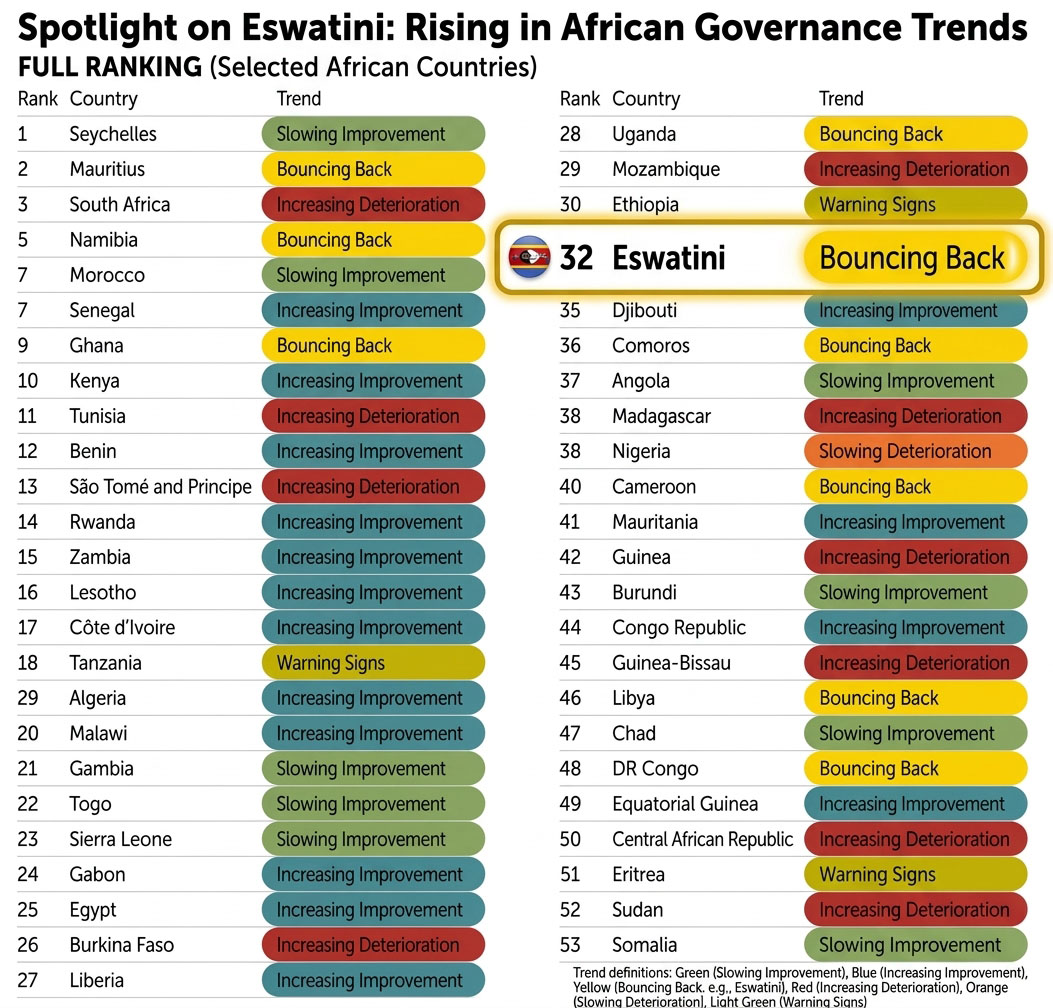
MBABANE – Eswatini’s governance performance has barely shifted over a decade, with the country ranking 32nd in Africa despite gains in connectivity, healthcare, economic opportunity and infrastructure.
Eswatini has recorded limited progress in overall governance over the past decade, with its performance remaining below both continental and regional averages, according to the latest Ibrahim Index of African Governance (IIAG).
The 2026 edition of the index, released by the Mo Ibrahim Foundation on October 31, assesses governance performance across 54 African countries between 2016 and 2025. It places Eswatini in 32nd position, with an overall governance score of 46.9 out of 100.
The country’s score is below the African average of 50.1 and the Southern African regional average of 56.1, highlighting the gap between Eswatini’s governance performance and that of other countries on the continent.
More concerning is that Eswatini’s overall score declined by 0.4 points between 2016 and 2025, suggesting that the country has struggled to translate improvements in selected areas into meaningful overall governance progress.
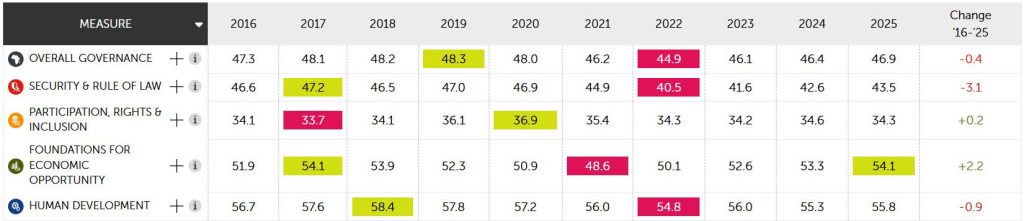
The findings present a mixed picture of the country’s governance trajectory, with improvements in economic opportunities, digital connectivity and certain human development indicators being offset by deteriorating performance in security, the rule of law, civic freedoms and public perceptions of service delivery.
One of the areas in which Eswatini has registered progress is foundations for economic opportunity, where the country improved its score by 2.2 points over the decade under review.
The improvement reflects gains across several indicators, particularly those relating to infrastructure, access to essential services and digital connectivity.
Mobile communications recorded the most significant improvement, gaining 37.8 points since 2016. This was followed by health quality, which improved by 20.8 points, while access to energy increased by 13.7 points.
Internet connectivity also registered progress, with the country’s score improving by 12.2 points over the same period.
These improvements point to gains in the country’s digital and physical infrastructure, particularly in mobile communications and access to essential services.
The progress in mobile communications is particularly notable given the growing importance of digital connectivity in facilitating economic participation, business operations, access to information and the delivery of services.
Improved internet access also provides opportunities for businesses and individuals to participate in an increasingly digital economy.
However, the gains in infrastructure and economic opportunity have not translated into a corresponding improvement in overall governance, with the country’s performance remaining below the continental and regional averages.
The index’s findings also reveal a distinction between improvements recorded in measurable service-related indicators and how citizens perceive the availability and quality of those services.
While Eswatini has made progress in selected economic and human development indicators, its performance in participation, rights and inclusion remains particularly weak.
The country recorded a score of just 34.3 out of 100 in this governance dimension, reflecting persistent challenges relating to political participation, civic freedoms, rights and inclusion.
Among the most concerning findings is that Eswatini scored zero out of 100 in both freedom of association and assembly and protection against discrimination.
Political pluralism also recorded an extremely low score of 0.3 out of 100.
These indicators highlight significant weaknesses in the country’s performance in areas associated with citizens’ ability to organise, participate in public affairs and enjoy protection against discrimination.
The findings suggest that improvements in infrastructure and access to services have not been accompanied by comparable progress in the broader environment for political participation and the protection of civic rights.
Freedom of expression and belief also registered a significant deterioration, declining by 18.6 points between 2016 and 2025.
This represents one of the notable setbacks in Eswatini’s governance performance over the period, pointing to growing challenges in an area that is central to participation, accountability and the protection of individual freedoms.