

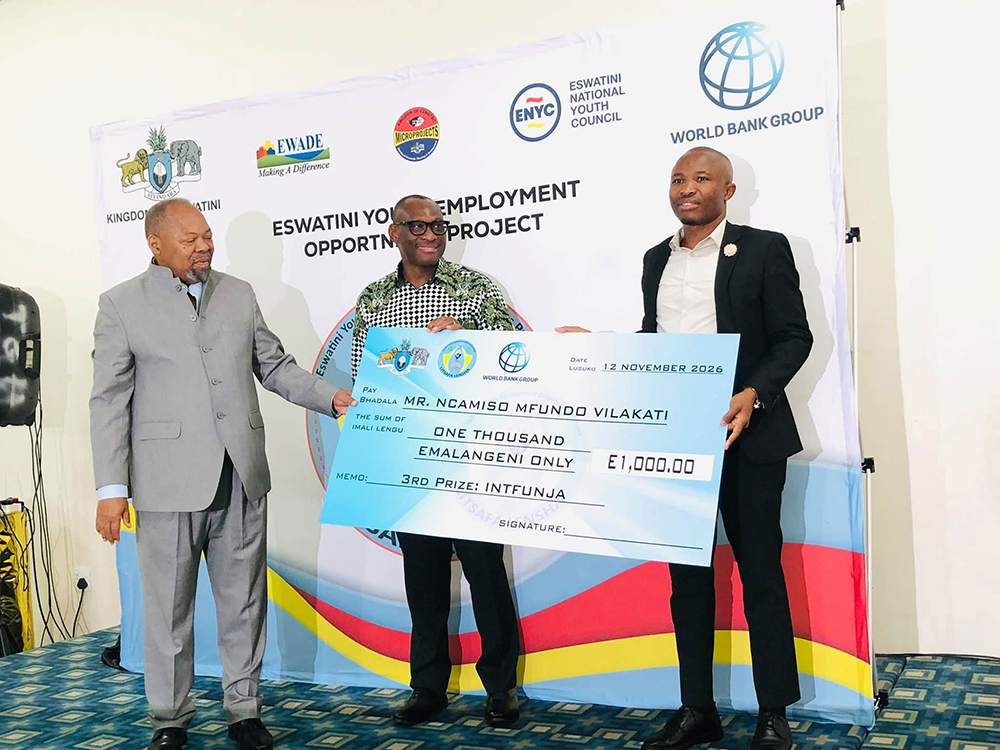
The Eswatini Youth Employment Opportunities Project (EYEOP) has officially adopted the siSwati name Litsafa Lensha, marking an important milestone in government’s efforts to address youth unemployment and expand economic opportunities across the country.
The name, submitted by competition winner Bongekile Zelda Dlamini, was unveiled alongside the project’s official logo during a ceremony held at The George Hotel in Manzini on Thursday, November 12, 2026. The event also featured the signing of memoranda of understanding (MoUs) with partner institutions and the handover of working tools, including vehicles and laptops, to support implementation. Minister for Economic Planning and Development Dr Thambo Gina described the unveiling as more than a branding exercise, saying it represented national ownership of an initiative designed around the aspirations of young emaSwati.
“The unveiling of a siSwati name and logo is more than a branding exercise. It represents our commitment to ensuring that this initiative is rooted in our national identity, speaks to the aspirations of our young people, and is embraced by the communities it is intended to serve,” said Dr Gina.
Tackling youth unemployment
The minister highlighted the scale of the country’s unemployment challenge, noting that approximately 25 000 young people enter the labour market annually, against only about 1 000 formal jobs created.
EYEOP is a five-year government initiative developed in partnership with the World Bank, with financing of US$27 million through an International Development Association (IDA) credit.
The project aims to create income-earning opportunities for up to 30 000 young people across Eswatini’s four regions through demand-driven skills development, apprenticeships, entrepreneurship support and improved access to productive resources and markets. Particular attention will be given to young women, persons with disabilities and young people in rural communities.
Dr Gina emphasised that employment creation should extend beyond securing formal jobs, with young people also requiring support to establish businesses, participate in agricultural value chains and develop sustainable livelihoods. “To our young people:
This project is an opportunity to unlock your potential, develop your capabilities and translate your ideas into productive economic activities. I encourage you to take ownership of this initiative, participate actively and make the most of the opportunities it presents,” he said. He further stressed that successful implementation would require collaboration between government, the private sector, development partners and communities, ensuring that training responds to market demand and entrepreneurship support produces viable businesses.
PARTNERSHIPS STRENGTHEN IMPLEMENTATION
Representing the Principal Secretary, Director of the National Population Unit Nombulelo Dlamini commended the young creatives who participated in the name and logo competitions, acknowledging their contribution to shaping the project’s identity.
The PS highlighted that the unveiling, partnership agreements and handover of working tools represented the transition of EYEOP from preparation into visible implementation.
The MoUs formalise partnerships with institutions including the Eswatini National Youth Council (ENYC), under the Ministry of Sports, Culture and Youth Affairs, and the Directorate of Industrial and Vocational Training (DIVT), under the Ministry of Labour and Social Security.
Other institutions involved in the partnership arrangements include the Microprojects Programme and the Eswatini Water and Agricultural Development Enterprise (EWADE).
The PS reaffirmed the project’s commitment to transparency, accountability and inclusivity, emphasising that resources must serve their intended purposes and progress must be regularly reported to government, the World Bank and beneficiaries.
EYEOP Project Coordinator Ncamiso Ngcamphalala presented an overview of the project’s progress, while the World Bank representative emphasised the importance of translating its objectives into tangible employment opportunities and measurable results.
YOUNG CREATIVES RECOGNISED
The ceremony also recognised the winners of the competitions that produced the project’s new identity.
In the logo competition, Sibusiso Petros Gama emerged as the winner, receiving E10 000.
Mazwi Dlamini secured second place and received E2 000, while Nkosikhona Dlamini came third, receiving E1 000.
For the siSwati name competition, Bongekile claimed first place with Litsafa Lensha. Nkosinathi Dlamini finished second with Sisusa Semsebe, while Ncamiso Mfundo Vilakati took third place with Intfunja.
The minister congratulated the winners and called on stakeholders to move beyond the unveiling and collectively focus on implementation, impact and results.
From identity to opportunities
With its new identity, institutional partnerships and working resources in place, Litsafa Lensha now faces the task of translating its objectives into meaningful opportunities for young people.
For thousands entering the labour market annually, the initiative seeks to widen pathways to practical skills, entrepreneurship and sustainable income.
Its impact will ultimately be reflected in the livelihoods created, businesses established and opportunities opened for young emaSwati.
















Leave a comment