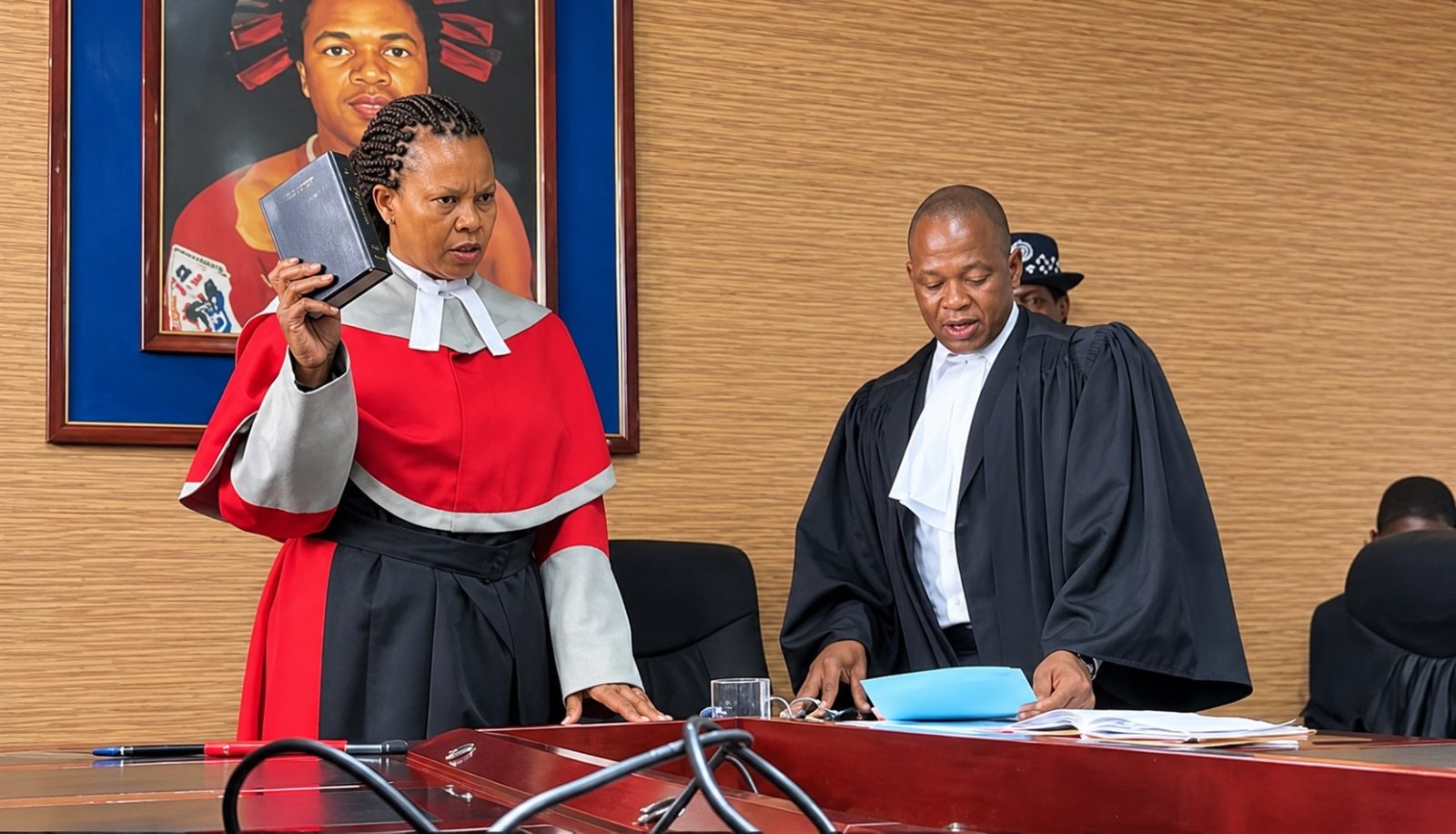
MBABANE – Acting Chief Justice (CJ) Mumcy Dlamini has suspended all non-fully sponsored trips involving judges, registrars and other employees of the Judiciary.
The directive also requires that funds previously allocated for such trips be redirected towards the institution’s core business.
Issued on November 13, 2026, the directive comes four days after Dlamini was sworn in as acting chief justice on November 9, following the death of former Chief Justice Bheki Cuthbert Moses Maphalala, who served in the position for almost 11 years.
Her appointment was announced by Minister for Justice and Constitutional Affairs Prince Simelane, in the presence of members of the Judicial Service Commission (JSC).
Dlamini, who became the first liSwati woman to occupy the Office of the Chief Justice, albeit in an acting capacity, has now issued her first major directive concerning the administration of the Judiciary.
The suspension of non-fully sponsored trips applies to judges, registrars and other members of staff within the institution.
In a memorandum dated November 13, 2026, issued under reference HJS/01/2026, the Office of the Acting Chief Justice informed the judges that, following consultations with the JSC, all non-fully sponsored trips had been suspended until further notice.
The suspension may only be lifted in instances where there are compelling and exceptional circumstances warranting such trips. The memorandum further directs that funds previously allocated for the trips should instead be diverted towards catering for the core business of the Judiciary.
The directive places restrictions on the use of institutional resources for trips that are not fully sponsored, while requiring that the funds be redirected towards the Judiciary’s operational requirements.
A look into the Judiciary’s spending on travel and communication for the first quarter of the current financial year reflects that the estimated budget stood at E7 062 010, which was revised to E3 201 091. The expenditure, according to the first quarter performance report, stood at E1 352 902, while commitments of about E933 380 were made. The expenditure commitments stood at E2 286 283, and the variance was E914 808. The percentage of the variance stood at 29 per cent.
implications
The decision comes at a time when public expenditure on official travel has attracted attention, with public sector unions raising concerns about the financial implications of repeated trips by public officers.
On November 11, 2026, the Times of Eswatini reported that public sector unions had called for tighter controls on government officials undertaking repeated overseas trips.
In an article titled ‘Unions want curbs on govt overseas trips’, this publication reported that the unions had raised concerns about prolonged or successive overseas trips undertaken by the same government officers. The concerns emerged during consultations on the draft External Travel Management Policy Framework, which seeks to strengthen accountability and control expenditure on official overseas travel.
The consultations were convened by the Public Policy Coordination Unit (PPCU), the Ministry of Public Service and the Eswatini Economic Policy Analysis and Research Centre (ESEPARC).
During the meeting, the unions proposed measures to regulate the frequency of trips undertaken by public officers. They also called for separate approval procedures for officials travelling abroad on union business.
Secretary to Cabinet Victor Nxumalo, who chairs the Joint Negotiations Forum (JNF), reportedly said the policy review was intended to establish clear and accountable procedures for government travel. He acknowledged that overseas trips were necessary for government to fulfil its international obligations, participate in bilateral and multilateral engagements, undertake study visits and represent the country at international forums.
However, he emphasised the need for such trips to be properly planned, justified, approved and accounted for, taking into consideration their financial implications. The proposed framework also seeks to ensure that officers account for travel advances and submit supporting documents after completing their assignments.
The issue of expenditure on official trips has also featured in parliamentary deliberations, with Members of Parliament raising questions about the amounts spent by public institutions on international travel.
On June 4, 2026, the Times of Eswatini reported that Nhlambeni Member of Parliament (MP) Manzi Zwane had alleged that a town clerk spent approximately E5 million on international trips. The matter emerged when Housing and Urban Development Minister Apollo Maphalala appeared before Parliament to respond to questions concerning the state of roads in municipalities, including Hlatikhulu, Matsapha and Mbabane.
Zwane questioned the alleged expenditure, prompting the minister to seek clarity on whether the E5 million had been spent on a single trip or several trips.
Maphalala said he was not aware of any instance where a chief executive officer had spent E5 million on a trip, but undertook to investigate the matter.
He also explained that municipal budgets and expenditure were subject to oversight and accountability measures, including the submission of audited financial statements.
Budget
During the Mid-Term Budget Review Report debate held at the House of Assembly on Monday, MPs called on government to find ways of reducing expenditure on international trips, particularly the high costs associated with air tickets, arguing that better planning could save the country substantial amounts of money.
The MPs raised concern over what they described as unnecessary expenditure on international travel, challenging government to introduce measures that would ensure public funds were not wasted on expensive flights.
First to raise the issue was Mafutseni MP, Sabelo Mtetwa who argued that government continued to spend heavily on air tickets without demonstrating a clear strategy to reduce the costs. “Money is being wasted on international trips as they go with expensive air tickets or flights, with no plan to make some savings,” he said.
Responding to the concerns, Minister for Finance Neal Rijkenberg admitted that there was room for government to reduce expenditure on international travel, particularly through better planning and the advance booking of flights. He explained that government had already moved away from purchasing first-class tickets, with officials and ministers now travelling in business class.
Rijkenberg, however, acknowledged that business-class tickets remained expensive, although he maintained that some international trips were necessary for government to fulfil its responsibilities.
He said his travels, for instance, were sometimes required to attend meetings where he represented the country and pursued financial support and other resources needed for national development. “I’ve never bought a first-class ticket, honourable Speaker. We do fly, we have moved from flying in first class to flying in business class, so that is an impact that’s done,” he said.
The minister said government could not completely eliminate international travel because certain engagements were critical to the country’s interests.
Rijkenberg revealed that the Prime Minister, Russell Mmiso Dlamini, through the Prime Minister’s Office had commissioned an in-depth study into government travel. He said a new travel plan was being developed, which would require government officials to plan their international engagements well in advance.
According to the minister, this would allow government to purchase air tickets earlier, instead of making last-minute bookings that often come at significantly higher prices. He added that knowing travel dates in advance would allow government to secure cheaper tickets, potentially saving substantial amounts of public money.
The issue also came via a motion, which was moved by Lobamba Lomdzala MP, Marwick Khumalo.
The motion called for the minister for Finance, in consultation with the Office of the Prime Minister, to, as a matter of urgency, introduce a culture of saving on air travel for the entire government system, including parastatals.
This, the motion stated, should be done by ensuring that air tickets are purchased well in advance, in order to circumvent wasteful expenditure that could have easily been avoided, largely because most international conferences and meetings are known earlier or in good time.
The minister accepted the motion.
Meanwhile, on November 10, 2026, this publication highlighted some of the matters awaiting the acting CJ attention as she assumed the country’s highest judicial office.
Among the major challenges identified was the backlog of civil and criminal cases, with the Judiciary having been reported to be preparing a five-year strategy in July 2025 to address more than 29 000 outstanding cases.
The backlog has implications for accused persons who remain in correctional facilities for prolonged periods while awaiting trial.
A United Nations Development Programme (UNDP) assessment published on July 8, 2025, found that nine of the country’s 11 correctional facilities had accused persons who had been detained for more than 12 months without trial.
The assessment also found that the nine facilities accommodating pre-trial detainees had exceeded their combined capacity of 3 090 by nearly 50 per cent.
Other challenges identified included pending committals to the High Court, the expiry of contracts for acting judicial officers, delayed judgments and sentences, unavailable witnesses and ongoing investigations.
Apart from the case backlog, Dlamini also inherited concerns about shortages of judges, magistrates and court support personnel.
The Ministry of Justice and Constitutional Affairs’ 2024/2025 Annual Performance Report identified vacancies involving assistant registrars, assistant masters, clerks, secretaries, typists and estate examiners.
The shortage of courtrooms and inadequate infrastructure were also highlighted, with the report indicating that judges and magistrates were sharing facilities.
Another concern was the Judiciary’s financial position. The ministry’s annual performance report stated that the institution’s budget had remained low over several years, hampering its operations.
Other matters awaiting the Acting Chief Justice included the integrity and security of court records, the administration of the Master of the High Court, judicial independence, the appointment and tenure of acting judges, access to legal aid and the safety of legal practitioners.
The newspaper also highlighted the implementation of 42 recommendations arising from the Commission of Inquiry into the affairs of the Master of the High Court, as well as the need to modernise court operations through the Integrated Electronic Case Management System (IECMS).