
MBABANE – A Matsapha businessman has been left counting losses of about E813 000
after the vessel carrying his consignment of motor vehicle spare parts was attacked at sea.
The shipping line entrusted with the cargo, CMA CGM, says the goods will finally be delivered to Eswatini, although it has not said when.
For close to nine months, Abubakar Saddique has been trying to establish the whereabouts of a commercial container entrusted to CMA CGM, the French multinational shipping and logistics group headquartered in Marseille. His repeated attempts to obtain a full account of the container’s journey have yielded, in his view, assurances rather than firm answers. Founded in 1978 by Jacques R Saadé, the group has grown into one of the world’s major maritime transport operators, with a presence in more than 160 countries, over 400 offices and a fleet exceeding 650 vessels.
Under the leadership of its Chairman and Chief Executive Officer, Rodolphe Saadé, the group serves approximately 420 commercial ports through over 250 shipping lines, with operations extending beyond maritime freight to logistics, air cargo and land transportation.
The vessel identified in Saddique’s shipping documents, the CMA CGM San Antonio, was struck by missiles while transiting the Strait of Hormuz, the narrow waterway linking the Gulf to the Arabian Sea, on May 5, 2026. The United Kingdom Maritime Trade Operations (UKMTO) logged the incident, and international outlets including Reuters and Seatrade Maritime reported that eight crew members, said to be Filipino nationals, were injured and evacuated to receive medical treatment.
CMA CGM confirmed the attack. In a statement widely reported by international media, the company said one of its vessels ‘was the target of an attack’ while transiting the strait, ‘resulting in injuries among crew members and damage to the vessel’, and that it was ‘closely monitoring the situation’ and ‘remains fully mobilised alongside the crew’.
Industry publications reported that the 2 824-TEU Malta-flagged vessel had been among 14 CMA CGM ships stranded in the Gulf after the conflict in the region intensified in February
2026 and that she was escorted to safety several weeks after the attack. In July 2026, Reuters reported that Rodolphe Saadé had told a business conference in France that the ship ‘was so damaged that we’re wondering whether we should send it for scrapping’.
The incident came against the backdrop of heightened security measures in the region. CMA CGM had earlier announced an Emergency Conflict Surcharge, effective March 2, 2026, citing developments in Iran and across the Arabian Peninsula. In its 1 March advisory, the company announced charges of E34 580 (US$2 000) for a 20-foot dry container, E51 870 (US$3 000) for a 40-foot dry container and E69 160 (US$4 000) for refrigerated or special equipment.
CMA CGM’s Commercial Manager, Frazer Ndlovu, told the Times of Eswatini SUNDAY the company had engaged the customer.
“We can confirm that we have contacted our customer to provide an update on the container’s current status, location and next steps towards delivery,” he said.
The company has indicated that the consignment will finally arrive in Eswatini, although it has not provided a timeframe for the delivery. It is that open-ended assurance, the businessman says, that he finds hardest to accept, because without a delivery date he cannot plan stock arrivals, honour orders already placed or give his customers and creditors a clear picture.
When Saddique, the businessman, was contacted on Thursday, he confirmed that the company had been in touch with him, though he said the updates he has received so far had not yet given him the certainty he needs about where the container is or when it will reach Matsapha.
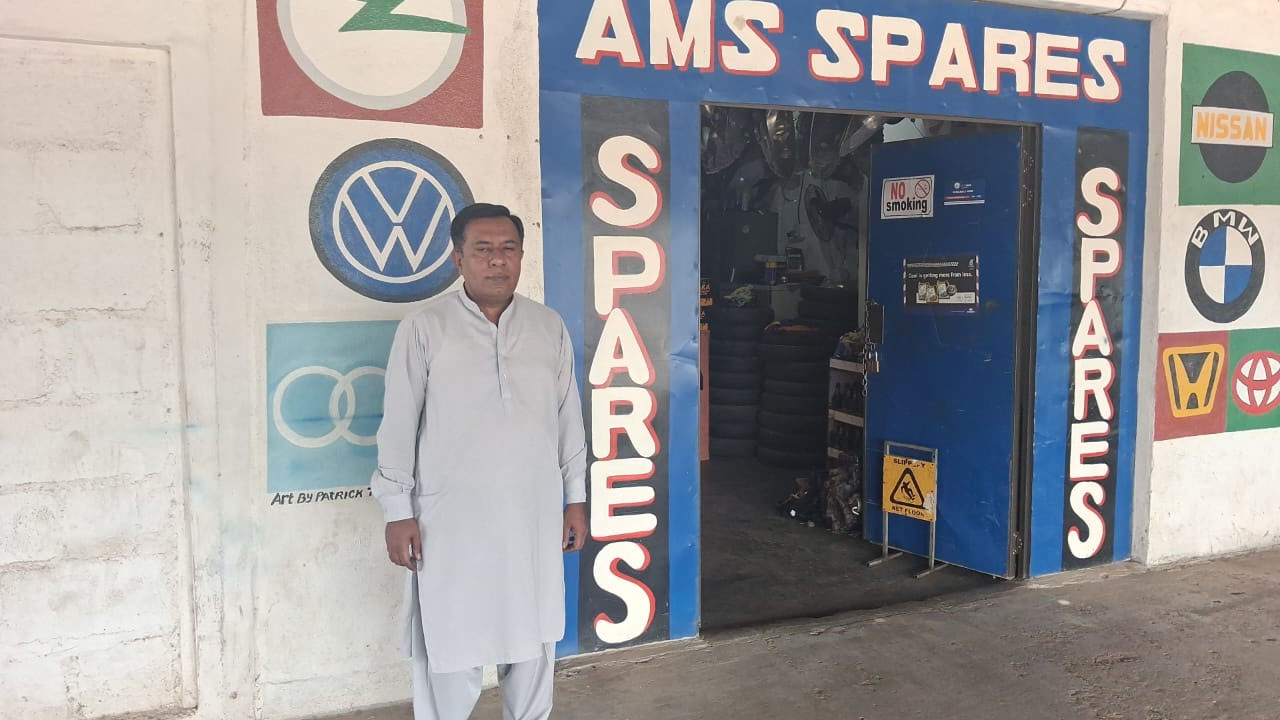
Documents supplied to this publication show that the consignment, billed to Haroon Investments (Pty) Ltd, trading as A.M.S Auto Spares, was loaded into a 40-foot high-cube container, TLLU8879443, under bill of lading number DXB1026485. The documents record Jebel Ali in the United Arab Emirates as the port of loading and Matsapha as the final delivery destination. According to him, the quantities suggest the shipment was intended to replenish a substantial motor vehicle spares operation rather than serve a limited number of individual orders.
The goods were purchased from MOHD FAWAD ASIF USED AUTO SPARE PARTS TR, L.L.C, a supplier based in Sharjah in the UAE, whose invoice lists 100 categories of merchandise with a total value of AED 149 240, equivalent to approximately E705 092. It has been established that the shipment comprised 84 used vehicle engines with gearboxes, accounting for E340 640 and 1 515 assorted motor vehicle spare parts valued at approximately E364 452.
The latter included 300 sets of front and rear lights valued at E113 389, 150 side mirror sets worth E49 608, 340 jacks worth about E24 072 and 220-wheel cup sets valued at E15 576.
Other components included 100 control arm sets, 93 complete radiators, 75 sets of shocks, 54 front and rear bumpers, 46 steering racks, 25 cylinder heads, 20 CV shaft sets and 17 standalone gearboxes, with Toyota, Nissan, Mazda and Honda engine codes among the engine units.
AIG Shipping L.L.C, which handled the freight forwarding arrangements, issued a tax
invoice reflecting export charges of E72 710.10 (AED 15 500) and a war-risk surcharge of E17 203 (AED 3 685). According to the businessman’s records, the documented financial exposure on the consignment, combining the merchandise value and the shipping charges, amounts to approximately E813 000.
He estimates that the prolonged disruption has cost his business close to E10 million in lost turnover and other losses, while leaving four locally employed emaSwati workers and numerous customers in uncertainty. Saddique said his biggest concern is that, despite repeated attempts, he has been unable to obtain a clear account of the container’s whereabouts. He showed this publication emails sent to the shipping company, several of which he said went unanswered, and he said people acting on his behalf also visited the company’s regional offices in Dubai, where they spent several hours seeking assistance.
He is no longer satisfied with general assurances that enquiries are being made. He wants the last confirmed location of the container, the date it was last physically accounted for and records of any transfer between vessels.
He also wants to know whether the container was discharged at an alternative port and, if so, what arrangements have been made for its onward transportation to Eswatini.
The disappearance of reliable tracking information has added to the uncertainty. He told Times SUNDAY that the tracking platform indicated last week that the container was being loaded, but that the system has since been displaying an error message, leaving him unable to establish whether the container is still at a port, has been transferred to another vessel or is being held pending further shipping arrangements.
Based on correspondence seen, Saddique described the past nine months as a logistical and financial nightmare, and said international shipping companies should not leave local businesses in prolonged uncertainty over merchandise entrusted to them. The absence of a confirmed delivery date, he said, has also made it difficult for him to make commercial commitments to customers who ordered specific vehicle components.
He believes the shipping company is best placed to provide a comprehensive account of what happened to the merchandise and to address the financial consequences if it cannot be recovered. While he accepts that the attack on the vessel was a security event beyond the company’s control, he maintains that having paid the war-risk surcharge, he should not be left to carry the loss.
“I have also been paying Eswatini Revenue Service (ERS) honestly despite having no business for close to a year now. Even if the vessel was hit by a missile, we insured our goods through the war-risk surcharge; therefore, they should refund me,” he said.
This newspaper independently checked the claims surrounding the vessel and established that the attack did take place. International maritime reporting, including Reuters, Seatrade Maritime and The Maritime Executive, citing UKMTO, confirms that the CMA CGM San Antonio was struck by projectiles, reported to be missiles, while transiting the Strait of Hormuz on May 5, 2026, and CMA CGM itself confirmed the following day that its vessel had been attacked.
The value of the consignments carried for all clients aboard is harder to establish, as no official figure has been published and the shipping line has not released a valuation of the cargo. What is documented is that the trade publication, The Loadstar, reported in July 2026 that roughly 200 to 250 of the containers on board belonged to Indian shippers, who at the time feared their cargo could be written off as a total loss.
According to the same report, the containers are expected to be discharged at a safe or feasible location in the Gulf region, and the shipping line was believed to be weighing a declaration of General Average, a maritime procedure under which the shipowner and cargo owners share the costs of sacrifices made for the common safety of the venture.
Under such a declaration, cargo owners may secure the release of their goods only after paying or securing their share of the contribution and industry experts described the process as considerably lengthy.