

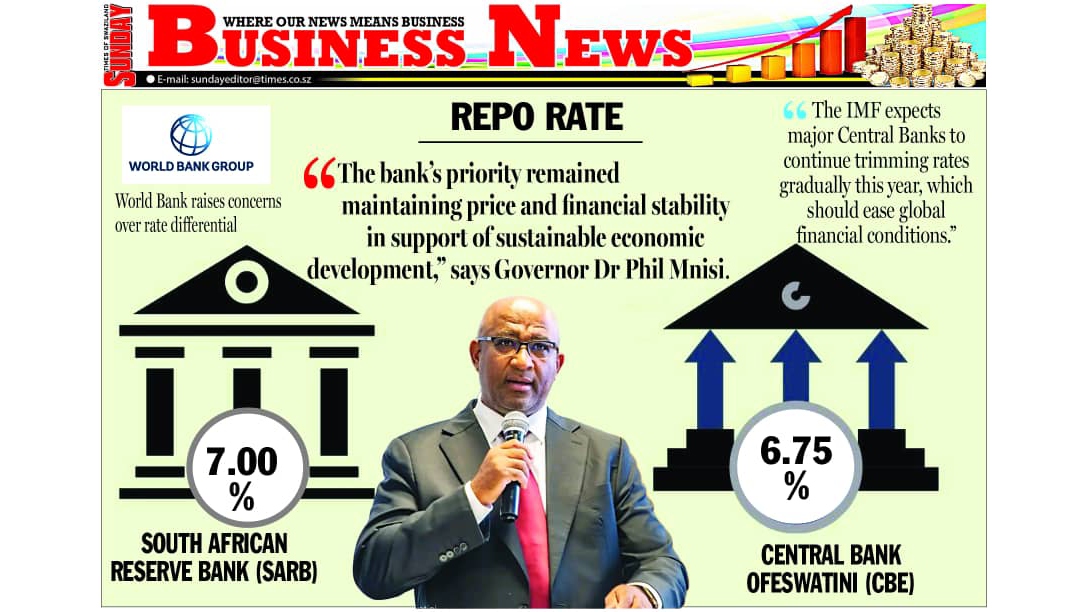
MBABANE – The Central Bank of Eswatini (CBE) has maintained its repo rate at 6.75 per cent, even as headline inflation eased for the fifth consecutive month to 2.9 per cent in June 2025.
Announcing the decision after the Monetary Policy Consultative Committee (MPCC) meeting on August 1, Governor Dr Phil Mnisi said the Bank’s priority remained “maintaining price and financial stability in support of sustainable economic development.”
The decision came against the backdrop of the South African Reserve Bank (SARB) lowering its repo rate by 25 basis points to 7.00 per cent during its July 31 meeting, creating a small but significant divergence between the two countries’ policy stances. The move immediately drew attention, given Eswatini’s membership in the Common Monetary Area (CMA) and the Lilangeni’s peg to the South African Rand.
Unpacking the statement reveals a Central bank walking a tightrope. Globally, the International Monetary Fund (IMF) has marginally revised up its 2025 growth forecast to 3.0 per cent from 2.8 per cent, with global inflation expected to ease to 4.2 per cent. The IMF expects major Central Banks to continue trimming rates gradually this year, which should ease global financial conditions.
Regionally, South Africa’s economy remains weak, expanding only 0.1 per cent quarter-on-quarter in the first quarter of 2025. The SARB cut its repo rate to support demand amid its revised 0.9 per cent growth forecast for 2025. South African inflation was stable at 3.0 per cent in June, within its 3–6 per cent target band.
Domestically, the picture is mixed. Eswatini’s economy contracted by 0.3 per cent year-on-year in the first quarter of 2025, reversing a 1.7 per cent expansion in the previous quarter. The decline was driven by a 7.3 per cent contraction in the primary sector and a steep 10.2 per cent drop in the secondary sector, offset by a robust 7.2 per cent rebound in services. Despite the weak growth, inflationary pressures have continued to subside, falling from 3.2 per cent in May to 2.9 per cent in June, largely on the back of slower food inflation and transport cost deflation. Dr Mnisi stressed that the Bank “cautiously considered the credibility of the peg against the South African Rand and the need to ensure adequate gross official reserves.” That statement underscores the primary motive: Defending external stability in a small, open economy with thin reserves.
By holding the repo rate at 6.75 per cent, the CBE has effectively kept the prime lending rate for commercial banks at 10.25 per cent. This means borrowing costs for households and businesses remain unchanged, offering no immediate relief to debt-servicing burdens. For banks, the steady rate preserves interest margins but highlights a subdued lending environment. Latest figures show credit to the private sector contracted 0.05 per cent month-on-month in June to E21.6 billion. Business credit fell 2.2 per cent to E11.7 billion, while lending to other sectors dropped 2.9 per cent. Consumer lending remained broadly flat.
Full article available in our paper.




















Leave a comment