

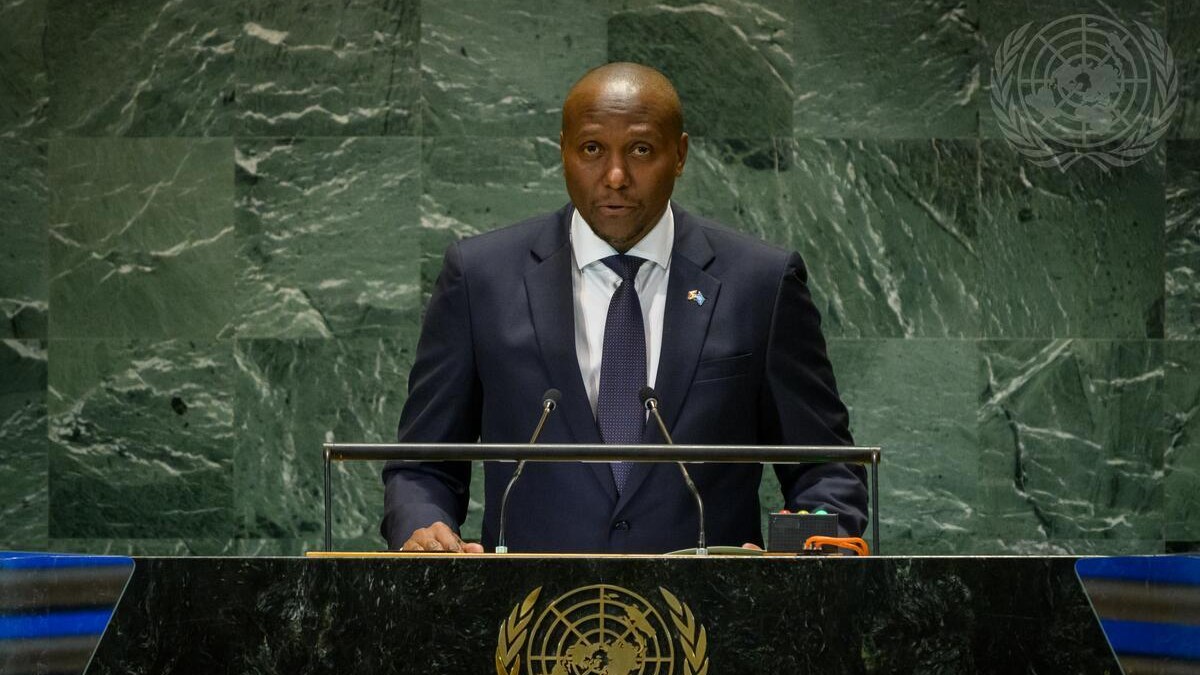
MBABANE – Prime Minister (PM) Russell Dlamini says civil servants must be granted the freedom to choose how they wish to save for their retirement.
Broadening the debate over the conversion of the Eswatini National Provident Fund (ENPF) into a pension scheme, the PM said the answer to the question of whether to allow conversion or not, could be with the public servants.
The PM said the civil servants should be allowed to decide how their pension should be structured. The PM, speaking on government’s position, emphasised that workers should not be forced into a single pension arrangement. Instead, he argued that both the Public Service Pensions Fund (PSPF) and the ENPF could co-exist, providing civil servants with diversified retirement options. “The civil servants should be allowed to put their eggs in different baskets,” Dlamini said. “Government does not want to collapse the PSPF, but rather to create an extra layer of protection for public servants when they retire.”
According to Dlamini, government’s proposed arrangement under the ENPF would require a contribution of E400 per worker.
Of this, E200 would be paid by government as the employer, while the remaining E200 would come from the employee.
He was quick to stress that this would not amount to an additional financial burden on the civil servants because the contributions would be redirected from the savings already being channelled into the PSPF.
“The impact of this will not be felt by the workers because the funds are sourced from what they are already contributing,” he explained.
“In essence, this is not about increasing deductions but about allowing workers to diversify their retirement savings.”
The PM described the ENPF conversion as offering an ‘extra retirement pot’ that civil servants could tap into upon reaching retirement age.
He maintained that this would strengthen the financial safety net available to public employees. The ENPF’s conversion proposal has been met with strong resistance from some quarters, particularly from those who fear it could destabilise the PSPF, which has long been the cornerstone of pension security for civil servants.
PSPF management has warned that diverting contributions to the ENPF might lead to reduced liquidity and undermine the long-term sustainability of the PSPF.
However, Dlamini dismissed such fears as a misconception. He pointed out that Eswatini already has a variety of pension schemes operating concurrently in the private sector, and none has led to the collapse of another. “It is misleading to suggest that the PSPF will collapse if civil servants are allowed to save a portion of their pension in the ENPF,” he insisted. “Other pension schemes exist side by side in the country, serving different segments of the population without threatening each other’s survival.” The PM also revealed that he had previously asked the PSPF management to demonstrate, with evidence, the likely impact of workers redirecting part of their savings to the ENPF. However, he said the explanations provided were not convincing.
“I was not persuaded that the risks raised by the PSPF were as severe as they were being portrayed. The fund must adapt and innovate to remain sustainable,” Dlamini stated. In an attempt to ease concerns about potential disruptions, Dlamini said the ENFP had deliberately designed a 15-year transition period for workers to contribute to the ENPF. He explained that this timeframe was sufficient to allow the PSPF to recalibrate its business model, adjust to changing financial flows and secure its long-term sustainability. “Fifteen years is a significant period,” he said.
“It gives the PSPF enough time to plan, restructure and reposition itself for the future. This should not be viewed as an abrupt shift, but rather as a carefully phased approach.” The PM stated that the ENPF needed significant participation to remain viable. Without a strong base of contributors, the fund would not be able to meet its mandate of providing social security to the nation.
“Numbers are key for the sustainability of the ENPF,” he explained. “We must ensure that the fund delivers on its purpose.”
This is not the first time PM Dlamini has spoken firmly in favour of reforming the country’s pension landscape.
He recently emphasised the need for pension reforms that broaden financial security for civil servants, while avoiding monopolistic tendencies in the pensions market. Previously, when asked about the rivalry between the PSPF and ENPF, the PM argued that pension funds should not be viewed as competing entities, but as complementary vehicles of savings.
He maintained that government’s role was to create an environment where multiple pension schemes can thrive, thereby giving workers greater flexibility and choice. Dlamini remarked, that ‘the issue is not whether one fund should survive at the expense of another. Rather, it is about building a pension ecosystem where both funds can play their roles effectively.’
Eswatini’s pension sector is undergoing a period of significant change, driven by demographic pressures, shifting labour markets and the rising cost of living.
Meanwhile, the ENPF conversion proposal is part of a wider effort to strengthen social protection mechanisms. Advocates argue that by expanding the ENPF into a fully-fledged pension scheme, the country would broaden coverage and reduce the vulnerability of retirees. At the same time, the PSPF has historically been one of the most stable and reliable funds in the country. It manages billions of Emalangeni in assets and has consistently paid out benefits to retired civil servants.
Full article available in our publication.


















Leave a comment