

MBABANE – The International Monetary Fund (IMF) has called on government to strengthen the independence of the Central Bank of Eswatini (CBE) and restrict cash advances to the Treasury.
The IMF said this is aimed at preserving the country’s foreign reserves and bolstering confidence in the Lilangeni’s peg to the South African Rand.
The recommendation was made by IMF Executive Directors following their recent assessment of Eswatini’s economy under the 2025 Article IV Consultation. The fund emphasised that maintaining prudent monetary and fiscal discipline is essential to sustain macroeconomic stability, particularly in light of volatile Southern African Customs Union (SACU) revenues and mounting fiscal pressures.
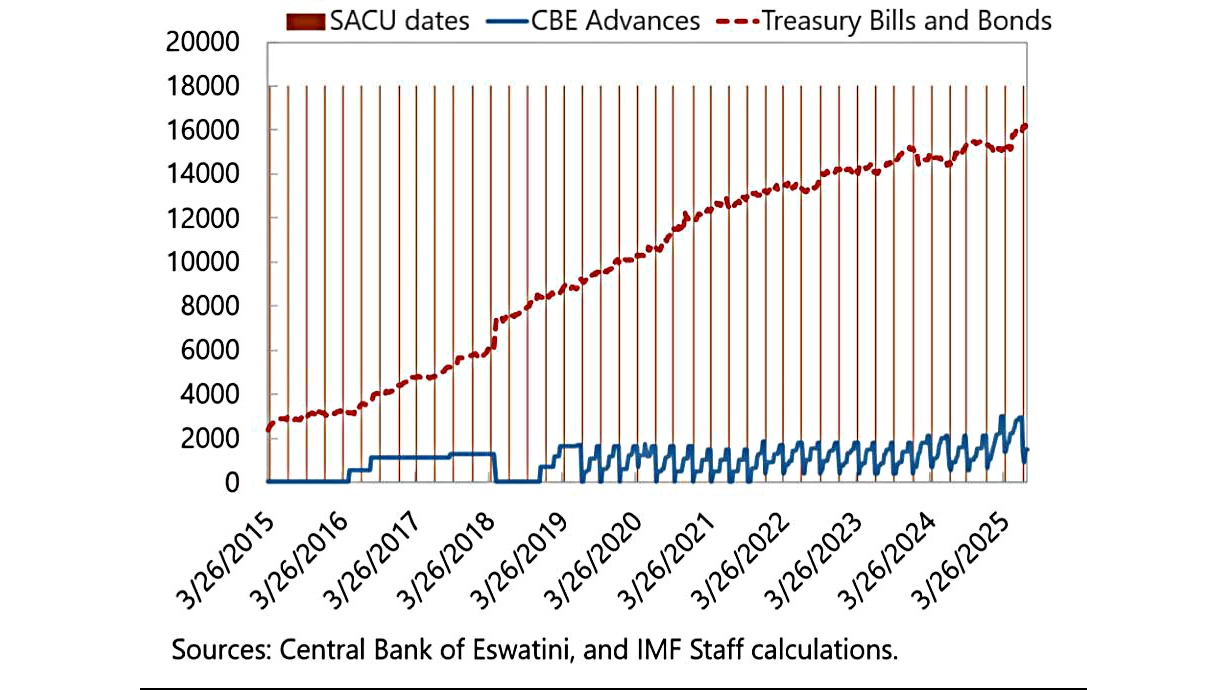
“Directors recommended strengthening Central Bank independence and limiting Central Bank cash advances to government to lower pressure on foreign reserves,” reads the IMF Executive Board’s statement.
The IMF noted that Eswatini’s exchange rate peg to the Rand continues to serve the economy well by anchoring inflation and facilitating trade and financial transactions with South Africa.
However, it warned that frequent government borrowing from the Central Bank, known as cash advances, risks undermining the country’s international reserve position, which remains below recommended levels.
International reserves are essential for countries to manage external shocks such as sudden capital outflows or commodity price swings by providing liquidity to support the balance of payments.
Reserves also reinforce confidence in a country’s monetary and exchange rate policies, reduce the risk of financial crises and can lower borrowing costs. For countries with strong fundamentals, reserves offer flexibility to respond to temporary shocks without resorting to abrupt policy changes.
*…
Call for legal, institutional reforms
MBABANE – Beyond monetary operations, the IMF urged Eswatini to proceed with legislative updates to modernise the Central Bank Act and align it with international best practices.
It also called for enhanced coordination between fiscal and monetary authorities to ensure consistency in macroeconomic management.
“Strengthening the autonomy of the Central Bank is key to maintaining macroeconomic stability,” the IMF said, adding that reforms to limit quasi-fiscal operations and ensure clear separation of roles between government financing and monetary policy would enhance credibility. Responding to the IMF recommendations, authorities reaffirmed their commitment to safeguarding the peg and ensuring that the central bank operates within a framework that supports monetary stability.
*…
Reforms to modernise monetary framework
MBABANE – The IMF further recommended that the CBE strengthen its monetary policy framework by harmonising its policy rate with the overnight call rate to improve transparency and market communication.
It also called for the introduction of liquidity forecasting and the development of a more active money market, including repurchase (repo) operations.
Such reforms, the IMF said, would enhance the effectiveness of monetary policy and ensure that the Central Bank can better manage liquidity in line with its mandate to maintain external stability.
The IMF’s Article IV Consultation took place against a backdrop of moderate economic growth and persistent structural challenges.
*…
Calls for tighter oversight of financial sector
MBABANE – The IMF has urged financial regulators to maintain close supervision of banks and non-bank financial institutions (NBFIs) to preserve financial stability amid a still-elevated level of non-performing loans (NPLs).
According to the IMF’s latest Article IV Consultation, while Eswatini’s banking sector remains well-capitalised and liquid, risks associated with bad loans persist and require vigilant monitoring by supervisors.
“Close supervision of banks and NBFIs is warranted. While banks remain well-capitalised, the NPL-to-total gross loans ratio remains relatively elevated with variation across banks,” the IMF stated.
The fund noted that the government’s ongoing efforts to clear domestic arrears are expected to ease liquidity pressures in the banking system. However, it cautioned that supervisors must remain alert to potential vulnerabilities in credit quality.
Non-bank financial institutions, which include insurance companies, pension funds and savings and credit co-operatives, now account for an estimated 78 per cent of total financial sector assets in Eswatini, a reflection of their growing systemic importance.
*Full article available in our publication.



















Leave a comment