

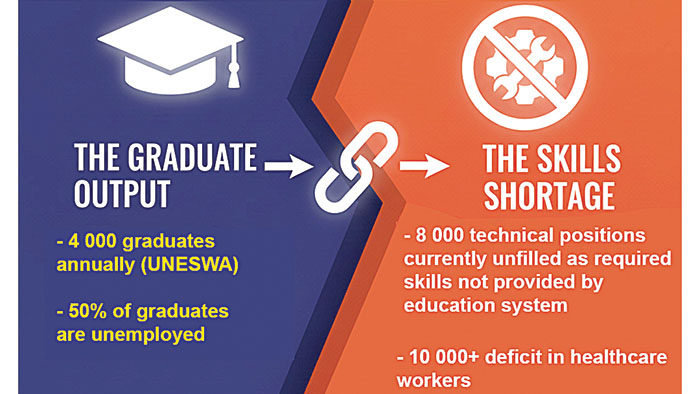
MBABANE – With over 4 000 graduates annually, there are seemingly minimal jobs for the graduates in most of the projects that are being pursued in the country.
This is despite that annually; government disburses about E700 million to students while a variety of loans are pursued by government to create jobs in Eswatini.
In light of recent graduations, the challenge of integrating graduates into a sluggish job market raises pressing questions about future employment opportunities.
Despite the economy creating new jobs that seek to create job opportunities, particularly for graduates, the University of Eswatini (UNESWA) produces approximately 4 000 graduates annually, yet the Ministry of Labour’s 2023 Skills Audit found that 71 per cent graduate in fields with fewer than 100 new positions created each year.
Meanwhile, the same audit identified 8 000 unfilled positions requiring technical skills the education system does not provide and according to the Eswatini National Skills Audit Report (2022), more than half of Eswatini’s graduates are unemployed.
Eswatini has allocated E702.35 million for scholarships in the 2025/26 financial year, which is a significant increase aimed at supporting local and international studies. This funding will allow for an additional 1 000 students to receive study loans for local institutions, bringing the total to 4 450.
Additionally, about 80 students received scholarships for international study in STEM (Science, Technology, Engineering and Mathematics) fields and other rare skills.
Non-creation of job opportunities presents a gap in the revolving of the scholarship as government cannot regain the funding from the graduates if they remain unemployed.
Minister for Commerce, Industry and Trade Manqoba Khumalo revealed that the economy is creating new jobs and the only gap is that some are speciality jobs like teaching and nursing, for example, and those have limitations in that they rely on retirements, resignations for the creation of the new posts and that present a limitation.
“That is where we take a lot of beating as an economy, otherwise it is creating new jobs and a significant number of the graduates will be absorbed,” he said.
The minister outlined some of the projects which seek to create jobs for emaSwati and they include the Eswatini Road Infrastructure Improvement Programme (ERIIP) Phase 1; upgrading of Siphofaneni –Sithobela –Maloma -Nsoko (MR14) Road and Maloma-Siphambanweni (MR21) Project, where government received a loan from the African Development Bank (AfDB) for financing the project.
*…
Job crisis deepens as unemployment hits staggering 35.4%
MBABANE – High joblessness now affects over a third of the active workforce, despite growth in the key services sector.
The World Bank’s Eswatini Economic Update states that the most acute crisis remains unemployment, which has soared from 23 per cent in 2016 to a staggering 35.4 per cent in 2023.
This failure to create formal jobs, according to the report, means the majority of new job opportunities are concentrated in the informal sector, leaving many without stability or social protection. The national rate is substantially higher than those found in peer lower-middle-income countries.
It says the country’s economy is fundamentally rooted in its service sector, which now comprises over half of its gross domestic product (GDP). Manufacturing makes up another substantial third. Although expansion drove growth in 2023 and 2024, it has failed to create meaningful jobs.
“Achieving true structural transformation requires not just growth in the high-value services sector, but a massive shift of workers from the informal sector into formal, higher-productivity activities,” reads the report in part.
This strategy, according to the report, is based on valuable lessons from small, geographically isolated economies like Estonia, Mauritius and Singapore, where digitalisation and services were vital for connecting with external markets and creating jobs.
To reverse high unemployment, it is suggested that the services growth must become more inclusive, with skills and investment targeted towards formal job creation for all.
*Full article available in our publication


















Leave a comment