

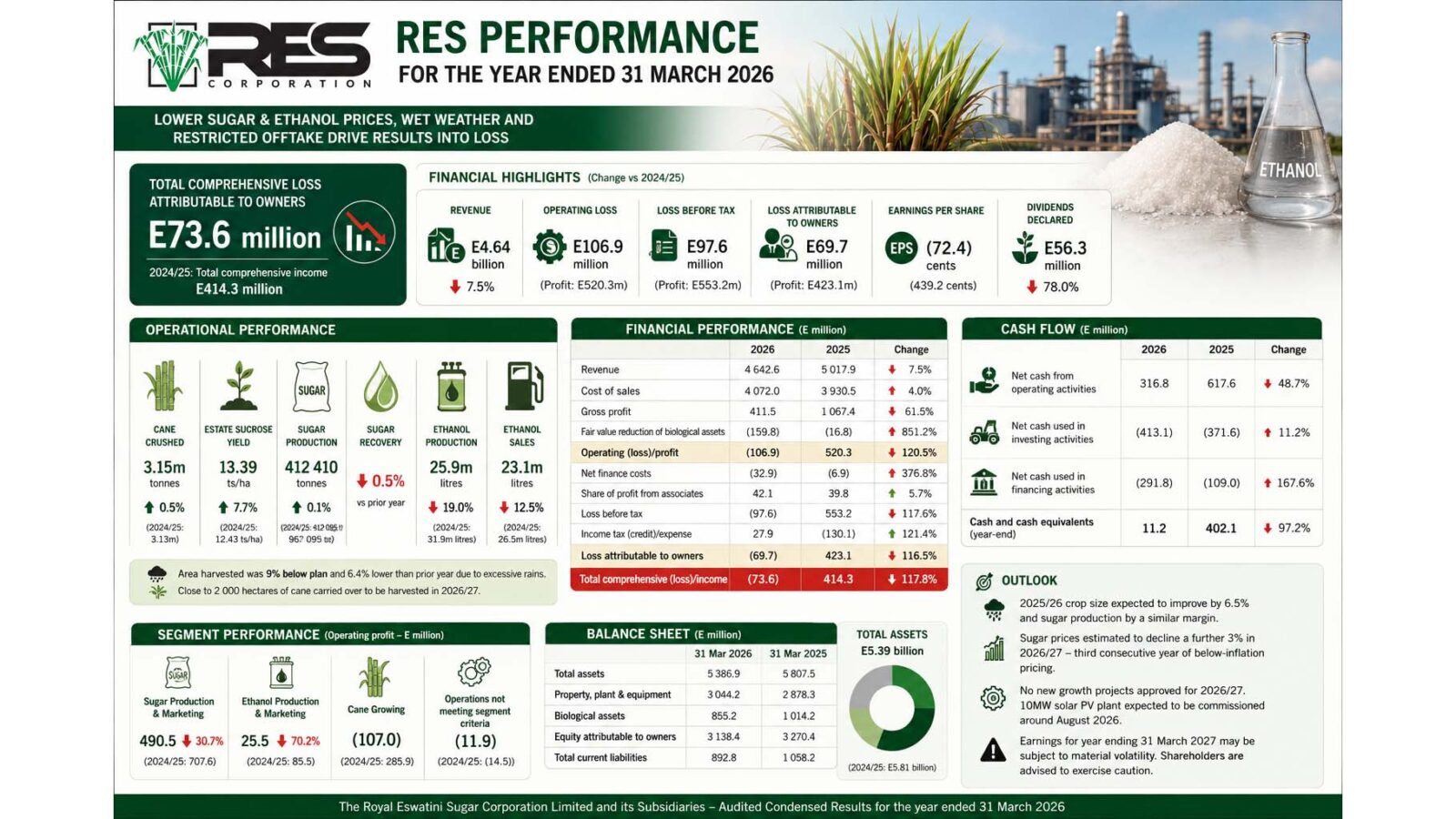
MBABANE – The Royal Eswatini Sugar Corporation (RESCorp) has reported a total comprehensive loss attributable to the owners of the company of E73.6 million for the year ended March 31, 2026.
This represented a dramatic reversal from the E414.3 million total comprehensive income recorded during the previous financial year.
According to the group’s audited condensed financial statements, the significant swing was largely attributed to lower sugar and ethanol pricing, weather-curtailed harvesting activities and restricted ethanol offtake, resulting in one of the most challenging financial years experienced by the listed sugar producer in recent years.
The decline comes despite management implementing cost containment measures during the year, with weaker commodity prices, operational disruptions and constrained market conditions weighing heavily on both revenue and profitability.
Group revenue declined by 7.5 per cent to E4.64 billion, down from E5.02 billion recorded during the previous financial year.
While turnover weakened, the cost of sales moved in the opposite direction, increasing by 4 per cent to E4.07 billion, compared to E3.93 billion previously.
Management attributed the increase to inflationary pressures on production inputs together with higher costs associated with wet harvesting operations.
Consequently, gross profit declined sharply from E1.07 billion to E411.5 million, reflecting the combined impact of lower sales and higher production costs.
The results were further affected by the movement in the fair value of biological assets, which recorded a reduction of E159.8 million, compared to a reduction of only E16.8 million during the previous financial year.
Other income increased modestly from E133.4 million to E142.2 million, while distribution expenses decreased slightly to E12.4 million from E13 million.
Administration expenses declined by 3 per cent to E649.3 million, compared to E672.7 million in the previous year.
The company also recorded an impairment recovery on trade receivables amounting to E1.1 million, compared to an impairment loss of E1.3 million recorded during the previous year.
Despite these measures, RES moved from an operating profit of E520.3 million during 2024/25 to an operating loss of E106.9 million in the year under review.
Finance income declined to E42.6 million from E56.3 million, while finance costs rose from E63.2 million to E75.4 million. This resulted in net finance costs increasing substantially from E6.9 million to E32.9 million.
The group’s share of profit from equity-accounted investees increased by 5.7 per cent to E42.1 million, compared to E39.8 million achieved in the previous financial year. Overall, the group recorded a loss before taxation of E97.6 million, compared to a profit before taxation of E553.2 million previously.
Following an income tax credit of E27.9 million, compared to an income tax expense of E130.1 million in the previous year, the final loss attributable to owners of the company amounted to E69.7 million, compared to a profit of E423.1 million recorded in 2024/25.
The company reported that when it comes to segments performances, sugar production and marketing remained the group’s largest business segment, generating revenue of E4.17 billion, followed by ethanol production and marketing at E376.8 million. Revenue from cane growing amounted to E5.2 million, while operations not meeting segment criteria generated E90 million.
In terms of operating performance, sugar production and marketing generated E490.5 million, down from E707.6 million recorded previously.
Ethanol production and marketing contributed E25.5 million, compared to E85.5 million in the previous year.
The cane growing segment recorded an operating loss of E107 million, compared to an operating profit of E285.9 million achieved during 2024/25.
*Full article available on Pressreader*


















Leave a comment