

MBABANE – Eswatini’s financial system closed 2025 on a mixed note, with strong credit expansion and rising money supply signalling economic momentum.
There was a sharp decline in foreign reserves, which raised concerns about external stability.
This is according to the Central Bank of Eswatini’s (CBE) November/December 2025 Monthly Statistical Release, which paints a detailed picture of domestic credit trends, banking sector liquidity, government finances and the country’s reserve position.
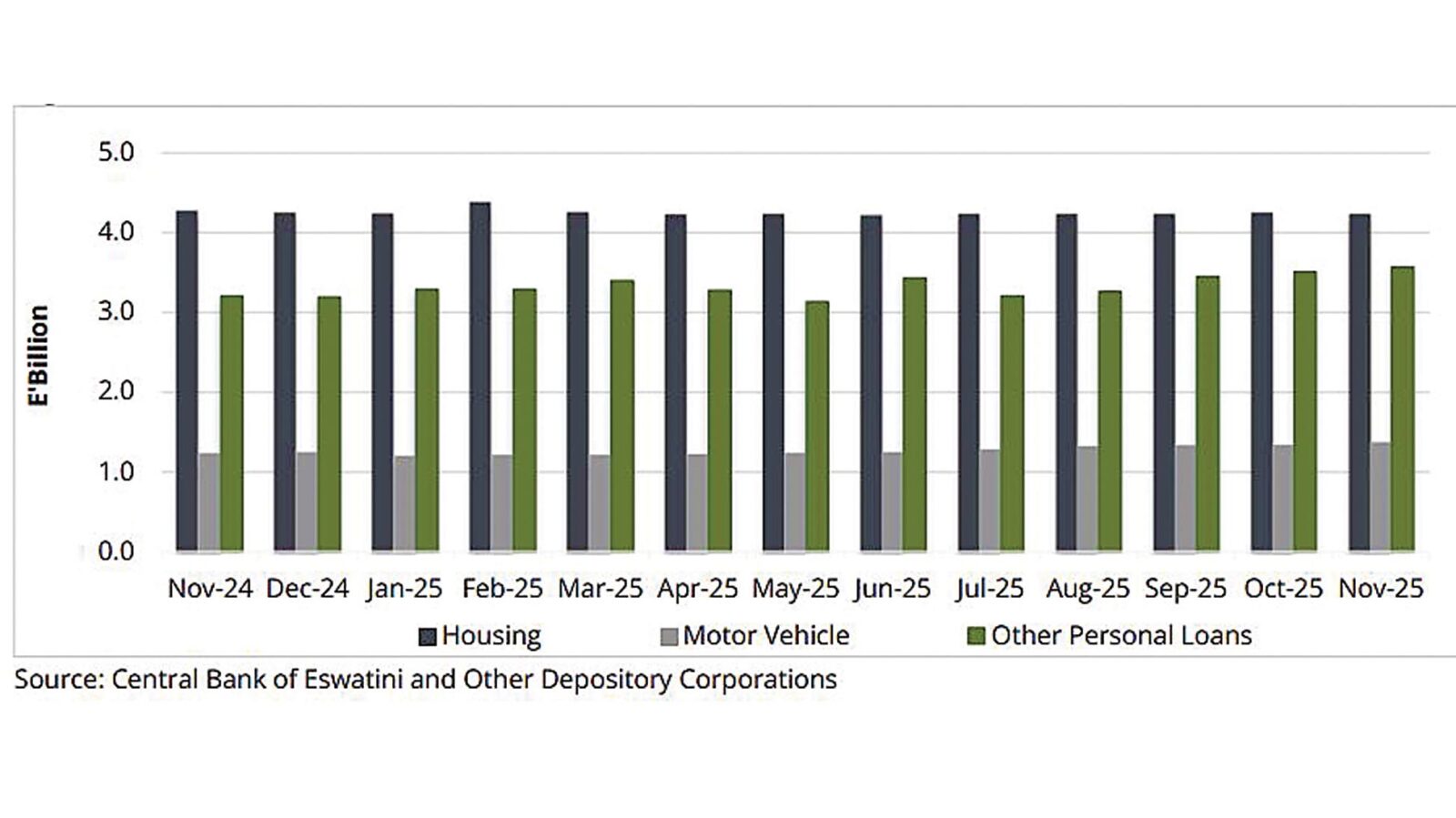
At the centre of the report is the continued expansion of private sector credit, which stood at E21.9 billion in November 2025. This represents a 1.1 per cent month-on-month increase and an 8.5 per cent year-on-year rise, reflecting sustained demand for financing across key sectors of the economy.
The growth was broad-based, driven by increased borrowing from businesses, households and other domestic sectors. Credit to businesses alone rose by 1.4 per cent in November and by 11.8 per cent over the year to reach E11.6 billion.
The strongest gains were recorded in agriculture and forestry (6.8 per cent), manufacturing (2.7 per cent), real estate (1.8 per cent), transport and communications (0.5 per cent), and construction (0.2 per cent).
These trends suggest renewed investment activity in productive sectors, particularly agriculture and manufacturing, which remain central to Eswatini’s economic growth and employment creation agenda.
*…
Banking sector liquidity remains strong
MBABANE – The liquidity position of Eswatini’s banking sector continued to improve in November 2025.
Domestic liquid assets rose by 7.2 per cent month-on-month and 24.0 per cent year-on-year to reach E12.5 billion. This was driven by higher balances held with the Central Bank, increased foreign currency holdings in banks’ vaults and greater investment in government securities.
Despite this improvement, the liquidity ratio remained unchanged at 42.3 per cent, well above the regulatory minimum. The loans-to-deposits ratio declined to 67.6 per cent, indicating that banks still have sufficient capacity to extend further credit to the economy without compromising financial stability.
Strong liquidity positions suggest that the banking sector is well-placed to support business expansion, infrastructure projects and household financing needs in 2026.
The most concerning development in the report is the sharp drop in Eswatini’s gross official reserves. Provisional reserves fell to E11.4 billion in December 2025, representing a 26.2 per cent month-on-month decline, although still 12.9 per cent higher than a year earlier.
In Special Drawing Rights (SDR) terms, reserves decreased by 27.5 per cent to SDR 481 million. As a result, the country’s import cover weakened from 3.6 months in November to 2.7 months in December.
The drawdown was partly driven by net foreign currency outflows linked to transactions with commercial banks. While the year-on-year improvement indicates some recovery compared to 2024, the sharp monthly fall raises concerns about Eswatini’s external buffers.
*Full article available on Pressreader*



















Leave a comment