

MBABANE – Government’s nationwide mass vaccination of cattle against FMD risks being undermined by the continued deterioration of the border fence separating Eswatini and South Africa.
While the Ministry of Agriculture has moved to contain foot-and-mouth disease (FMD) through an estimated E90 million vaccination rollout, large gaps along the border remain unrepaired.
These openings allow for free movement of livestock between the two countries, raising concerns that the vaccination campaign may be addressing only the symptoms rather than the source of the problem.
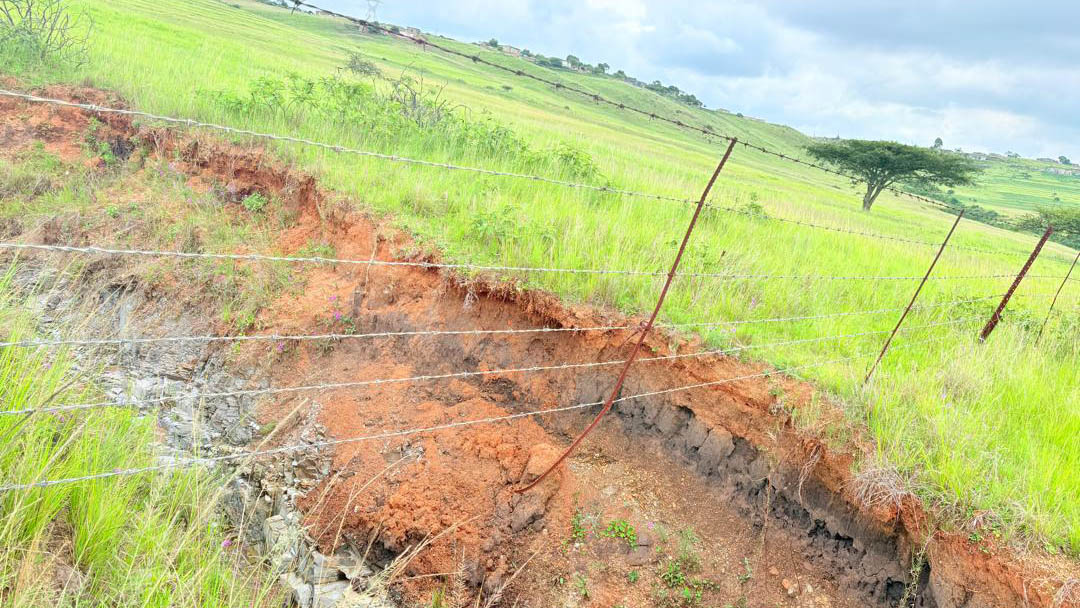
The resurgence of FMD at Zombodze Emuva, near Nhlangano, has partly been attributed to these gaps. The area shares a porous border with Mshololo in South Africa, overlooking Itshelejuba Hospital and several schools on the South African side.
Investigations by the Times of Eswatini revealed sections of the fence so extensively damaged that a full-grown cow could pass through without difficulty. While the Mshololo crossing point is monitored by soldiers and cordon guards from both countries, long stretches towards Mantambe remain unattended, increasing the risk of livestock intermingling.
Local herder Sipho Ndlela, who looks after 17 cattle at Zombodze Emuva, confirmed that some animals in the area are infected with FMD, including within the herd he tends.
“A few cattle here are infected, though I have not yet reported this to the owner or veterinary assistants,” Ndlela said. “We will report at the dip tank on Tuesday, but many suspected cattle are turned away if they show signs of infection.”
Ndlela noted that all the cattle he tends were recently vaccinated by the Ministry of Agriculture, which he believes helped prevent reinfection.
“I suspect the new cases are from cattle that missed vaccination or those that mingle along the broken border fence,” he said.
Residents on both sides of the border share family ties, schools, health facilities and shopping centres, making strict separation difficult.
“It is very possible for cattle to touch the fence because it has holes. That could explain why FMD keeps resurfacing here,” Ndlela added.
Another resident, Mandla Gumedze, said veterinary officials recently vaccinated cattle and collected samples to determine the strain of the disease. He confirmed that cattle previously roamed freely through one of the fence gaps before authorities intervened.
“Whenever one gap is closed, another opens due to soil erosion. The fence needs constant maintenance, not once-off repairs,” Gumedze said.
Bongiwe Xaba pointed to a nearly two-metre opening beneath the fence caused by a water stream flowing from South Africa into Eswatini.
*…
Farmers urged to tighten FMD precautions
MBABANE – Farmers have been urged to reinforce FMD safety measures as Eswatini faces challenges in vaccine availability following a temporary shutdown at the Botswana factory that supplies the country’s FMD vaccines.
Principal Secretary in the Ministry of Agriculture Sydney Simelane, highlighted that the Botswana factory producing the foot-and-mouth disease (FMD) vaccine had undergone a scheduled shutdown.
He clarified that the pause was not solely related to the holiday season but was part of the factory’s routine machinery servicing.
“The company decided to align their shutdown cycle with the holidays, but the primary reason was to service their machines,” Simelane explained.
He confirmed that the ministry had contacted the factory and was informed that production would resume shortly. A team from Botswana is expected to visit Eswatini in the coming weeks to collect blood samples from cattle. The samples will help determine the specific FMD strain affecting the country, allowing for a tailored vaccine to be produced.
“Very soon, the team will arrive in Eswatini to conduct blood sampling so they can identify the exact type of FMD circulating. This will enable them to produce a vaccine that directly targets the virus,” Simelane said.
The principal secretary added that the ministry had anticipated the shutdown and placed a larger vaccine order to mitigate shortages. While the ministry initially required about 150 000 doses, it increased the order to 188 000 to cover any unexpected outbreaks. “Besides the amount calculated for the known areas, we ordered extra doses to address any unbudgeted cases,” Simelane said.
Despite these precautions, Simelane warned that the existing vaccine stocks would last only one more week. He stressed that this limited supply could hamper efforts to contain new outbreaks until the production of the new vaccine is completed.
*Full article available on Pressreader*


















Leave a comment