

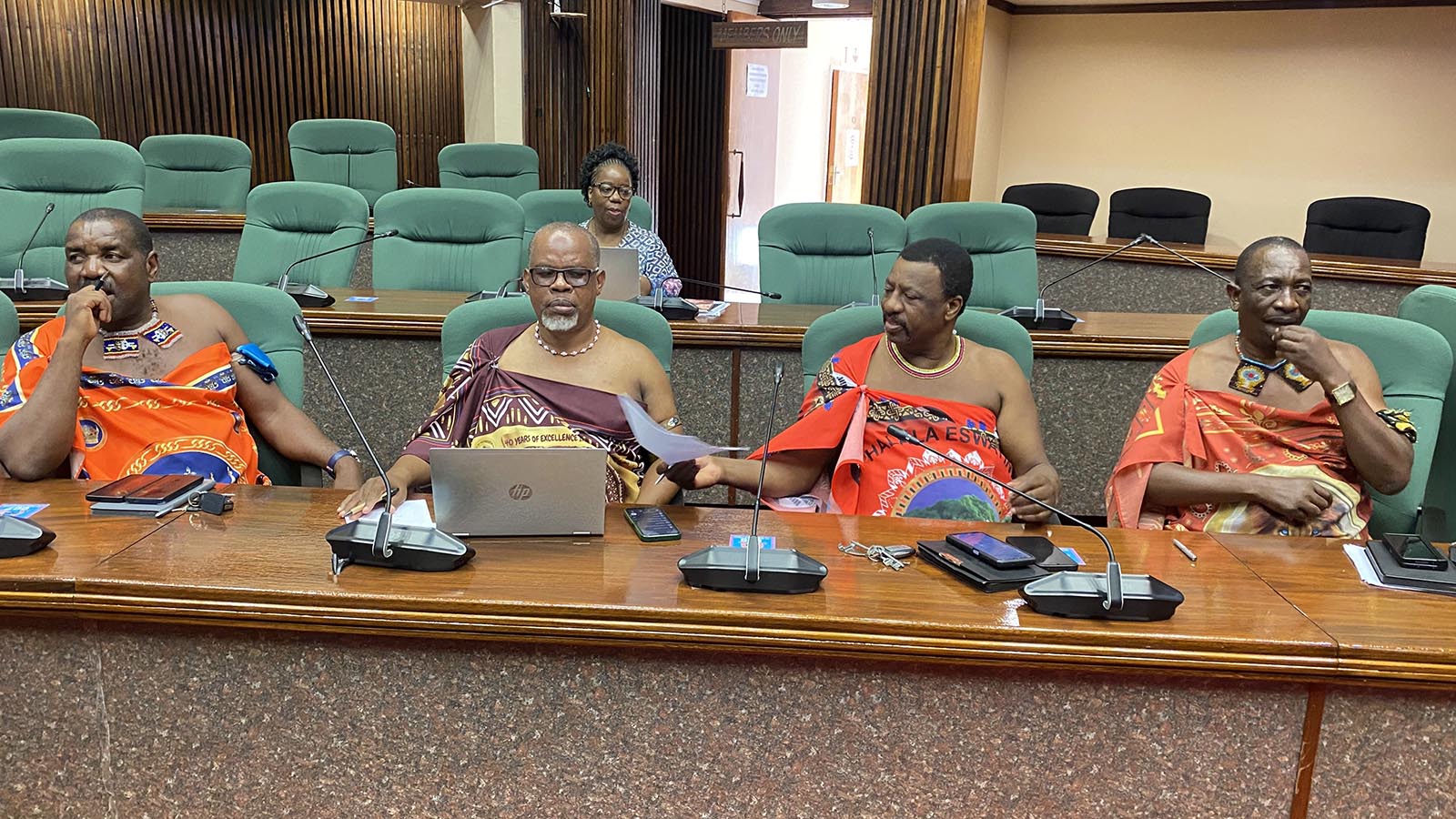
LOBAMBA – Questions around higher education governance and funding dominated the Ministry of Education and Training Senate Portfolio Committee debate yesterday.
This as senators probed financial accountability and regulatory effectiveness. Senator Celumusa Mndvoti criticised the Eswatini Higher Education Council (ESHEC), accusing it of failing emaSwati students.
“ESHEC is really doing a run-around with emaSwati children because people spend fortunes on tuition, only to graduate with defunct qualifications,” he said. He further questioned why institutions such as Birchcooper College continued to operate and advertise programmes despite credibility concerns from ESHEC and demanded that clarity is made concerning the college. Mndvoti also questioned reports of E55 million allocated to Eswatini Medical Christian University (EMCU), while also raising concerns about international travel expenditures and the status of the SADC University initiative. He asked whether control of the initiative had shifted from the ministry to the Prime Minister’s Office.
Adding to the debate, the Senate President Lindiwe Dlamini expressed concern over declining education standards despite the country’s historically strong system. She highlighted that 32 out of 42 tertiary institutions remained under provisional status beyond the legally stipulated two-year period, questioning the ministry’s compliance and oversight.
She also raised concerns about private institutions operating as business entities, urging stronger coordination between the Ministry of Education and the Ministry of Commerce to ensure proper registration and regulation.
Meanwhile, Senator Qethuka Sigombeni Dlamini described the ministry as central to the country’s future, stating that its direction ultimately shaped national development. However, he expressed concern over the continued reliance on contract teachers, noting that such arrangements left many unable to access loans or lead stable lives.
He questioned whether the ministry had concrete solutions to challenges facing the University of Eswatini (UNESWA), an institution he said had a strong legacy, including past collaborations with regional universities such as the University of Botswana. He also raised alarm over graduate unemployment, recounting an encounter with a university graduate selling guavas at Mfabantfu.
*…
Minister responds to concerns on UNESWA engaging consultants
LOBAMBA – Responding to the issues raised during the debate, the Minister for Education and Training acknowledged many of the challenges and outlined steps being taken to address them.
On UNESWA, the minister confirmed that although the institution was semi-autonomous, it relied on government funding. He revealed that the university had duplicated consultancy processes already being undertaken by government with support from the World Bank, prompting the ministry to intervene.
“We have written to UNESWA to stop independent consultations and sought clarification on the source of funding,” he said, adding that implementation of reforms would soon begin under a team of experts.
Regarding ESHEC, the minister described the situation as sensitive, noting that some institutions admitted students with insufficient qualifications.
“We cannot compromise quality. Students must upgrade where necessary,” he said, adding that monitoring would be strengthened to prevent institutions from being closed mid-course.
On EMCU, he explained that the E55 million allocation was based on an existing memorandum of understanding, which would remain in place until it is reviewed.
Addressing concerns about CBE, the minister said the programme was being supported by consultants from the United Kingdom and urged patience in its implementation.
“Rome was not built in a day,” he said, adding that alternative pathways such as Technical and Vocational Education and Training (TVET) could provide viable livelihoods.
*Full article available on Pressreader*














Leave a comment