

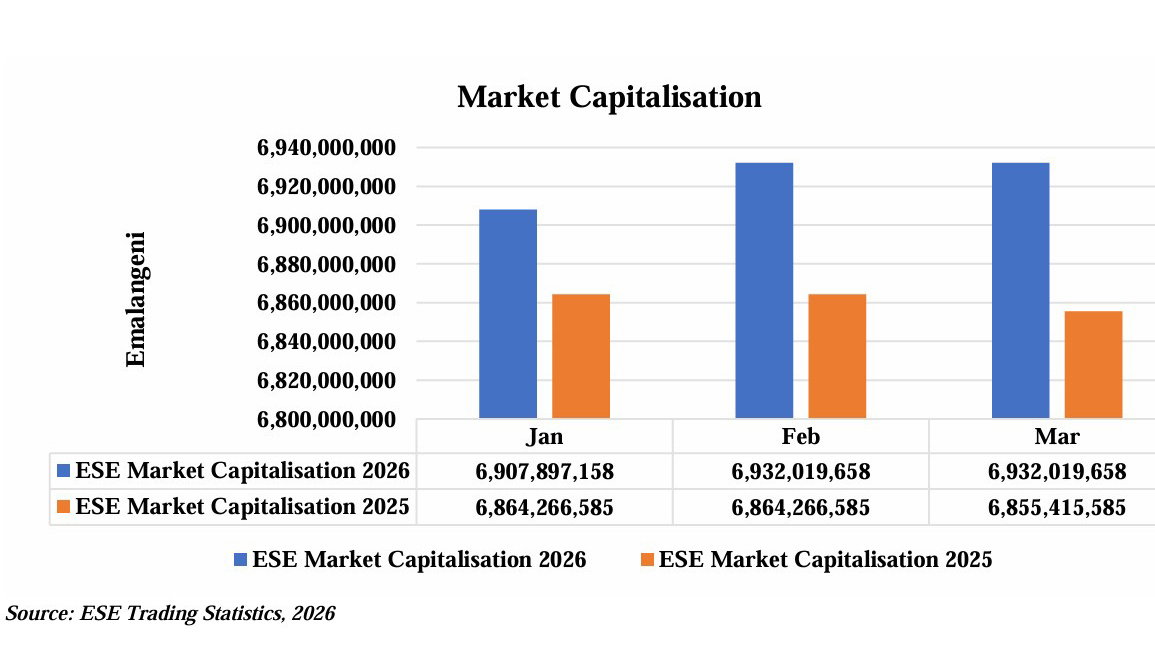
MBABANE – The Eswatini Stock Exchange (ESE) recorded a modest, yet encouraging, performance in the first quarter of 2026, with market capitalisation increasing by 0.51 per cent, reflecting steady investor confidence amid subdued trading activity.
According to the ESE First Quarter Report for the period January to March 2026, total market capitalisation rose from E6.896 billion at the end of the fourth quarter of 2025 to E6.932 billion by the end of March 2026. This growth, while relatively small, points to a market that remains stable and resilient despite broader liquidity constraints.
The increase in market capitalisation was largely driven by share price movements in SBC Limited, alongside the listing of AGSPAC Limited, a new entrant to the exchange during the period under review. On a year-on-year basis, the exchange also recorded a 1.12 per cent increase in market capitalisation, up from E6.855 billion in March 2025, signalling gradual expansion in the value of listed equities.
The ESE continues to operate with a relatively small and concentrated pool of listed companies. As at the end of the first quarter, there were 10 companies listed on the Main Board, all of which are domestic entities. While one new listing was recorded in January 2026, there were no additional entrants in February and March, highlighting the slow pace of new listings. Market concentration remains evident, with a handful of large companies dominating overall capitalisation. First National Bank Eswatini leads the pack, accounting for 28.45 per cent of the total market capitalisation. It is followed by Royal Eswatini Sugar Corporation at 23.63 per cent and SBC Limited at 14.27 per cent. Other notable contributors include Swazi Empowerment Limited and Greystone Partners Limited, each holding just under 10 per cent of the market. Smaller players such as Inala Capital Limited and Nkonyeni Pre-cast Limited account for marginal shares, while AGSPAC Limited, the newest listing, contributes just 0.16 per cent to the overall market value.
The concentration of market capitalisation within a few large counters reflects the structural nature of Eswatini’s equity market, where limited listings and relatively low free float constrain broader participation.
The ESE has reiterated its call for more local companies to list, arguing that doing so would not only enhance liquidity, but also promote financial inclusion by allowing emaSwati to participate as shareholders in domestic enterprises. Increased listings would also provide companies with access to capital for expansion and innovation.The ESE All Share Index, which measures the overall performance of listed equities, registered a slight increase during the quarter. The index rose by 0.35 per cent, from 491.45 at the end of the fourth quarter of 2025 to 493.16 by the end of March 2026.
This modest increase reflects limited trading activity across the market. The report indicates that a single trade in SBC Limited had a significant influence on the index’s upward movement, while the majority of other counters recorded no change in share prices.
On a year-on-year basis, the index increased by 0.96 per cent from 488.49 in March 2025, reinforcing the view that the market is experiencing slow but steady growth rather than rapid expansion.
The muted movement in the index underscores the broader challenge facing the ESE, low levels of trading activity and liquidity, which limit price discovery and overall market dynamism. A closer look at individual stock performance reveals a mixed picture. SBC Limited emerged as the strongest performer, with its share price increasing by 13.89 per cent year-on-year. This gain played a key role in boosting both market capitalisation and the All Share Index during the quarter.
Nedbank Eswatini also recorded a notable increase, with its share price rising by 10 per cent over the same period. These gains suggest that certain counters continue to attract investor interest and deliver value.
*Full article available on Pressreader*




















Leave a comment