

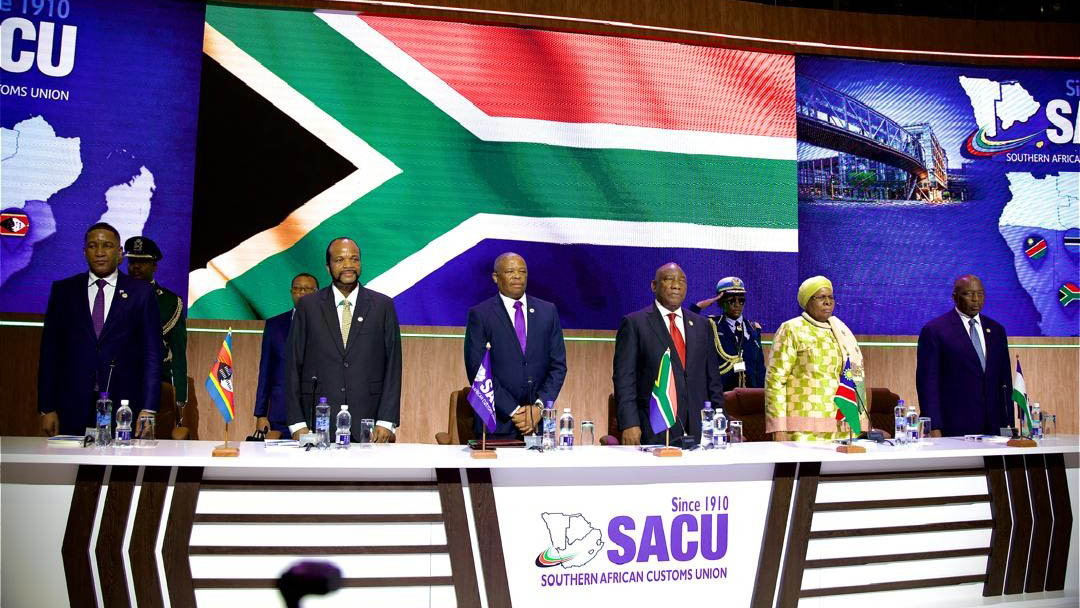
CAPE TOWN, SOUTH AFRICA – The Southern African Customs Union (SACU) will now protect member States from political spillovers that could disrupt regional trade and the shared revenue pool.
This will be done by engaging in trade negotiations as a bloc, as opposed to leaving it to a country-by-country approach. The commitment came under scrutiny at a post-9th SACU Summit press conference on Friday when Times of Eswatini Managing Director Martin Dlamini asked South African Finance Minister Enoch Godongwana for clarity on this resolution. He asked whether the bloc could achieve a clear separation of business from politics and guarantee that geopolitical alliances or disputes would not undermine regional industrialisation efforts.
Minister Godongwana said external actors often attempt to undermine SACU’s unity rather than the union itself undermining free trade. He cited examples of the United States occasionally preferring bilateral deals with individual members such as Lesotho or South Africa which, if accepted, would fracture the customs union’s integrity.
“China similarly favours negotiations only with countries holding formal diplomatic relations with Beijing, complicating matters for members with differing alignments. As a unified bloc, we cannot allow a divide-and-conquer approach to negotiation. We will continue to negotiate collectively as a union,” the minister stated.
Addressing the intersection of trade and politics Godongwana said: “There is no such thing as a trade negotiation completely devoid of politics. Every nation enters negotiations guided primarily by its own national interests. As a regional bloc, our job is to define the collective political and economic interests of SACU and negotiate as a unified front. Trade and politics are inherently intertwined.”
The SACU approach aligns with Article 31 of the 2002 SACU Agreement, which requires members to engage third parties collectively. This framework aims to prevent weaker economies from being picked off individually and to safeguard the common revenue pool that distributes tariff income across all five nations, with smaller members often receiving a disproportionate share to support their development. For Eswatini, the China episode illustrates both the costs and protections of bloc solidarity. While the kingdom’s ties with Taiwan have cost it direct access to the world’s second-largest economy, the collective stance may give it a lifeline and ensure that South Africa and the other members cannot simply pursue separate deals that might leave Eswatini further isolated.
*…
SA pledges greater support for growth
CAPE TOWN, SOUTH AFRICA – South Africa has committed itself to fostering greater industrial growth among its neighbours through the Southern African Customs Union (SACU).
This commitment was made by Finance Minister Enoch Godongwana when responding to questions on its longstanding economic dominance within SACU at a post-summit press conference here on Friday.
Hhukwini Member of Parliament, Alec Lushaba, had asked the minister about SACU’s 116-year history, noting that over three decades of regional democratic transitions, South Africa had remained an overwhelmingly dominant player in the SACU pool. MP Lushaba highlighted the uneven development of electricity infrastructure, pointing out that neighbouring countries had not built independent capacity because it was simpler to import power from Eskom.
With South Africa now unable to shoulder the entire region’s burdens alone, he asked whether the new development fund signalled a genuine shift towards deliberately building industries in Botswana, Eswatini, Lesotho and Namibia.
In response, Minister Godongwane sought to separate ‘fact from fiction’ regarding SACU’s architecture. He explained that South Africa had historically managed tariff-setting for the region because other members initially lacked the institutional capacity. In exchange, the country agreed to a revenue-sharing formula under which nearly 50 per cent of the pool – generated overwhelmingly (98 per cent) by South African economic activity – is distributed to the other members. The minister acknowledged that this arrangement had long been a source of tension. He recalled that early in his tenure at ministerial meetings, there had even been proposals to scrap SACU entirely, but South Africa had rejected them as economically unwise for the region and, instead, officials had worked to preserve the union while reimagining its purpose.
Godongwana stated that South Africa welcomed industrialisation in its neighbouring countries. “It is not in South Africa’s national interest for Eswatini, Lesotho or Namibia to stagnate. If our neighbours are not growing, we are severely limiting our own export markets. We cannot thrive in isolation,” he said.
He pointed to examples of South African support for cross-border development, such as the Lesotho Highlands Water Project, which continues to receive significant funding and political backing because it benefits the wider region, including South Africa’s industrial heartland. He said should Lesotho advance hydropower or green energy initiatives, South Africa stands ready as an eager off-taker of that clean electricity.
Similarly, he said, Namibia’s emerging natural gas projects require a reliable off-taker to become commercially viable and South Africa is positioned to fulfil that role. The minister emphasised that the industrial and infrastructure projects discussed at the summit are designed as genuine cross-border joint ventures rather than isolated national efforts. While conceding that execution of such plans had not always been as aggressive as needed in the past, Godongwana insisted that a reimagined SACU is explicitly intended to transform these ambitions into vibrant, active economies across the region.
*Full article available on Pressreader*


















Leave a comment