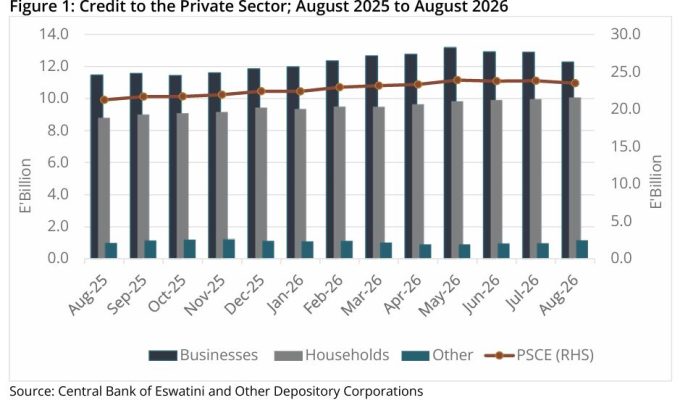
MBABANE – Credit extended to Eswatini’s private sector climbed to E23.9 billion at the end of May 2026.
This was driven by stronger borrowing from businesses and households, according to the Central Bank of Eswatini’s latest Recent Economic Developments (RED) report.
The report shows that private sector credit grew by 2.5 per cent month-on-month and 10.6 per cent compared with May 2025, signalling sustained demand for financing despite prevailing economic uncertainties.
Growth was mainly supported by increased lending to both the business sector and households, while credit extended to other sectors of the economy continued to decline.
Credit extended to businesses increased by 3.2 per cent during the month and 9.8 per cent year-on-year to reach E13.2 billion.
The increase was largely driven by higher lending to key productive sectors of the economy.
Agriculture and forestry recorded the strongest monthly growth in business credit at 12.9 per cent, followed by construction at 11.4 per cent and distribution and tourism at 6.9 per cent.
Transport and communication borrowing rose by 0.4 per cent, while manufacturing credit edged up 0.2 per cent.
However, lending declined in several industries, including mining and quarrying, which contracted by 3.0 per cent, community, social and personal services, which fell 2.3 per cent, and real estate, where credit eased 0.5 per cent.
The Central Bank said the growth in business credit was almost entirely driven by large enterprises.
Loans extended to large businesses increased by 7.3 per cent month-on-month and 9.0 per cent year-on-year to E9.0 billion.
By contrast, lending to small and medium enterprises (SMEs) declined by 4.7 per cent during the month to E4.1 billion.
Despite the monthly decline, SME credit remained 11.6 per cent higher than a year earlier, indicating that financing to smaller businesses continues to trend upwards over the longer term.
Household borrowing also increases
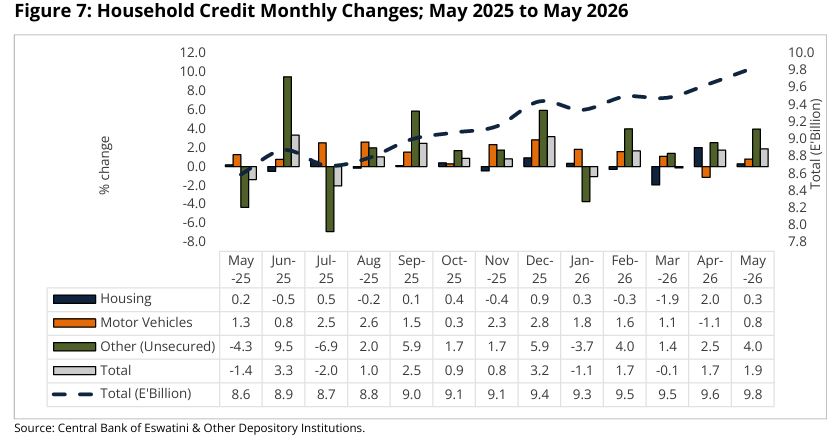
Credit extended to households and non-profit institutions serving households (NPISH) rose by 1.9 per cent during May and 14.4 per cent over the year to E9.8 billion.
Growth was recorded across all major household loan categories.
Other personal loans increased by 4.0 per cent to E4.1 billion, remaining the fastest-growing category during the month.
Housing loans edged up 0.3 per cent to E4.3 billion, while motor vehicle financing increased 0.8 per cent to E1.4 billion.
The broad-based increase suggests households continued to access credit for consumption, housing and asset purchases.
Meanwhile, credit extended to other sectors of the domestic economy declined for the third consecutive month, falling 0.2 per cent month-on-month and 11.6 per cent year-on-year to E903.2 million.
The decline reflected lower lending to other financial corporations and public enterprises.
Credit to other financial corporations fell 0.5 per cent to E420 million, while lending to public enterprises slipped 0.1 per cent to E399.4 million.
In contrast, credit extended to local government increased 0.7 per cent to E83.9 million.
Bad loans rise but ratio improves
The report also shows that the value of non-performing loans (NPLs) increased to E1.4 billion in May 2026.
This represented a 1.4 per cent increase from April and a 7.1 per cent rise compared with the same month last year.
Despite the increase in the value of bad loans, the banking sector’s NPL ratio improved slightly.
The ratio declined by 0.1 percentage point month-on-month and 0.3 percentage points year-on-year to 6.93 per cent.
According to the Central Bank, the improvement reflects the fact that overall loan growth continued to outpace the increase in non-performing loans, indicating that while impaired loans increased in absolute terms, they accounted for a slightly smaller share of total credit.