MBABANE – The non-bank financial institutions (NBFI) sector has recorded a nominal E2 billion decline in total assets following the reclassification of Swaziland Building Society (SBS) into a commercial bank.
However, the Financial Services Regulatory Authority (FSRA) says the reduction reflects a statistical adjustment rather than weakening sector performance.
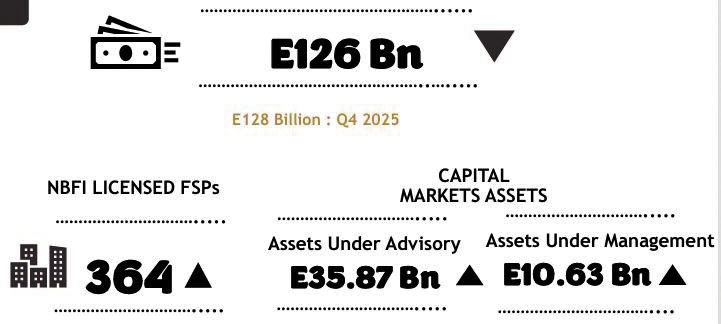
According to the FSRA’s first quarter 2026 non-banking financial institutions statistical bulletin, total NBFI assets declined from E128 billion to E126 billion after SBS exited the non-bank sector to join the country’s banking industry.
The regulator emphasised that the decline should not be interpreted as a deterioration in the financial health of the NBFI sector, explaining that the assets have remained within Eswatini’s financial system and are now reflected under the banking sector’s balance sheet.
“The assets have not left the domestic financial system; they remain productively deployed within the economy, now under the banking sector’s regulatory umbrella,” the FSRA said. The authority stressed that analysts, investors and other stakeholders should view the movement within its proper context. “NBFI sector assets have not eroded through poor performance, market loss or regulatory failure. Rather, the sector has, in effect, graduated one of its members.”
The transition marks one of the most significant structural developments in Eswatini’s financial services industry in recent years, with SBS becoming the latest institution to move from the non-bank regulatory framework into the commercial banking sector.
The FSRA described the transition as the culmination of an extensive regulatory and institutional transformation process that demonstrates the ability of financial institutions to grow and evolve within the country’s regulatory system.
For decades, SBS has been one of Eswatini’s leading financial institutions, providing mortgage finance, housing loans and savings products to thousands of emaSwati.
Its conversion into a fully fledged commercial bank significantly expands its operating mandate, allowing it to mobilise deposits more broadly, diversify its lending portfolio and participate fully in the national payments system under the supervision of the Central Bank of Eswatini. The regulator said the successful transition highlights the effectiveness of Eswatini’s financial regulatory architecture.
According to the FSRA, the re-licensing demonstrates that institutions operating within the non-bank financial sector have a clear pathway to develop, strengthen governance standards and eventually graduate into higher tiers of the financial system. The authority noted that the transition followed comprehensive assessments covering capital adequacy, corporate governance, operational resilience and regulatory compliance before SBS qualified to move under the Central Bank’s supervisory framework. The FSRA views the development as evidence that Eswatini’s two-tier regulatory model is functioning as intended.
Under the framework, the FSRA supervises non-bank financial institutions, while the Central Bank regulates commercial banks, allowing institutions to transition between the two sectors as they grow and meet increasingly demanding prudential requirements.
“This development is a positive affirmation of the robustness of Eswatini’s financial regulatory architecture,” the regulator stated. “It demonstrates that the two supervisory frameworks can work in coordination to accommodate institutional growth and transition.” Despite the headline decline in aggregate assets, the remaining non-bank financial sector continued to post encouraging performances across most subsectors during the first quarter of 2026.
The bulletin shows that the overall NBFI sector recorded a 1.49 per cent quarter-on-quarter decline in assets to E126 billion, largely because of the SBS reclassification. However, on an annual basis, the sector still achieved 10.61 per cent growth, underlining continued expansion across the remaining institutions.
Retirement funds possess E60.48bn assets
Retirement funds, which remain the largest component of the NBFI sector, also maintained stability despite volatile global investment markets.
Total retirement fund assets increased marginally by 0.20 per cent to E60.48 billion, supported by stronger investments in long-term debt instruments and property. The regulator said growth was partly offset by declines in domestic and foreign equity markets, as well as lower holdings of short-term money market instruments and deposits, indicating a shift towards longer-term domestic investments.