MBABANE – Eswatini remains one of Southern Africa’s stronger fiscal performers, although slowing growth in South Africa continues threatening the kingdom’s medium-term economic prospects.
Eswatini compares favourably with many of its Southern African peers on several key fiscal indicators, including debt sustainability, taxation and public finance, but the kingdom’s economic fortunes remain closely tied to South Africa, whose sluggish growth, mounting fiscal pressures and infrastructure constraints continue to pose risks to the region.
Those are among the key findings emerging from the African Development Bank’s (AfDB) 2026 Country Focus Report on South Africa, which goes beyond analysing Africa’s most industrialised economy to provide extensive regional comparisons that include Eswatini.
While the report focuses on South Africa, its data offers valuable insight into where Eswatini stands within Southern Africa and the broader continent. One of the report’s most striking features is the number of regional comparisons in which Eswatini appears.
Rather than portraying the kingdom as an economy under pressure, many of the comparative graphs suggest Eswatini remains relatively well-positioned when measured against neighbouring countries on taxation, debt servicing and public finance.
For policymakers and investors alike, this paints a picture of a relatively stable economy, although one that remains highly exposed to developments beyond its borders.
Given that South Africa accounts for the majority of Eswatini’s imports and exports, dominates the country’s banking sector and provides the largest share of SACU revenues, any change in Pretoria’s economic performance quickly filters into the kingdom’s economy.
According to the AfDB, South Africa’s economy expanded by only 1.1 per cent in 2025 after growing just 0.5 per cent in 2024.
Growth is projected to improve only modestly to 1.2 per cent in 2026 before reaching 1.6 per cent in 2027.
Although positive, these growth rates remain well below what is needed to reduce unemployment or significantly expand regional demand. For Eswatini, slower South African growth means weaker demand for exports, softer investment flows and potential pressure on future SACU receipts.
Furthermore, the AfDB identifies electricity shortages, freight rail inefficiencies, congested ports, declining investment, water shortages and governance weaknesses as the principal constraints on South Africa’s economy.
Manufacturing contracted by 1.2 per cent during 2025, construction declined by 4.4 per cent for the ninth consecutive year, while electricity, gas and water production fell by 4.3 per cent. These problems extend well beyond South Africa.
Most of Eswatini’s exports and imports move through South African logistics infrastructure. Delays at Durban Port or disruptions to freight rail networks inevitably increase transport costs for emaSwati businesses, reducing competitiveness and squeezing profit margins.
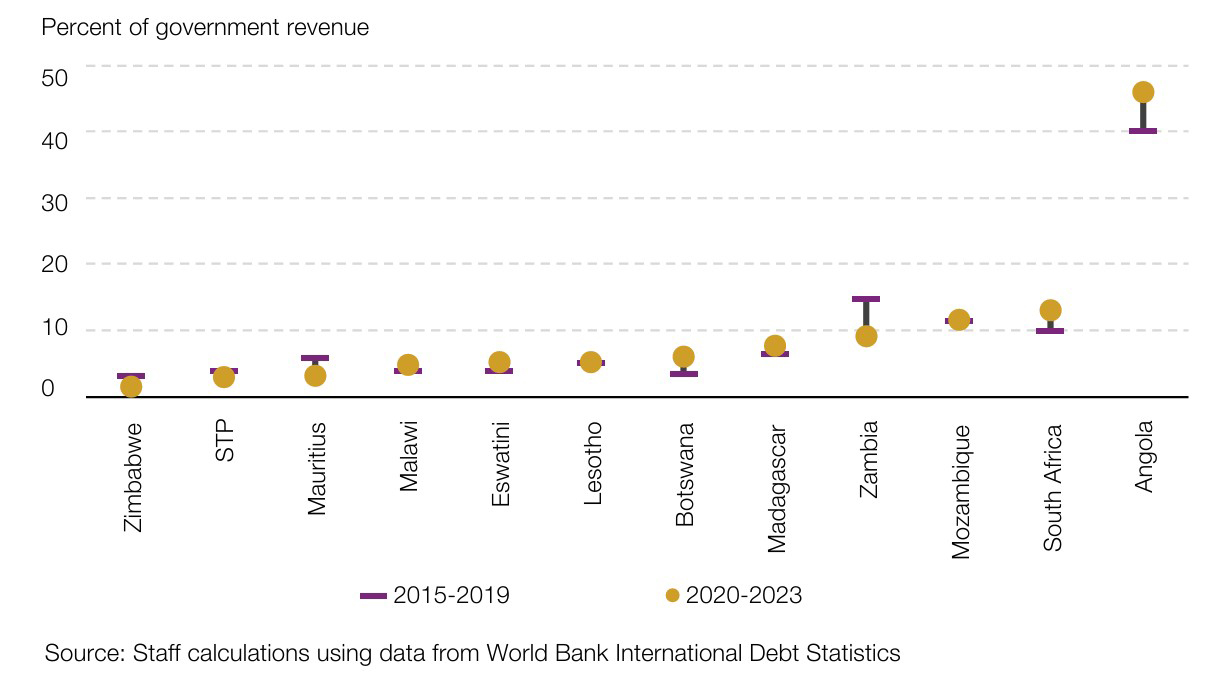
Among the report’s regional comparisons is external public debt servicing as a share of government revenue. Although Eswatini’s debt servicing obligations have increased over recent years, the kingdom still performs considerably better than some countries in the region.
The AfDB’s analysis shows Zimbabwe, São Tomé and Príncipe, Mauritius and Malawi recording significantly higher debt servicing burdens than Eswatini, while countries such as Botswana, Madagascar, Zambia, Mozambique, Angola and South Africa perform more favourably.
The graph illustrates an important point. Debt itself is not necessarily the problem. The real concern is how much of government’s revenue must be diverted away from public services simply to repay loans.
Countries with heavier debt servicing obligations have less fiscal room to finance healthcare, education, roads and infrastructure.
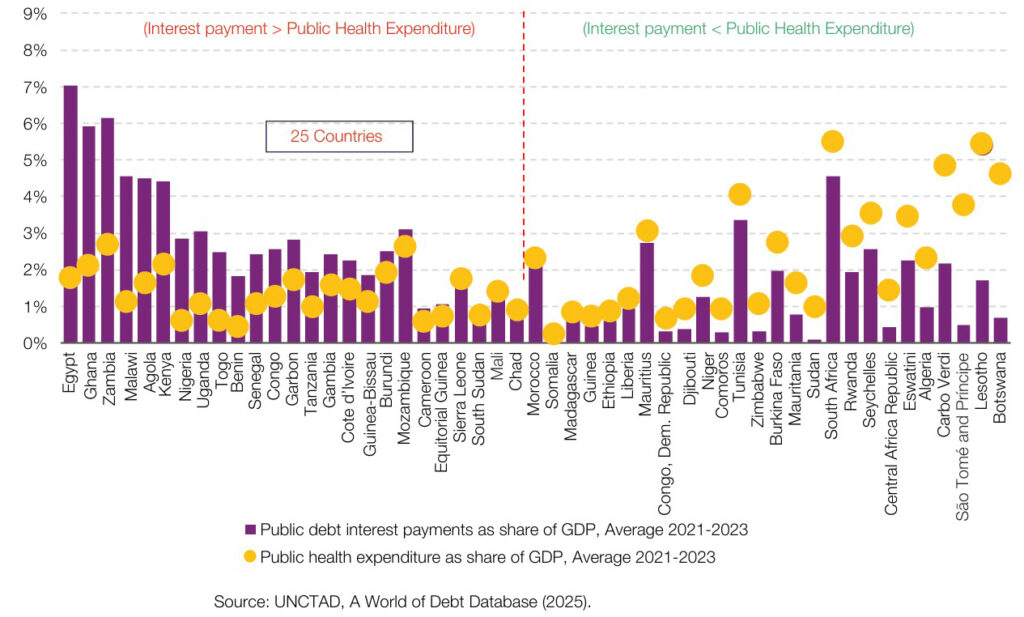
Although Eswatini’s position warrants continued fiscal discipline, it remains well below the region’s most distressed economies. Another encouraging comparison concerns debt interest payments against public health expenditure. Across Africa, the report shows several countries now spending more servicing debt than funding public healthcare. Eswatini, however, remains on the healthier side of that divide.
According to the AfDB, the kingdom still spends proportionally more on public health than on external public debt interest payments, placing it among countries where debt has not yet crowded out critical social spending. The finding is significant because international development institutions increasingly assess debt sustainability not only by debt levels but also by whether governments retain enough fiscal space to continue investing in citizens.
The report also presents a continent-wide comparison linking public debt levels with labour productivity.
Its conclusion is straightforward: Countries carrying heavier public debt generally experience lower productivity growth.
The AfDB cautions that while the relationship differs from country to country, excessive debt often limits government’s ability to invest in productive infrastructure, education and innovation, ultimately slowing economic expansion.
For Eswatini, this reinforces the importance of maintaining prudent borrowing, particularly as government continues implementing major capital projects. One bright spot in South Africa’s economy is inflation.
Average inflation fell to 3.2 per cent in 2025, the lowest annual rate since 2004, allowing the South African Reserve Bank to reduce interest rates six consecutive times, lowering the benchmark rate from 8.25 per cent to 6.75 per cent.
Lower borrowing costs could eventually support stronger household spending, investment and business confidence. Given the strong integration of Eswatini’s banking system with South Africa, local businesses could also benefit indirectly from improved regional financial conditions.