

MBABANE – Eswatini’s merchandise trade deficit widened to E1.05 billion during the first four months of the 2026/27 fiscal year, as imports continued to grow faster than exports.
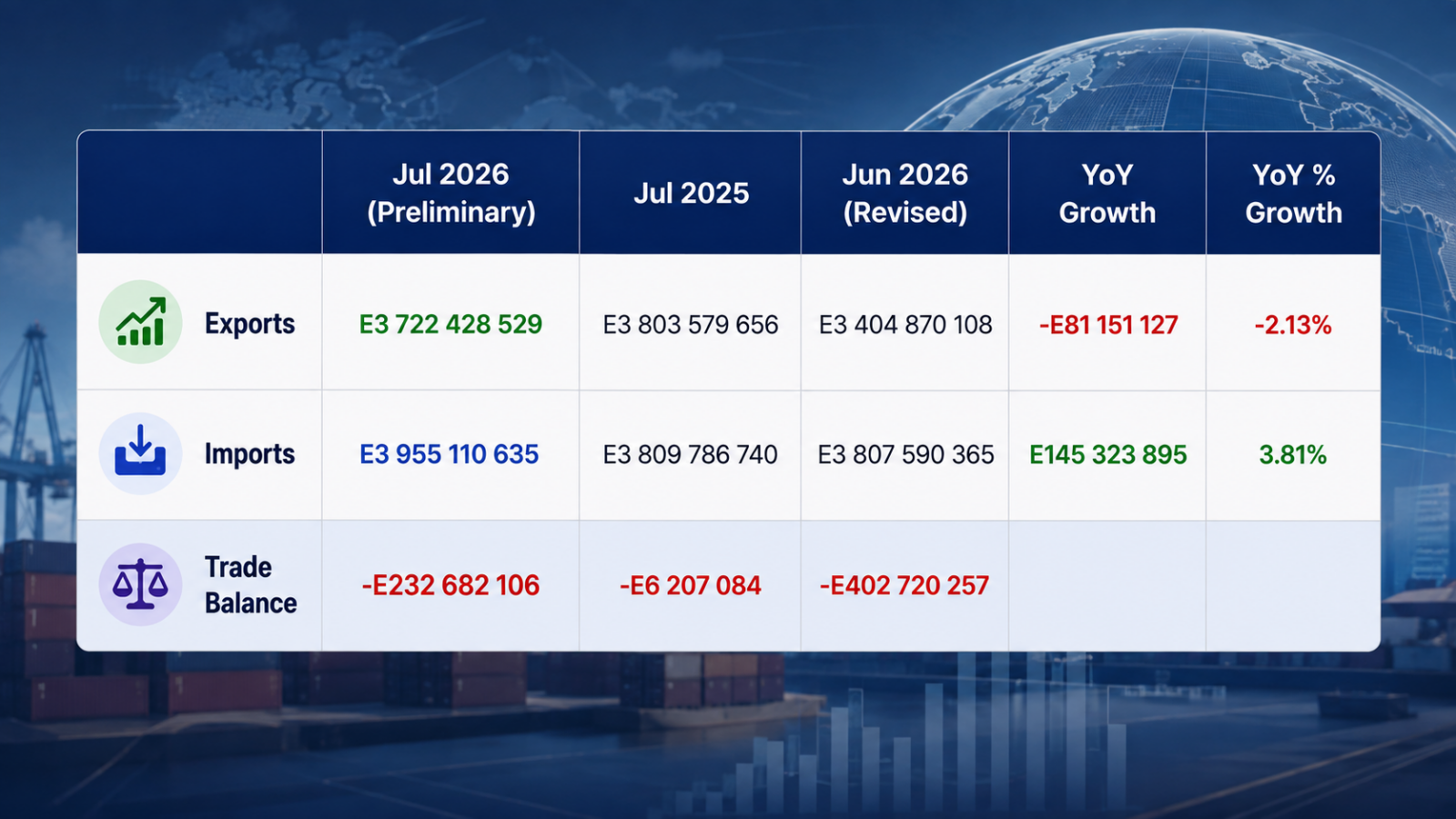
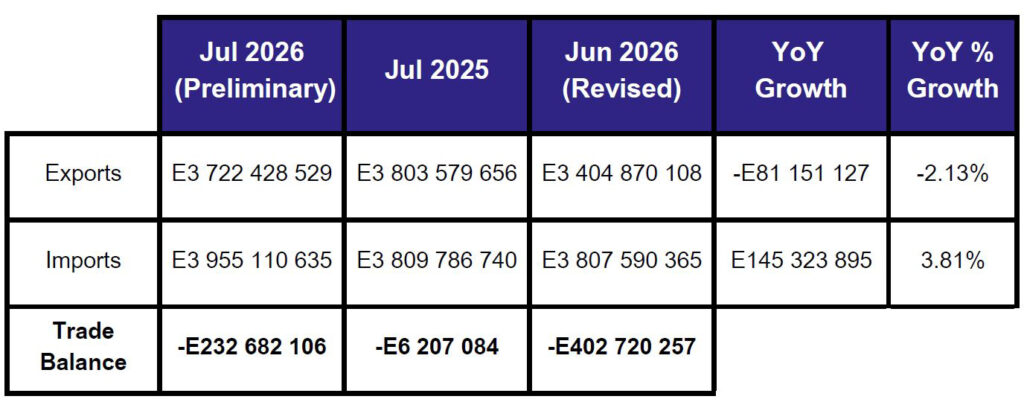
Preliminary merchandise trade statistics for July 2026 show that the country recorded a monthly trade deficit of E232.68 million, with exports amounting to E3.72 billion against imports of E3.96 billion. The figures include trade with Southern African Customs Union (SACU) partners Botswana, Lesotho, Namibia and South Africa.
The July deficit represents a deterioration from the E6.21 million deficit recorded in July 2025 and also narrowed from the E402.72 million deficit recorded in June 2026, according to the preliminary statistics.
The latest figures highlight the continued pressure created by the country’s import bill, with the value of goods entering Eswatini increasing at a faster pace than merchandise exports during the opening four months of the financial year.
For the April-July 2026 period, merchandise exports reached E14.38 billion, representing growth of 5.99 per cent compared to E13.57 billion during the corresponding period of the previous financial year.
Imports, however, increased by 7.76 per cent to E15.43 billion from E14.32 billion.
This resulted in a cumulative trade deficit of E1.05 billion, substantially higher than the E753.65 million recorded during the same period in 2025/26.
The widening deficit means that, despite stronger export earnings over the first four months, the growth in imports has outpaced the expansion in exports.
On a year-on-year basis, July merchandise exports declined by E81.15 million, or 2.13 per cent, from E3.80 billion in July 2025 to E3.72 billion in July 2026.
The decline was mainly reflected in some of the country’s key export categories.
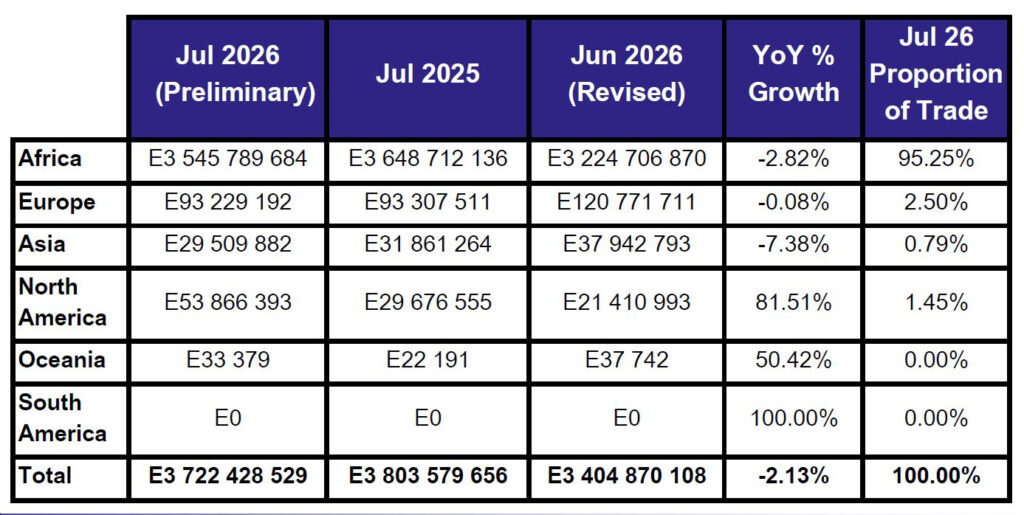
The statistics show that exports of products of chemical or allied industries, one of the largest export categories, fell by E179.46 million, or 11.87 per cent, to E1.33 billion.
Prepared foodstuffs, beverages, spirits, vinegar, tobacco and manufactured tobacco substitutes declined by E14.09 million, or 1.16 per cent, to E1.20 billion.
Mineral product exports decreased by E3.67 million, or 4.07 per cent, to E86.29 million.
The statistics attribute the overall year-on-year decline in merchandise exports to lower exports of concentrates and chewing gum.
However, several export categories recorded notable increases. Textile and textile article exports rose by E53.81 million, or 12.80 per cent, to E474.33 million, while wood and articles of wood increased by E20.34 million, or 7.21 per cent, to E302.54 million.
Machinery and mechanical appliances, electrical equipment and related products increased by E27.15 million, or 57 per cent, to E74.79 million.
Base metal exports also increased by E5.91 million, or 28.88 per cent, while exports of precious and semi-precious stones, precious metals and related articles more than doubled, increasing by E9.83 million, or 135.59 per cent.


















Leave a comment