

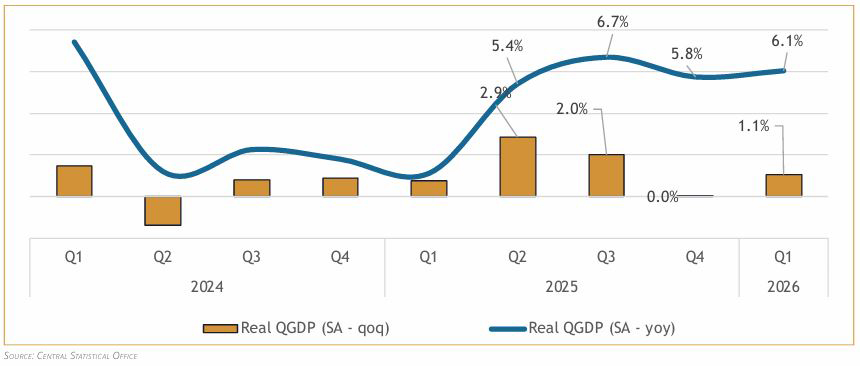
MBABANE – Eswatini’s economy expanded by 6.1 per cent in the first quarter of 2026, placing the country among the stronger-performing economies in the Southern African Customs Union (SACU) region.
According to the Central Bank of Eswatini’s June 2026 Quarterly Review, the domestic economy recorded year-on-year growth of 6.1 per cent on a seasonally adjusted basis in the first quarter, accelerating from a revised 5.8 per cent in the fourth quarter of 2025.
The performance was underpinned principally by a sharp recovery in the secondary sector, while the primary and tertiary sectors also recorded positive growth, although performance within the sectors was uneven.
On a quarter-on-quarter basis, economic activity increased by 1.1 per cent on a seasonally adjusted basis during the first quarter.
The Central Bank’s assessment comes against a varied economic picture across SACU, with Botswana recording a much stronger 9.2 per cent year-on-year expansion, while Namibia contracted by 1.5 per cent. South Africa recorded quarter-on-quarter growth of 0.5 per cent, while Lesotho’s economy contracted by 0.8 per cent on the same basis.
The comparison nevertheless needs to be read with the measurement periods in mind. Eswatini’s 6.1 per cent and Botswana’s 9.2 per cent are year-on-year growth rates, whereas the figures reported for South Africa and Lesotho are quarter-on-quarter changes.
Botswana recorded the strongest reported expansion among the SACU economies during the first quarter of 2026, with real GDP growing by 9.2 per cent year-on-year.
The growth represented a significant turnaround from the 11.9 per cent contraction recorded in the fourth quarter of 2025.
The Central Bank said Botswana’s rebound was driven mainly by exceptionally strong performance in water and electricity, which expanded by 87.4 per cent, and diamond trade, which increased by 60.5 per cent.
Additional support came from education, mining, manufacturing and trade.
However, the performance was not broad-based across the entire Botswana economy, as most other sectors recorded only modest growth, while agriculture and construction contracted.
Eswatini’s 6.1 per cent expansion, therefore, came below Botswana’s reported rate, but represented continued positive momentum following the revised 5.8 per cent growth recorded in the final quarter of 2025.
In Eswatini, the strongest contribution came from the secondary sector, which expanded by 13.9 per cent year-on-year after contracting marginally by 0.4 per cent in the preceding quarter.
The secondary sector alone contributed 4.5 percentage points to overall GDP growth.
Manufacturing output increased by 12.4 per cent year-on-year, recovering from a 1.2 per cent contraction in the fourth quarter of 2025.
The Central Bank attributed the improvement mainly to stronger demand and increased activity in key manufacturing subsectors.
Construction provided another major source of momentum, accelerating by 33.3 per cent year-on-year from 11.8 per cent previously. The Central Bank linked the performance to ongoing public and private infrastructure projects.
The manufacturing of non-metal mineral products and manufacture of metal products also benefitted from sustained construction activity.















Leave a comment