

EZULWINI – Minister for Commerce, Industry and Trade Manqoba Khumalo has put forward a simple and uncomfortable argument.
He has explained why the country’s gross domestic product (GDP) may be growing, but ordinary workers are not feeling it.
In certain Eswatini companies, he points out, there is no formal salary structure and no ladder that sets the distance between the chief executive officer’s (CEO) pay and that of the least-paid worker.
Without that ladder, Khumalo mentioned that the gap between the top and the bottom is whatever management decides.
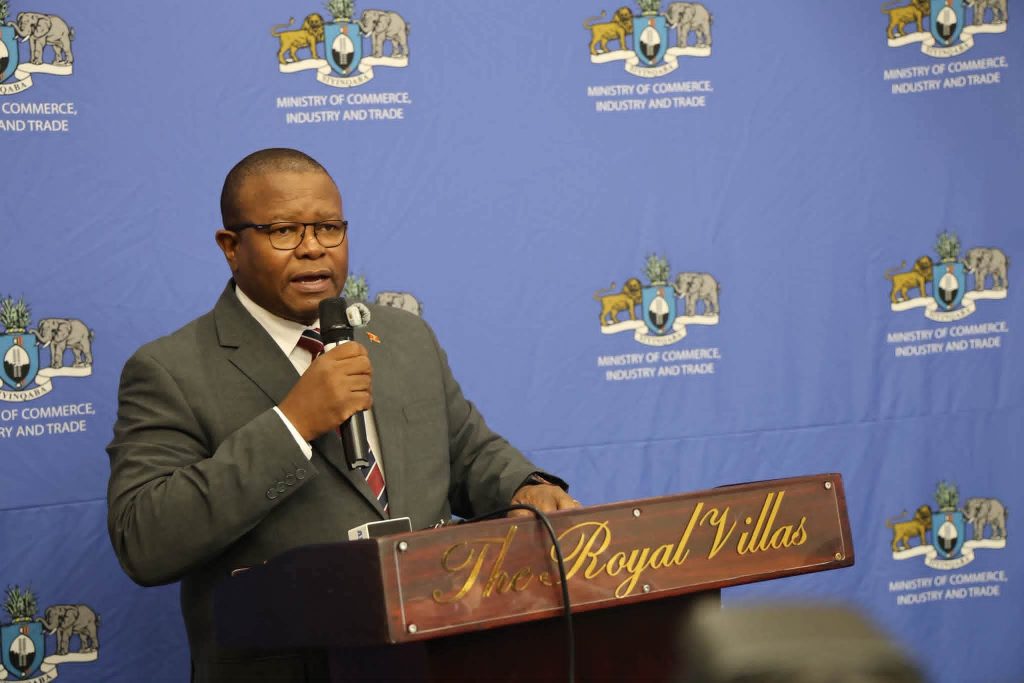
Speaking during a breakfast meeting with the country’s editors at Royal Villas in Ezulwini, the minister made an example that the chief executive earns E280 000 in some companies, while the least-paid employee takes home E3 500.
Put side-by-side, the minister actually means the boss earns 80 times what the cleaner or the packer earns.
In such companies, he argues, the economy grows for the high earners, while those at the bottom experience no difference in their lives at all.
The World Bank expects Eswatini’s economy to grow by about five per cent, which could be its strongest run since 2019.
However, it must be said that more than half of emaSwati still live below the national poverty line. Khumalo said pay gap in developed countries has been closed.
The minister served as the general manager of the Coca-Cola plant in Athy, County Kildare, Ireland, from February 2016 until November 2018, before leaving to become a senator and Minister for Commerce, Industry and Trade in Eswatini.
In August this year, Khumalo, responding to questions from senators, said income inequality remains a significant challenge.
He explained that while the economy might grow, the benefits of such growth were not always distributed equally, meaning that those who were already financially stable could experience the benefits more readily than vulnerable households.
He noted that this remained an issue requiring continued attention as government works towards more inclusive economic growth. He explained that a country could record strong economic growth while a significant portion of its population remained excluded from the economic activity driving that growth. “If the economy grows, it grows for those who are already well off,” he was quoted to have said.
On Thursday, the minister specifically addressed the issue of income in the context of salaries at the workplace, contrasting, for example, the salary of the CEO with the lowly paid employee.
Meanwhile, economists observe that growth is clearly arriving in Eswatini, but the mystery is where it goes. To find out, Eswatini News examined how two of the world’s biggest economies, the United States and the United Kingdom, handle the pay gap between bosses and workers as exemplified by Minister Khumalo.
Our own research on the subject reveals that a formal salary structure is simply a published pay ladder. It has been established that the company measures every job on the payroll, including cleaner, driver, accountant, chief executive and places it into a grade.
“Each grade carries a pay range and each step up the ladder is a fixed percentage above the one below it, often between 10 and 15 per cent. It has been learnt that nobody’s wage is a secret guess, but understandably a rung on a ladder that everyone can see.
With a structure, it is said that the worker on E3 500 can see exactly what the next rung looks like and what qualifies a person to step onto it.
It must be said that the boss’s pay sits at the top of the same ladder, at a distance the board has to justify. Without a structure, it is said that pay depends on bargaining power and the person at the bottom has the least power of all.
After the 2008 financial crisis, the United States decided that shareholders deserved to see the gap for themselves. Section 953(b) of the Dodd-Frank Act of 2010 ordered the Securities and Exchange Commission (SEC) to act, and the SEC adopted its rule in August 2015.
Eswatini News, in its research, established that Minister Khumalo is correct as since 2018, every listed American company has had to publish three numbers each year. They must publish what the chief executive, the middle and lower earners are paid. They are expected to publish the ratio between the three.
However, the Economic Policy Institute (EPI) indicates that pay gap between the boss and the least paid employee is still very high in the United States.
EPI states that the average chief executive of one of America’s 350 largest firms took home about E367 million (US$22.98 million) in 2024, roughly 281 times what the typical worker at the same firms received.
In 1965, it is said that the same ratio was just 21 to 1. The AFL-CIO trade union federation, using slightly different figures, puts the average gap among S&P 500 companies at 312 to 1; meaning the boss earns 312 times more than the least paid employee.
The S&P 500 is a stock market index tracking 503 common stocks across 500 large-cap US companies. It represents about 80 per cent of the total value of the American stock market.
This publication has also established that the city of Portland, Oregon, arguably became the first government in the world to tax extreme pay gaps in 2016. Here, companies whose bosses earn 100 times the median worker’s pay or more pay a 10 per cent surcharge, rising to 25 per cent once the gap reaches 250 to 1.
It must be said that Britain took a similar route.
For financial years beginning on or after January 1, 2019, with the first reports appearing in 2020, large listed companies with more than 250 employees in the UK must publish and explain the ratio between their chief executive’s pay and that of the median worker, as well as those of workers at the upper and lower quartiles.
The High Pay Centre, a research charity, reported in July 2026 that the median chief executive of a FTSE 100 company earned E112 million (£5.06 million) in 2025/26, which is 130 times more than the median full-time worker gets. That was the widest gap in eight years and up from 124 to 1 the year before.