

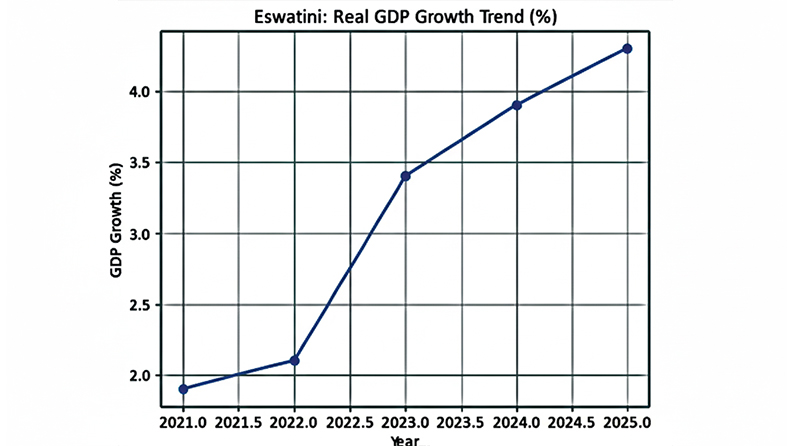
MBABANE – As 2025 draws to a close, Eswatini’s business sector has remained in a state of cautious expansion, shaped by domestic reforms, structural challenges, private sector dynamism and the evolving global economic dynamics.
Across sectors from investment and micro small and medium enterprises (MSMEs) to trade, financial markets, digital transformation and macroeconomic performance, 2025 has been a year of recovery, transition and strategic positioning.
The narrative that emerges is one of an economy balancing resilience against structural constraints while positioning for deeper integration into continental and global markets.
Broad Economic Performance and Macroeconomic Trends Real growth and economic recovery
Various national and international reports show that Eswatini’s economy expanded at a moderate pace in 2025. Quarterly indicators pointed to a rebound from earlier slowdowns with real GDP expanding in the middle of the year, supported by a recovery in manufacturing, construction and services.
Secondary and tertiary sectors were key drivers of this growth, offsetting contraction in primary sectors like forestry and mining.
International institutions have similarly projected modest, but meaningfully positive growth for the year. According to the International Monetary Fund’s (IMF) Article IV Consultation, real GDP growth was forecast to rise to approximately 4.3 per cent in 2025, a performance that would outpace average growth in the region under favourable investment and domestic capital deployment.
Inflation and consumer conditions
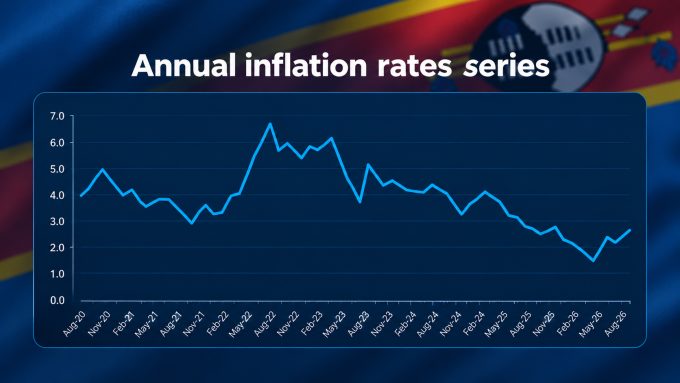
Inflation continued to ease through 2025, offering some relief to households and businesses alike. Reports indicated that consumer price inflation remained within the Central Bank of Eswatini’s targets, creating a more predictable planning environment for firms operating in local markets.
Fiscal and structural context
Despite these positive signals, structural strains persisted across the economy. The IMF and national quarterly analyses emphasised that Eswatini remains exposed to weak foreign reserve levels, low business credit uptake, and ongoing primary sector contraction.
These challenges reflect deeper structural constraints that could limit the sustainability of recent gains without accelerated reforms.
Investment and Business Environment Foreign Direct Investment (FDI)
One of the standout developments of the year was a marked rebound in foreign direct investment.
Data reported by this publication showed that FDI inflows surged by 215 per cent in 2024, with continued positive momentum expected into 2025.
This uptick places Eswatini among the faster-growing recipients of investment within the Common Market for Eastern and Southern Africa (COMESA), signalling renewed international confidence in the country’s investment climate.
Government investment promotion and job creation
Government efforts to attract investment translated into concrete outcomes.
Between April and June 2025, the Eswatini Investment Promotion Authority (EIPA) reported facilitating nearly 2 000 jobs from new and expanding firms, with commitments expected to generate tens of thousands more in the medium term.
This included repurposing idle factory shells into productive investments across textile and manufacturing sectors.
Additionally, major investor engagement events, such as Eswatini’s inaugural investor conference in Ezulwini, provided platforms to showcase pre-screened high-impact projects and engage global capital — an initiative that increasingly positions the kingdom as a viable investment destination within Southern Africa.
MSMEs and small business support
A central theme in 2025 has been the continued prioritisation of micro, small and medium enterprises as engines of job creation and inclusive growth. The government, in partnership with the United Nations Development Programme (UNDP), launched a national MSME policy early in the year.
This framework aims to formalise business operations, expand market access and integrate small firms into productive value chains, recognising that enterprise growth could drive significant employment gains, especially among youth.
International support also flowed through initiatives such as the EU-ITC supported inaugural MSME Conference, which brought regional expertise and visibility to the kingdom’s MSME sector development.
*Full article available in our publication















Leave a comment