

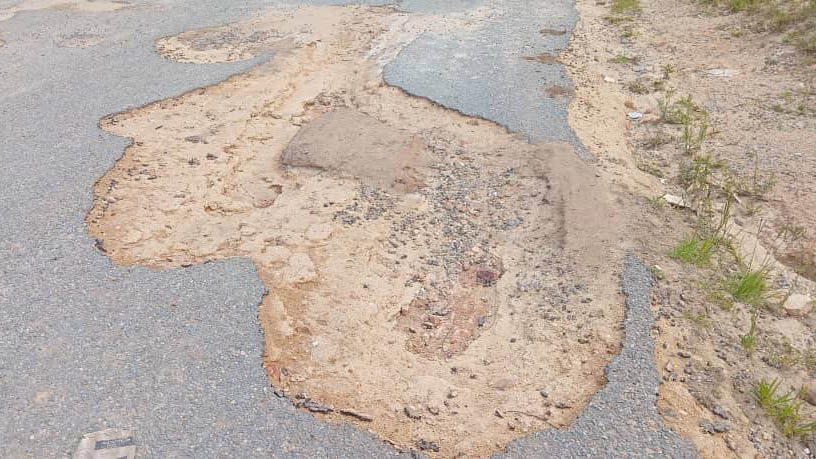
MBABANE – The contractor for the MR14 and MR15 roads has still not been announced, despite earlier indications that this would be done by the end of October 2025.
However, on November 7, 2025, a document was prepared indicating that the date of contract award would be December 15, 2025. In bidding terminology, the date of contract award refers to the official day on which a project owner (usually a government ministry or agency) formally grants a contract to a successful bidder or contractor.
Sources explained that this marks the point when the tendering or procurement process ends and the implementation phase begins. On this date, the winning contractor is usually notified in writing that they have been selected to carry out the project. It may also be the date from which the timelines, obligations and performance periods stated in the contract begin to apply.
In short, it is the date when the project officially moves from planning to execution.
MR14 and MR21 relate to the 105.9 km section of the Siphofaneni–Sithobelath–Maloma–Nsoko (MR14) and Maloma–Siphambanweni (MR21) roads. This is a project of the Government of the Kingdom of Eswatini, financed by the African Development Bank (AfDB).
Motivating the rationale for the road’s construction, government stated that these upgrades would reduce travel times and vehicle operating costs while boosting connectivity between agriculturally rich areas and other regions.
Moono Mupotola, the AfDB Country Manager for Eswatini, was quoted months ago as saying that the project would contribute to poverty reduction by creating jobs for the youth, adding that ‘this will be achieved through targeted vocational training and apprenticeship programmes’. This was reinforced by the Minister for Public Works and Transport, Chief Ndlaluhlaza Ndwandwe. Up to 200 jobs are expected to be created.
In an interview on Friday, Sandziso Malinga, the Communications Officer for the Ministry of Public Works and Transport, said the issue was still under process, following the necessary procedures and working within the ministry’s timelines to ensure satisfaction with the dictates of the evaluation report.
After that, Malinga said, government would be in a position to announce the company to be contracted to build the road. The date of contract award pertains to the civil works and the Environmental and Social Management Plan (ESMP) for the upgrading of MR14 and MR21.
The ESMP primarily refers to an Environmental and Social Management Plan.
It has been learnt that civil works in a road project refer to the physical construction activities and infrastructure development carried out on the ground during the project.
Research has shown that these include:
Site preparation – clearing vegetation, demolishing existing structures and levelling the ground.
Earthworks – excavation, filling, grading and compaction of the soil to form the roadbed.
Drainage systems – building culverts, stormwater channels and ditches to manage water flow.
Structures – constructing bridges, retaining walls and embankments.
Pavement works – laying the sub-base, base course and asphalt or concrete surface.
Ancillary works – installing road signage, guardrails, lighting and markings.
On the other hand, an ESMP is a detailed plan outlining how a road project will manage and mitigate potential environmental and social impacts during its design, construction and operational phases. It ensures that the project complies with national environmental laws and international standards, minimises negative effects on the environment (such as soil erosion, water pollution, noise and dust), also addressing social issues such as land acquisition, relocation, community safety and labour conditions.
*Full article available on Pressreader*



















Leave a comment