

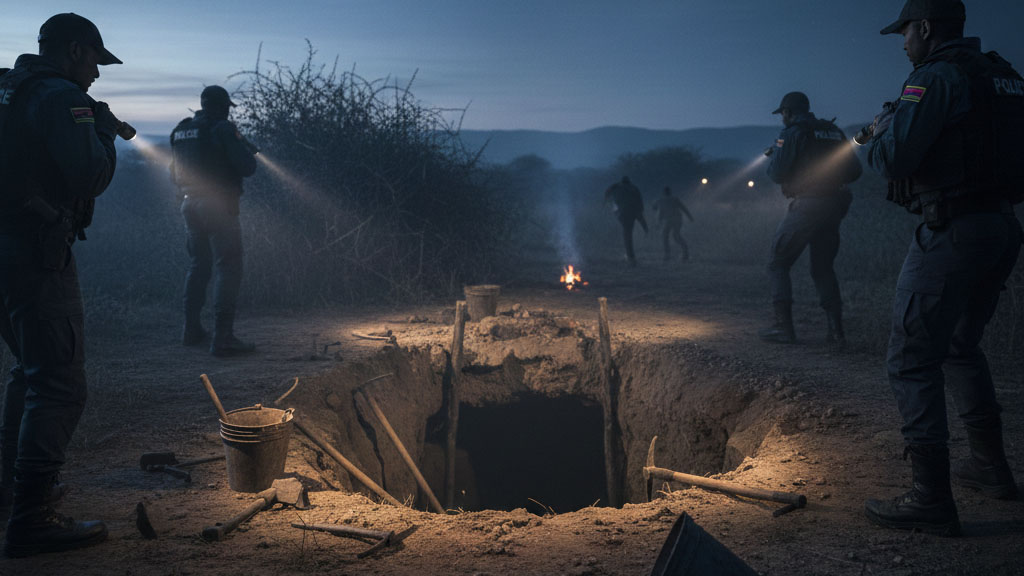
It is just before dawn when the police move in. Boots crunch against loose gravel, torches slice through the dark and somewhere underground, the muffled echo of metal striking rock freezes mid-swing. The Times of Eswatini recently placed readers at these very moments, raids on illegal mining hotspots in the north, where men scatter into the bush, tools abandoned, tunnels left yawning like open wounds in the earth.
On paper, these operations look small. A few suspects arrested. A shaft sealed. Equipment confiscated. Compared to industrial mining giants elsewhere on the continent, the country’s illegal gold operations may appear almost insignificant. But this is a dangerous illusion. Since illegal mining, even at a low scale, drains national resources in ways that are far costlier – and longer-lasting – than the gold extracted from beneath our soil. Illegal mining thrives on the myth of low cost. No licences. No environmental assessments. No taxes. No safety standards. Yet, it is precisely this informality that makes it extraordinarily expensive for the country as a whole. Every illegal shaft represents lost State revenue – money that never reaches public coffers to build roads, equip hospitals or fund rural development. Governments across Africa lose billions of Dollars annually to unregulated artisanal and illegal mining, according to international development and environmental agencies. Even countries with modest mining sectors are not spared; the proportional damage to their economies is often greater because public finances are already stretched thin. In Eswatini, where unemployment remains stubbornly high and public resources limited, the loss is felt more acutely. Police deployments themselves are costly — fuel, manpower, intelligence gathering and equipment all redirected from other pressing security needs. Each raid consumes State resources, only for illegal operations to quietly resurface weeks later, often a few kilometres away.
It is a treadmill of enforcement with no finish line. This reveals another uncomfortable truth: Illegal mining does not exist in isolation from the communities surrounding it. It is embedded in them. For some households, illegal mining has become a survival strategy – a dangerous one, but a necessary one in the absence of formal employment. Yet, the same activity that puts food on the table today steadily erodes the community’s future. Land is scarred and left unusable for farming. Water sources are contaminated. Young men disappear into hazardous shafts with no safety nets. International research shows this pattern repeating itself from West Africa to Southern Africa: Informal mining economies initially inject cash into communities, only to leave them poorer, sicker and environmentally degraded over time.
Perhaps, the most chilling aspect of Eswatini’s illegal mining story lies not in what can be seen, but in what cannot. A previous article exposed the rising use of mercury – a toxic substance quietly circulating alongside illegal gold mining. Mercury is used to bind gold particles during extraction, but its dangers are profound. Once released, it does not disappear. It lingers. Eswatini may not yet face mercury contamination on the scale seen in the Amazon Basin or parts of West Africa, but the warning signs are already here. And environmental damage, once done, does not respect borders, budgets or political terms.
Police raids are necessary. They signal that the State has not surrendered control of its natural resources. As long as poverty, unemployment and limited rural economic opportunities persist, illegal mining will continue to regenerate – quietly, stubbornly and at great cost. The real question Eswatini must confront is not whether illegal mining is criminal. It is. The question is whether the country can afford to keep fighting it only with handcuffs and barricades.
At the mine’s mouth, in the early hours of a police raid, it is easy to focus on the suspects running into the dark. Harder – but far more urgent – is confronting the deeper cost of what is being left behind. Long after the sirens fade, the holes in the ground – and in our national fabric – remain.

















Leave a comment