

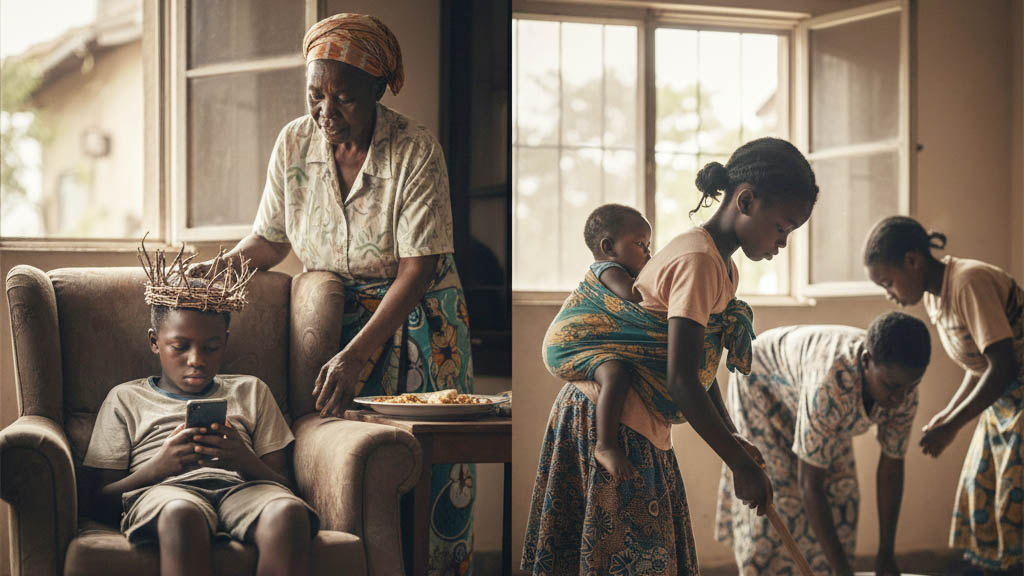
In many homes, the phrase ‘man of the house’ is spoken with pride. It is used to affirm a young boy’s importance, especially in households where the father is absent. On the surface, it sounds empowering. It suggests leadership, strength and responsibility, but in reality, in many cultural and social settings, this title comes without accountability. It often becomes a symbolic crown placed on a boy’s head while the real weight of responsibility is quietly carried by the women around him. This contradiction has consequences. When boys are raised to feel superior without being required to serve, contribute or self-regulate, they often grow into men who struggle with responsibility, emotional maturity and leadership. Meanwhile, girls raised in the same households are taught discipline, sacrifice and resilience from an early age. The imbalance shapes adulthood in profound ways.
Crown without weight: In many families, boys are given freedom that girls are not. They are excused from household chores. Their mistakes are laughed off as ‘boys will be boys.’ Their anger is tolerated. Their entitlement is normalised. They are told they are future leaders, providers and heads of households but they are also rarely trained in what those roles truly require. Being called ‘man of the house,’ sometimes, becomes more about authority than responsibility. The boy grows up expecting respect simply because of his gender, not because of his character. He may not learn emotional regulation because his outbursts are excused. He may not learn domestic skills because those tasks are labelled ‘women’s work.’ He may not learn accountability because someone else always cleans up his mess. When praise is given without discipline and status without service, the result is often an inflated ego without grounded competence.
Girl child’s different reality: In contrast, girls are frequently socialised to be helpful, careful and responsible. They are taught to cook, clean, care for siblings and manage emotions, sometimes at very young ages. They are warned about safety. They are told to be cautious, polite and modest. They are expected to mature quickly. While this upbringing can be burdensome and unfair, it often produces resilience, adaptability and emotional intelligence. Many women grow up accustomed to carrying both visible and invisible labour like organising, planning, nurturing and maintaining stability in the home. The imbalance becomes clear in adulthood. Women enter relationships already conditioned to manage responsibility. Some men, however, enter adulthood having been shielded from it.
From coddled boys to absent men: When boys grow up without learning accountability, the transition into adulthood can be problematic. Marriage requires partnership. Fatherhood requires sacrifice. Leadership requires decisiveness and emotional stability. These qualities do not appear automatically at age 30. They are built gradually from childhood. If a boy has never been taught to contribute to a household, he may struggle to share domestic responsibilities as a husband. If he has never been held accountable for his actions, he may struggle with commitment. If his emotional needs were always prioritised over others’, he may struggle with empathy.
This does not mean all men raised this way become irresponsible, but the pattern is visible: some grow into husbands who see provision as their only duty, absent fathers who mistake financial support for presence, or leaders who avoid hard decisions because they were never required to practice accountability. The world often continues to cushion them. Society frequently excuses male immaturity as ‘stress,’ ‘pressure,’ or simply ‘how men are.’ Meanwhile, women are expected to adapt, endure and compensate.
Impact on relationships, society: When men are not raised with responsibility, women often end up carrying emotional and practical burdens alone. This creates resentment, imbalance and burnout in relationships. It also affects the children who grow up witnessing unequal partnerships and may unconsciously replicate the same dynamics. Beyond the home, leadership suffers. Indecisive or emotionally immature leaders can create unstable workplaces and communities. True leadership requires humility, discipline and service which are traits that must be modelled and reinforced early in life.
Rethinking how we raise boys: The solution is not to burden boys unfairly, nor to diminish their confidence. It is to balance affirmation with accountability. Boys should be taught domestic skills, emotional intelligence and respect for partnership. They should learn that leadership is not dominance, but responsibility. They should see male role models who apologise, nurture and participate fully in family life. They should be corrected when wrong, not protected from consequence. They should be reminded that strength includes empathy and that authority requires service. At the same time, girls should not be overburdened with expectations of sacrifice. Equality in upbringing benefits everyone. The long-term health of families and communities depends on how we prepare children for adulthood. If boys are raised to expect privilege without effort, they may struggle when life demands maturity.

















Leave a comment