

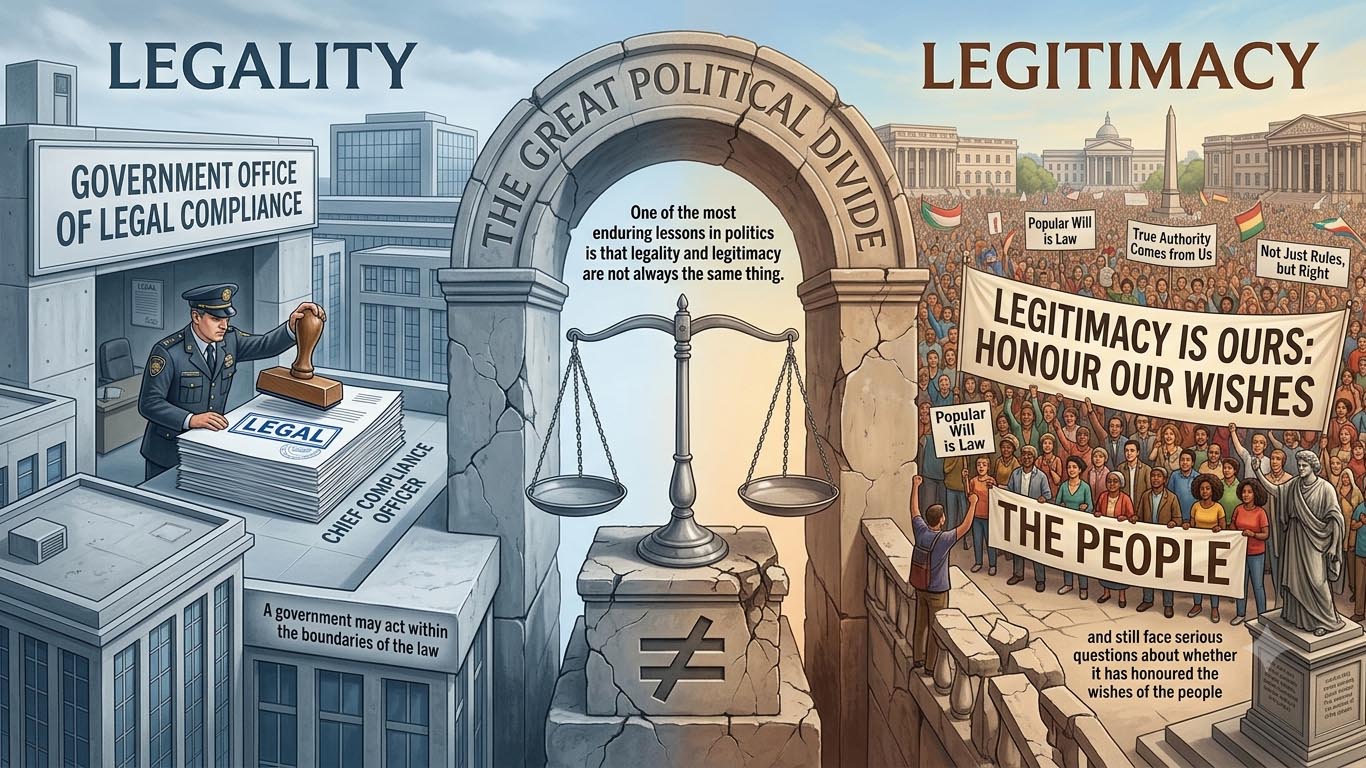
One of the most enduring lessons in politics is that legality and legitimacy are not always the same thing. A government may act within the boundaries of the law and still face serious questions about whether it has honoured the wishes of the people. That distinction sits at the centre of the growing debate in Zimbabwe following moves linked to extending President Emmerson Mnangagwa’s political future without first seeking the direct approval of voters through a referendum. Supporters of the move insist that everything has been done according to the law. Critics, however, argue that changing arrangements affecting the country’s highest office without consulting citizens directly weakens democratic participation. Into this heated debate stepped ZANU-PF Spokesperson Christopher Mutsvangwa, who reportedly dismissed opponents as merely ‘huffing and puffing’ during an interview on Newzroom Afrika.
Such remarks may energise party loyalists, but they do little to address the substance of the concerns being raised. In fact, they risk deepening public frustration. Citizens who question constitutional or political changes are not necessarily enemies of the State, nor are they simply making noise. In a democracy, scrutiny is not a nuisance. It is an essential safeguard.
The argument from those defending the decision is straightforward. If the law allows Parliament to make certain constitutional amendments, then there is no requirement for a referendum. On paper, that position may be correct. Laws exist for a reason and governments are expected to operate within them.
Still, politics is not conducted on paper alone. When decisions affect leadership, presidential terms or the future direction of a nation, many citizens understandably expect to have a direct voice in the process. The absence of that opportunity inevitably invites questions, regardless of whether the procedure followed is technically lawful.
History offers many examples where leaders relied on legal arguments while overlooking public sentiment, only to discover that legality could not shield them from political consequences. Citizens often judge decisions not simply by whether they are permitted, but by whether they are fair.
The concern here extends well beyond Zimbabwe. Across Africa and other parts of the world, debates over presidential tenure have repeatedly tested democratic institutions. Some leaders have sought constitutional amendments to remain in office longer. Others have pursued legal pathways that critics viewed as contrary to the spirit of democratic governance. In several cases, these actions triggered protests, political instability and lasting divisions.
That does not automatically mean every constitutional amendment is wrong. Constitutions are living documents and can be amended when circumstances require it. A referendum is not a perfect instrument. It can be expensive, divisive and vulnerable to misinformation. Nevertheless, it remains one of the clearest ways of obtaining direct public consent on matters of national importance. When governments choose not to use that route, they should expect vigorous debate rather than unquestioning acceptance.
This is why dismissing critics as people who are simply ‘huffing and puffing’ is unhelpful. The phrase suggests that objections lack substance and that those raising concerns are acting irrationally. Yet many of the voices questioning the move include legal scholars, civil society organisations, opposition figures and ordinary citizens. They may be right or wrong in their conclusions, but they deserve to be heard.
Strong democracies are built on engagement, not ridicule. Leaders and governing parties strengthen their own credibility when they respond to criticism with facts, reasoning and openness. Conversely, dismissive language can create the impression that public concerns are being brushed aside rather than addressed. There is also a broader principle at stake. Political power ultimately belongs to the people. Governments exercise authority on behalf of citizens, not the other way around.
Zimbabwe’s leaders may genuinely believe they are acting within both the letter and spirit of the law. Their supporters may regard the criticism as politically motivated. Those perspectives are part of democratic discourse. What is troubling, however, is the suggestion that citizens who question the process should simply be ignored because the legal boxes have been ticked.
The health of a democracy cannot be measured solely by what is permitted in legislation. It must also be measured by the extent to which citizens feel respected, included and heard. A government confident in its position should have little fear of robust public debate. Whether one supports or opposes the move, one point remains difficult to dispute. Decisions affecting the presidency are among the most consequential a nation can make. In such circumstances, citizens are entitled to ask questions, seek explanations and express disagreement. That is not huffing and puffing. ‘It is democracy in action’, when such happens; even former South Africa President Zuma once said, at the height of State capture, when he was asked how he feels about other parties and organisations taking him to court. The challenge for Zimbabwe is not merely to prove that the process is lawful. It is to persuade citizens that it is legitimate and fair.
















Leave a comment