

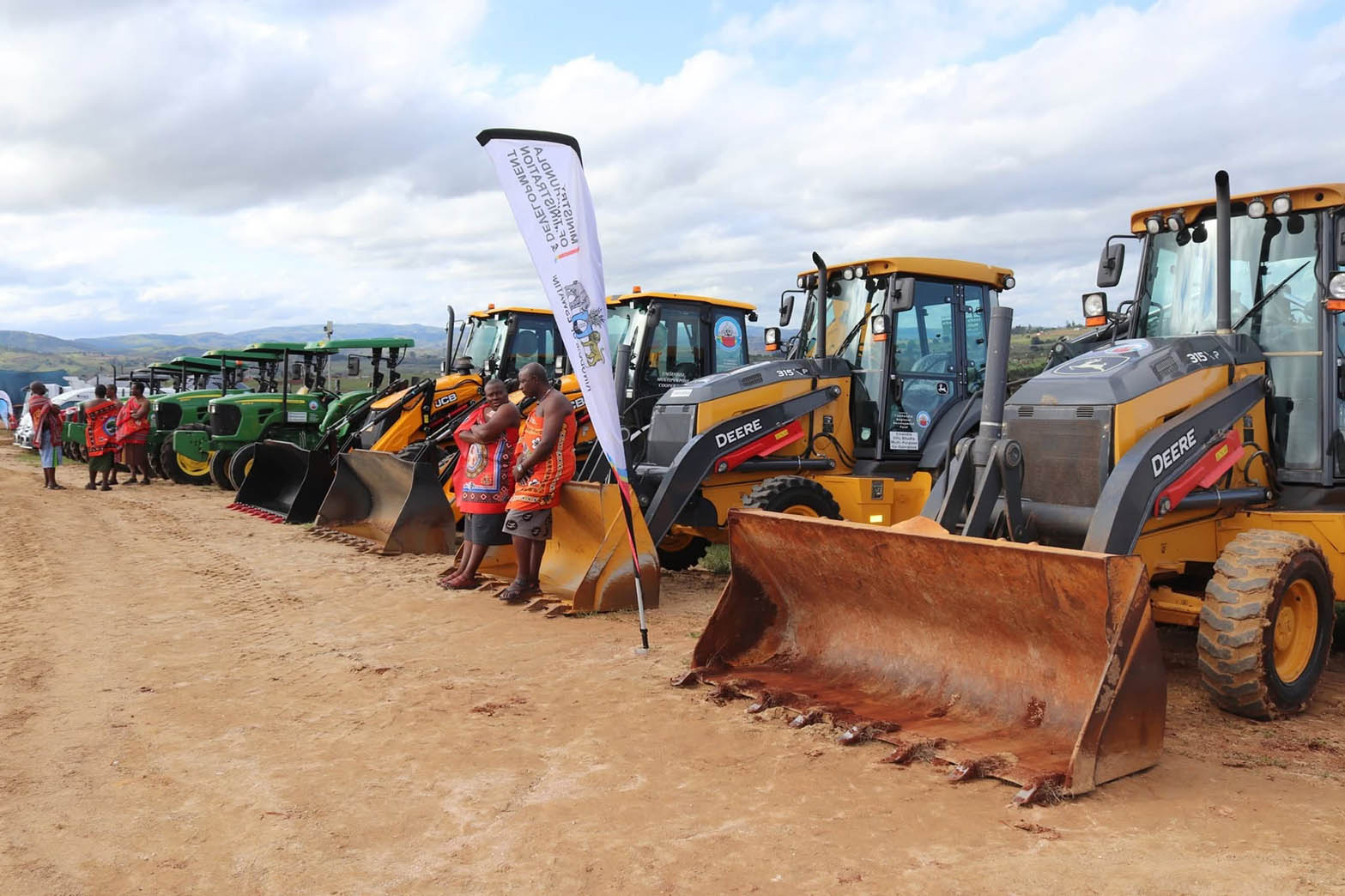
MBABANE – Government projects valued at about E600 million have stalled amid slow cash flow.
This has affected contractors, workers and service delivery across the country.
The money had been approved for the projects but it apparently exists on paper. Contracts have been awarded but the budget does not have money to finance the projects. It must be said that work had started on most of them.
However, in projects spread across government, the flow of money has not kept pace with the work that was expected to be done. The result is a growing backlog of unfinished projects, contractors waiting for payment and workers who depend on those contractors for their livelihoods finding themselves without income.
The projects affected include schools, roads, water infrastructure and livestock dipping tanks. The Microprojects Programme undertakes dipping tank projects on behalf of the Ministry of Agriculture, making the reported financial difficulties a concern not only for infrastructure delivery but also for livestock farmers who depend on the facilities.
For communities, the financial problems at Microprojects are ultimately about more than government accounts.
They are about services. Residents said they are waiting for classrooms because they want pupils to learn in better facilities, while cattle owners are waiting for the speedy completion of the construction of the livestock dipping tanks. Some communities are said to be waiting for better roads or easy access to schools as the rainy season approaches.
Some residents said projects in their communities should have been completed by now. This was noted particularly regarding classrooms, adding that they were hopeful that since schools were closed, contractors could use the holiday to their advantage and work before the pupils arrive. Through inside sources, the Times SUNDAY has established that the projects affected by the cash flow challenges are valued at over E600 million.
Many of these projects are under the Microprojects Programme, a semi-autonomous unit within the Ministry of Economic Planning and Development. However, the problems are not confined to the Microprojects Programme.
It has been learnt that they extend to government capital projects involving several ministries and entities, including the Ministries of Health, Education and Training, Economic Planning and Development, Defence, as well as Labour and Social Security. Further, entities such as the Rural Development Programme, Royal Eswatini Police Service (REPS) and His Majesty’s Correctional Services (HMCS) have also been affected.
The disruption has also affected projects under the Ministry of Public Works and Transport, which is responsible for overseeing massive projects including the construction of major roads. The crisis is said to have left contractors unpaid, officials unable to travel to sites and communities waiting for projects that should already be complete.
In particular, this situation is reportedly affecting the ability of the Microprojects Unit officials to conduct site inspections, with officials struggling even to buy fuel for vehicles, making it difficult to travel to communities where projects are being implemented.
The Microprojects Programme oversees projects with a value totalling hundreds of millions of Emalangeni. It has overseen the construction of massive projects from tinkhundla centres to health facilities such as state-of-the-art clinics. Further, other projects include the construction of water supply systems ranging from E20 million to E30 million per project.
The programme implements community demand-driven projects and capital projects for government ministries and departments. Its mandate covers education facilities, clean and safe water, rural electrification, agriculture, health and social welfare, low-level bridges and footbridges.
This means delays at Microprojects do not affect just one type of infrastructure. They can affect projects touching on everyday life in rural communities. The programme has already been facing concerns over funding. In March, MPs called for its budget to be increased to E1 billion, arguing that this unit is crucial to community development.
The reported cash flow crisis is particularly significant because of the scale of Microprojects’ mandate. The programme does not simply build one type of infrastructure. It works across sectors and implements projects for different Government ministries and communities.
Also, Microprojects oversees other ventures such as income-generating projects in various constituencies.
The Ministry of Economic Planning and Development’s performance report states that Microprojects implemented 154 community projects estimated to benefit 71 856 people, as well as 905 capital projects, during the period covered by the report.
The figures illustrate the extent to which the programme is involved in development activity. Its role places it at the centre of government’s efforts to deliver smaller-scale infrastructure to communities.
The National Development Plan also lists the Microprojects Coordination Unit among the units of the Ministry of Economic Planning and Development, with responsibility for Micro-Projects.
The Minister for Tinkhundla Development and Administration, Sikhumbuzo Dlamini, was also called via his cellphone but there was no reply.
Also, attempts were made to reach the Minister for Finance, Neal Rijkenberg. His cellphone also rang unanswered. Both cellphones rang unanswered. There were no responses from the ministers at the time of going to press.
Principal Secretary (PS) in the Ministry of Public Works and Transport, Thulani Mkhaliphi, believes better communication in future could help solve the cash flow crisis.
He also confirmed that even under his ministry, there are some projects which have stalled and that some were progressing slowly for the same reason.
Among them were the Lugaganeni/Ekukhanyeni roads and the Maloma/KaHlatsi Highway. Mkhaliphi said the projects were expected to commence this week. But the explanation he gave for the delays points to a problem that is larger than government simply not having money.
He said there had been slow cash flow, meaning projects were not progressing as they were supposed to. At the same time, he said the major problem was not necessarily that government did not have money.
Instead, he pointed to poor communication between relevant departments and contractors, as well as a mismatch in the way projects were being coordinated. The problem, he explained, was that many projects were not aligned with available cash flow. This meant several projects could reach the stage where they required substantial payments at the same time.
Mkhaliphi used E2 billion as an example of what could happen if projects were not properly coordinated. He stressed that the E2 billion was an example figure. The point was that if a large number of projects reached major payment stages simultaneously, they could collectively demand an amount of money that was not immediately available. The result is a bottleneck; projects wait, contractors wait and workers wait.
















Leave a comment