

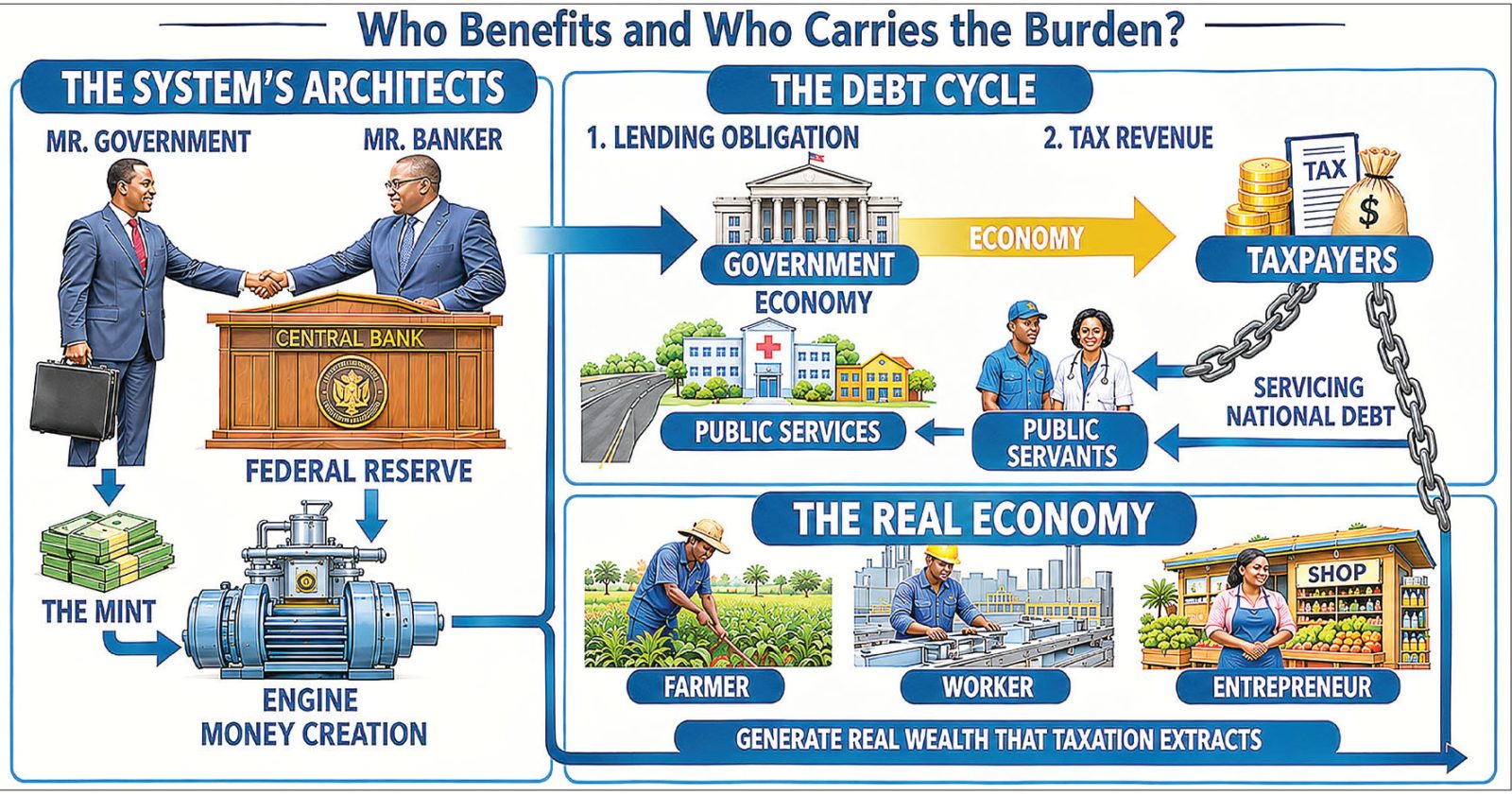
To sustain the illusion that government exists entirely to serve the people, we must first understand the structure behind the system.
While Mr Government maintains the appearance of authority, Mr Banker builds the engine that keeps the system running.
With the help of his brother, he establishes institutions such as central banks, the Federal Reserve in the United States, the Bank of England in the United Kingdom and similar institutions elsewhere. Then there is another institution, the mint, which produces physical currency.
Together, these institutions help create and manage the medium through which modern economies operate. Mr Government needs money to pay public servants, build roads, provide healthcare and run the State. So he turns to Mr Banker.
And this is where the game truly begins. Mr Banker does not simply hand over a pile of existing wealth. Modern banking systems can create new money through lending. Government borrowing then creates an obligation to repay the principal together with interest.
Imagine, for simplicity, that US$1 million is borrowed. The government does not just receive US$1 million and walk away. It assumes a larger obligation once interest and other costs are included.
This is where language becomes important. We call it ‘national debt’. The term sounds technical and distant, but ultimately the obligation is carried by the State and, therefore, by the taxpayers who finance it.
The government pays salaries and contractors. That money enters the economy and changes hands many times. But eventually, government takes a significant portion of economic activity back through income tax, VAT, duties, levies and other forms of taxation.
The justification is straightforward: Government needs revenue to meet its obligations, including servicing public debt. But where does tax revenue ultimately come from?
It comes from people who work, businesses that produce, farmers who grow, entrepreneurs who take risks and consumers who spend. It comes from real economic activity.
This is why the debate about money and debt matters. Financial systems can create purchasing power, but human beings still have to produce the goods and services that give an economy its real capacity.
Why do people accept the system?
Partly because they believe they have no alternative. Failure to comply with tax laws can bring penalties. More importantly, people are taught that contributing through taxation is part of their responsibility to society.
Compliance, therefore, does not depend on force alone. It is also maintained through law, institutions and social conditioning.
And Mr Banker does not stop with government.
The same financial system reaches into the lives of ordinary people.
A person wants to buy a home but does not have US$100 000. A bank may create a deposit through lending and provide the financing. The borrower then spends years repaying the principal and interest.
The bank receives its return. The borrower provides the collateral and, most importantly, years of future income. This is where the language of ‘debt slavery’ enters the debate.
It does not mean that borrowers are literally slaves. It describes a condition in which people can become heavily dependent on debt and spend a substantial part of their working lives servicing financial obligations.
The system is complex in its mechanics, but simple in its consequence: Financial institutions create and allocate purchasing power, while ordinary people create the goods, services and labour that sustain the real economy.
The question, therefore, is not simply whether the system works.
The deeper question is: Who benefits most from the way the system is designed, and who carries the greatest burden when it fails?
Do we understand the game we are playing, or have we become so accustomed to its rules that we no longer question them?
John

















Leave a comment