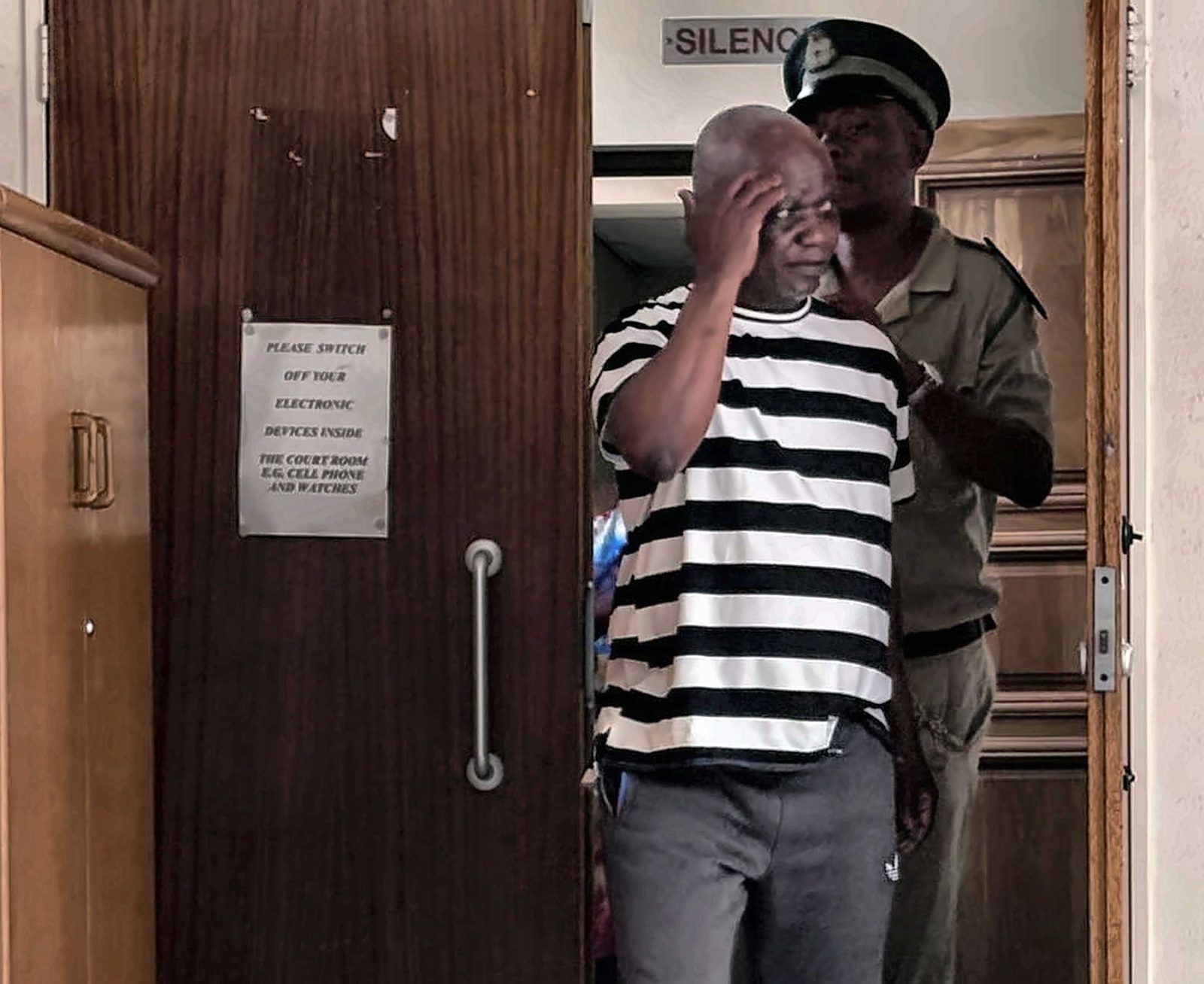
MBABANE – A businessman, who chased his teacher wife into the bathroom before shooting her at close range in the forehead, has been sentenced to 20 years imprisonment without the option of a fine.
Vusi Mkhumbuzi Dlamini, who was convicted of murdering his wife, Nokuthula, was sentenced by High Court Judge Justice Mavuso.
The deceased was a teacher at Othandweni Primary School, while her husband was a businessman with interests in the public transport sector. The couple were legally married, but had experienced marital disputes, which had previously brought them to the attention of the Domestic Violence Section at Nhlangano Police Station.
Dlamini was also sentenced to five years imprisonment without the option of a fine for unlawfully possessing an Astra 7.65mm semi-automatic pistol, Model 3 000, which was used in the killing. The sentence will, however, run concurrently with the 20-year imprisonment term for murder. In determining the sentence, Judge Mavuso found that there were extenuating circumstances surrounding the murder, including the absence of evidence that the couple had quarrelled before going to sleep on the night of the incident. The judge also noted that there was no evidence that Dlamini knew his wife had woken up and gone to the toilet. Furthermore, there was no allegation that he had planned the killing beforehand. The court considered these circumstances together with the fact that his conviction was based on dolus eventualis, meaning that he foresaw the possibility that his actions could result in death, but proceeded regardless.
The murder occurred on October 24, 2019, at Ngwenyameni in the Shiselweni Region. During the trial, Dlamini maintained that he had mistaken his wife for an intruder and shot her while pursuing the person he believed had attacked him.
However, Judge Mavuso rejected his explanation, finding that he had chased his wife into the bathroom before shooting her at close range. The court heard that on the evening of the incident, Dlamini returned home at approximately 10pm after spending time playing snooker at a bar with his brother, Bheki, and his son, Menzi.
He testified that he initially sat in the sitting room before his wife asked him to accompany her to the bedroom. According to his version, they argued over a motor vehicle which she wanted to use but he refused to give her.
He claimed that as he was leaving the bedroom, his wife threw a blanket over him, resulting in a struggle. He said he managed to escape and returned to the sitting room.
Dlamini further testified that he believed people were expected to attack him and consequently retrieved a firearm he had hidden under the sofa, placing it beside him before falling asleep.
He alleged that someone struck him on the ear while he was sleeping, causing him to roll over the sofa. He claimed that the person ran towards the passage and that he pursued the individual before firing a shot as the person was about to enter the bathroom. According to his account, he only discovered that he had shot his wife after returning to the sitting room to retrieve his mobile phone and using its light to establish what had happened. He said he contacted his brother and son, instructing them to report the incident to the police, before leaving for South Africa.
However, the court found inconsistencies in this explanation. Judge Mavuso noted that if Dlamini had shot his wife before she entered the bathroom, as he claimed, her body would probably have been found outside the room.
Instead, police officers found her body lying across the bathroom doorway, in a pool of blood. The investigating officer observed a large wound on her forehead, with blood also visible at the back of her head. The post-mortem examination established that she died from a firearm injury, while the ballistics expert confirmed that a fired round recovered from her brain had been discharged from the Astra pistol examined in connection with the case.
The court also considered evidence from the scenes of crime officer and the post-mortem report, which recorded faint soot particles on the deceased’s forehead. Judge Mavuso found that this established that she had been shot at close range. The judge further questioned Dlamini’s claim that he had been expecting intruders, particularly because there was no electricity at the homestead and he had allegedly pursued the supposed intruder in darkness.
The court also considered the couple’s history of marital disagreements. Detective Constable Xolani Ntshangase, who was stationed at the Domestic Violence Section at Nhlangano Police Station, testified that the couple frequently visited the police station over their marital problems. Dlamini had previously appeared in court for assaulting his wife in a matter registered under docket number 501/2019. The charge was subsequently withdrawn after the deceased withdrew her complaint. “Among their disagreements were complaints by the accused that his wife did not want the children he had from previous relationships. He also accused her of failing to honour an undertaking to pay electricity bills and instead arranging an illegal electricity connection that bypassed the meter,” the court heard.
In his sentencing judgment, Judge Mavuso considered Dlamini’s personal circumstances. He was 54 years old when the offence was committed, had nine children, two of whom were attending school, and was responsible for their maintenance and upkeep.