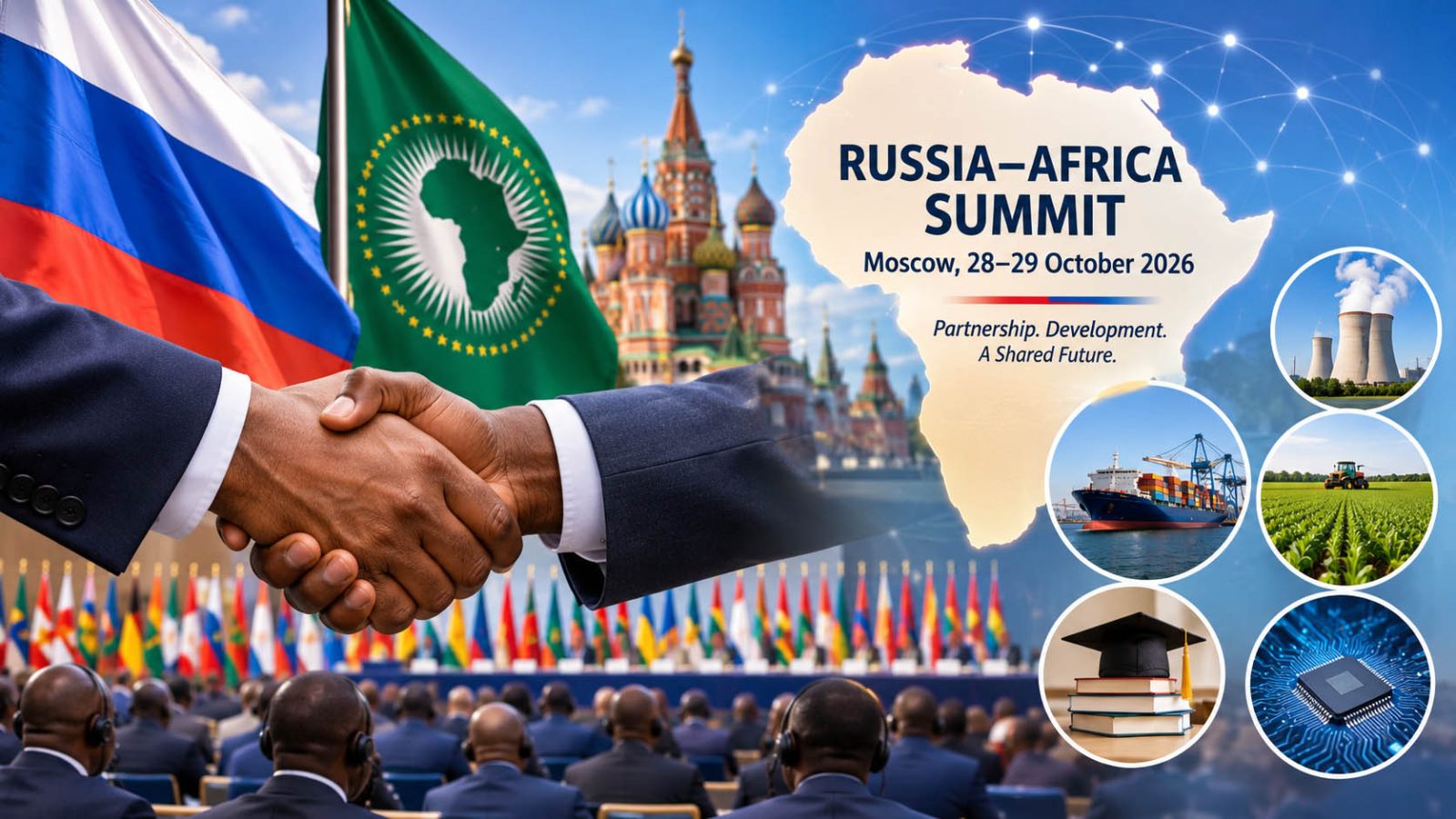
The Third Russia-Africa Summit, held in Moscow on October 28 and 29, 2026, was about considerably more than diplomatic handshakes and leaders posing for photographs. Beneath the discussions of trade, development, and international cooperation lay a bigger conversation about who gets to influence Africa’s future, who controls its resources and where the continent intends to position itself in an increasingly divided world.
With representatives from 48 African countries, including 22 heads of State and government, the summit was an important indication of Russia’s determination to deepen its relationship with the continent. But what exactly was discussed and why should an ordinary African, including someone sitting in Eswatini, pay attention?
One of the most interesting developments was Russia’s push to present itself as an alternative to traditional Western partners. President Vladimir Putin argued that Russia offered Africa a relationship based on equality and mutual benefit, contrasting this with what he described as Western exploitation of African resources. This argument is politically significant because it speaks to a long-standing African frustration: A continent rich in minerals, agricultural land and other natural resources but still struggling with poverty, unemployment and dependence on foreign economies.
Russia wants to occupy a bigger space in this conversation. It is pursuing stronger relationships in defence, energy, agriculture, technology and infrastructure. Putin also reported that Russia-Africa trade had exceeded US$27 billion (E451 billion) in 2025, although this remains relatively modest compared with Africa’s trade with other major economic partners. Among the discussions with potentially far-reaching consequences was cooperation in nuclear energy. Russia is positioning itself as a major partner for African countries seeking to expand electricity generation. Through its state-owned nuclear corporation, Rosatom, it has been pursuing nuclear cooperation agreements across the continent.
Discussions
Ghana’s announcement on Saturday that Russia had agreed to work with it on developing a proposed 2 000-megawatt nuclear power plant illustrates how discussions at the summit could translate into individual country projects. Ethiopia and Burundi have also expressed interest in nuclear cooperation.
Russia’s influence is not limited to military cooperation and political relationships. Its position as a supplier of wheat and fertilisers makes it an important player in Africa’s food security. When fertiliser prices rise or grain supplies become disrupted, the consequences eventually reach ordinary households through food prices and the cost of agricultural production. Another interesting aspect was the attention given to educational exchanges, Russian-language programmes, journalist training and cooperation between African and Russian media organisations. The summit also adopted a separate declaration on cooperation in civilian artificial intelligence. These may appear to be softer areas of diplomacy, but they are important instruments of long-term influence. Scholarships, university partnerships, media exchanges and technology programmes create relationships that can shape how future generations understand Russia and engage with its interests.
Russia is not simply seeking African markets. It is investing in relationships that can extend into institutions, professional networks and public discourse.
Perhaps the most politically important discussion concerned reform of international institutions, particularly the United Nations Security Council, where African representation remains inadequate.
Russia expressed support for permanent African representation and closer coordination on reforming international financial institutions such as the International Monetary Fund (IMF) and the World Bank.
There were also discussions about colonial reparations, the return of African cultural artefacts and opposition to unilateral sanctions. These are issues that resonate beyond the countries represented in Moscow. They touch on Africa’s historical grievances and its continuing struggle to have greater influence over decisions affecting its people.
However, there is another side to this growing relationship. Russia’s expanding military and security partnerships, particularly in parts of the Sahel, have raised questions about the political and security consequences of its involvement. Its growing influence should therefore be examined alongside the interests of African governments and the long-term implications for regional stability.
The summit adopted a new Russia-Africa Partnership Forum Action Plan covering 2027 to 2029. This is important because it moves the relationship beyond diplomatic declarations towards an organised programme of cooperation. But perhaps the biggest lesson is that Africa is increasingly becoming an important destination for competing global powers. For ordinary Africans, understanding these developments matters because international politics eventually finds its way into electricity bills, food prices, employment opportunities, education and national security.
Eswatini may not have been at the centre of every conversation in Moscow, but it exists within the same geopolitical environment. What happens to Africa’s trading relationships, security arrangements and access to technology affects the development choices available to every African country. Russia’s growing influence is, therefore, neither something to celebrate uncritically nor something to dismiss automatically.