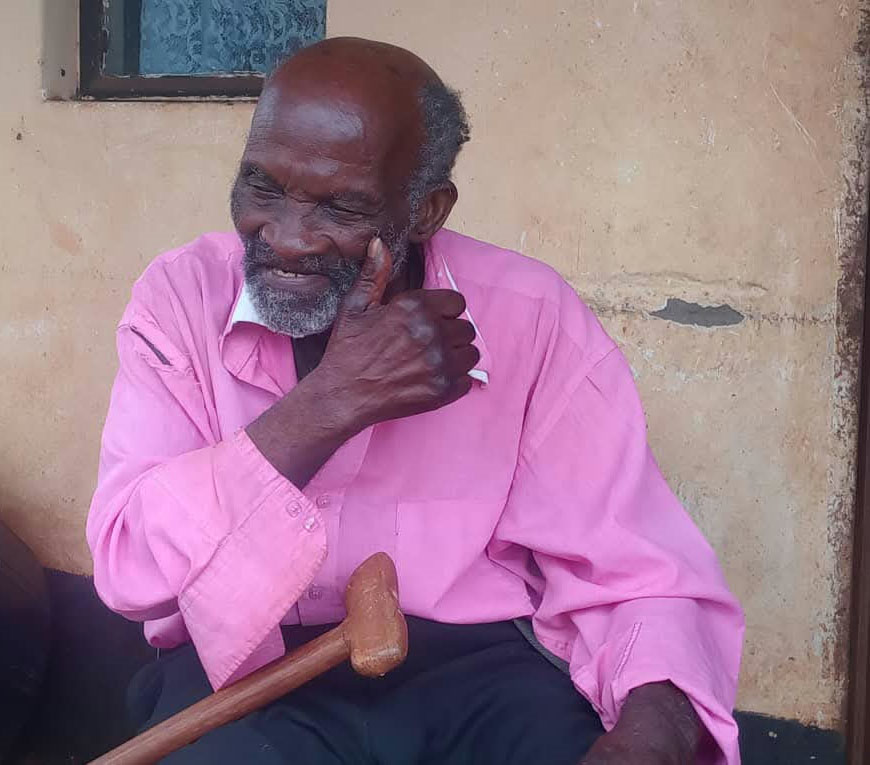
Nhletjeni – Mkhulu Samuyeli Dlamini, (105), is troubled by men who kill women over failed relationships.
At an age when many people would struggle to recount events from their distant past, 105-year-old Samuyeli Dlamini remembers how young men in his generation handled romantic disagreements, including infidelity and competition over women.
His recollections have led him to question why some young men today resort to killing women when relationships end or when they discover that their partners have been unfaithful. Affectionately known as Mkhulu Samuyeli, the Nhletjeni patriarch believes that neither infidelity nor the breakdown of relationships is a new phenomenon. Instead, he said such experiences have existed during his youth, yet the way men responded to them was very different.
According to him, disagreements involving two men interested in the same woman would sometimes result in physical fights. However, he recalled that the intention was not to take another person’s life.
He said the man who emerged victorious would eventually earn the respect of the other, who would also receive assistance in cleaning his wounds. “Once one person was beaten down, the principle was that you would then assist him in washing the blood and from there, he would respect you,” he recalled.
The centenarian said he was particularly disturbed by reports of young men killing women after relationship disagreements, questioning how a romantic relationship could be sufficient reason to take another person’s life.
Observation
His observations come against the backdrop of persistent gender-based violence (GBV) in Eswatini, where killings linked to domestic and intimate relationships continue to claim lives. This publication can reveal that figures recently presented by the National Commissioner of Police Manoma Vusi Masango during the National Gender-Based Violence Indaba in June 2026, showed that police recorded 1 994 GBV cases between January and March 2026.
The figures were reported by the Royal Eswatini Police Service and highlighted the extent to which violence continues to affect families and communities across the country.
January to March 2026: 22 people reportedly died in GBV-related incidents, including 16 women and six men. Seven of the deceased were children under the age of 17.
2025 police figures: 25 family dispute-related murders and 17 passion killings.
UNFPA study: 145 intimate partner femicides between 2009 and 2022, about 10 women a year.
Infidelity
The figures provide a contemporary context to Mkhulu Samuyeli’s observations about how society has changed in the way men respond to romantic disputes.
Most interestingly, Mkhulu acknowledged that infidelity had always existed, though he maintained that the present situation was particularly worrying.
He also spoke about the importance of understanding the responsibilities that come with entering relationships, particularly when marrying women who have children from previous relationships.
According to him, young people should receive proper guidance on how to approach such relationships to avoid conflicts that can affect families.
He further cautioned young men against demanding gifts they had purchased for their girlfriends after relationships ended, arguing that the termination of a relationship should not become an excuse for disputes over material possessions.
On another note, he urged young people preparing for marriage to pay attention to relationship teachings, specifically recommending programmes presented by Reverend Johannes Mazibuko on radio.
His observations also extended to the relationship between men and their wives during his working years in Johannesburg. He recalled that men who travelled to the mines understood the importance of respecting their marriages, despite spending extended periods away from their families.
Although he acknowledged that infidelity was not entirely absent during those years, he said long-distance relationships were approached differently.
Mkhulu Samuyeli was speaking during an interview with Eswatini News at his home at Nhletjeni, Shiselweni Region, where he was found resting while holding a carefully crafted, brown-polished wooden knobkerrie.
Despite recently celebrating his 105th birthday, he made his way out of the house without assistance before asking his son, Stephen Dlamini, to explain who had come to visit.
Once informed, he welcomed the visitors and spoke extensively about his experiences, demonstrating a remarkable ability to recall events from his childhood and working years.
He said he was aware that he could be among the oldest living people in the country, or even the oldest, explaining that most people with whom he grew up had since died.
He expressed a desire to continue living, despite acknowledging that some people would not necessarily wish to reach his age. His son, Stephen, is a retired teacher who once served within the ministry of the late Deputy Prime Minister Albert Heshane Shabangu.
Education is greatest gift I ever gave my children – mkhulu
Nhletjeni – A painful encounter in Johannesburg’s mines convinced Mkhulu Samuyeli his children deserved better. Mkhulu, when asked if he got an opportunity to attend school, said he never did, apart from a few classroom lessons that enabled him to acquire basic reading and writing skills, including reading parts of the Bible and writing his name.
However, he shared how his experience in Johannesburg changed his understanding of education and the opportunities it could provide.
He recalled travelling to the mines with a man from Mahamba whom he knew only by his surname, Kunene. After securing employment, he said he never saw him despite frantic efforts to locate him within the mine compounds.
However, when they eventually met again, he discovered that Kunene had been promoted to reading the names of miners reporting for duty before they descended underground. He would also read the register when workers knocked off.
The responsibility marked a change in Kunene’s working position, something Mkhulu Samuyeli attributed to his ability to read.
The experience, he said, left him disappointed as he realised that his limited education had placed him at a disadvantage in the workplace. He subsequently made a commitment that his children would not encounter the same difficulties.
He said he ensured that all his children attended school, with some eventually becoming teachers. His son Stephen, who sat beside him during the interview, is a retired teacher while some of his children pursued different career paths.
Colonial rule still
remains a painful chapter
Meanwhile, Mkhulu Samuyeli also narrated the period when land ownership changed under colonial administration, leaving communities dispossessed. He said white settlers acquired large portions of land and subsequently declared them private farms, despite his understanding that much of the land had originally been Eswatini National Land (ENL). He recalled that the settlers presented the properties as privately acquired land after taking control of them. Nhletjeni was among the areas where he remembered white settlers establishing themselves.
Though he did not mention it, a white family, the Vyff family (Ka-Fyf as it is commonly known), acquired a considerable stretch of land within his community. Remnants of the family’s former homestead remain, while the locality continues to be associated with the name Ka-Vyff.
The elderly described colonialism as one of the most difficult periods experienced by emaSwati, particularly because of the manner in which land was taken from communities.