

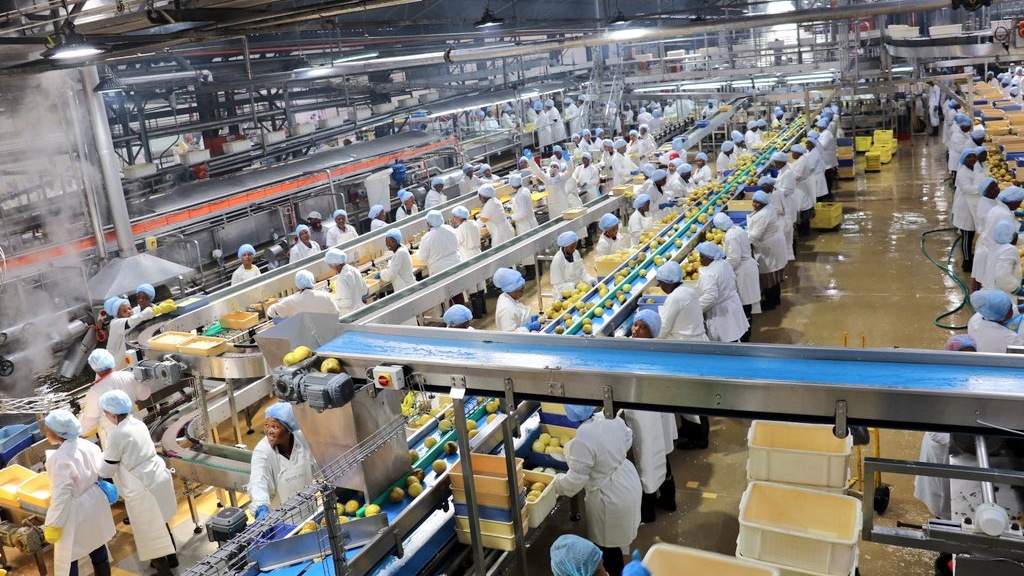
MBABANE – Fruit juice and apparel led Eswatini’s export boom to the United Kingdom in May 2025, helping the country record a strong trade surplus.
According to the latest data from the Observatory of Economic Complexity (OEC), fruit juice generated E2.4 million, non-knit men’s suits earned E1.6 million and other non-knit clothing accessories brought in E947 050 during the month.
The surge in these key export products pushed Eswatini’s total exports to the UK up to E5.8 million, a sharp 154 per cent increase from E2.3 million recorded in May 2024. At the same time, imports from the UK fell by 39.4 per cent to E2.2 million, down from E3.7 million a year earlier.
The result was a positive trade balance of E3.6 million for May 2025, highlighting the strength of Eswatini’s export performance in a challenging global trade environment.
The year-on-year growth was driven entirely by fruit juice and textiles, each recording a 100 per cent increase. The trend underscores the growing demand for Eswatini’s agro-processing and garment products in high-value international markets such as the United Kingdom. It is worth noting that Rhodes Food Group (RFG), populary known as Swazi Can exports Pineapple, Citrus (white grapefruit and Red grapefruit) juice concentrate to the UK.
Latest data indicates that the leading agro-processing firm exports in 205-litre drums to juice processors who then process it into finished products, which are found on retail shelves.
On the import side, hard liquor remained the leading category at E1.45 million, followed by computers (E371 300) and cars (E329 000). However, imports of cars dropped by 100 per cent compared to last year, while hard liquor imports fell by nearly 30 per cent.
Hard liquor, also known as distilled spirits or liquor, is an alcoholic beverage produced by distilling fermented grains, fruits, or vegetables. This process concentrates the alcohol content, resulting in a higher alcohol by volume (ABV) compared to beverages like beer or wine, which are produced by fermentation alone. Common examples include whiskey, gin, rum and vodka.
The latest data also comes at a time when a landmark announcement was made on July 10, 2025, where the UK Government unveiled upgrades to its Developing Countries Trading Scheme (DCTS), with the intention of simplifying access to the UK market for developing nations.
Eswatini, along with 64 other countries, stands to benefit from enhanced trade access, tariff-free exports and targeted support in meeting international trade standards.
The reform package, which comes as part of the UK’s broader Trade for Development offer, is designed to deepen economic partnerships with African countries and accelerate inclusive global growth. This latest move is expected to strengthen Eswatini’s export potential and stimulate job creation in key local industries.
Among the most impactful changes is the introduction of simplified rules of origin. These allow DCTS member States, including Eswatini, to use raw materials and components sourced from across the African continent, while still qualifying for duty-free access to the UK market.
Full details in today’s copy.



















Leave a comment