

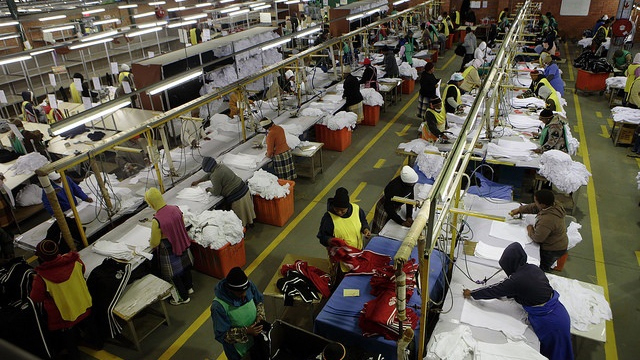
MBABANE – The World Bank has warned that Eswatini’s textiles and apparel industry could be among the most affected in Sub-Saharan Africa by escalating global trade tensions.
In its latest Africa’s Pulse report, released this month, the bank says new tariff and non-tariff measures by the United States and its trading partners have created fresh uncertainty for export-oriented industries linked to global supply chains.
According to the report, the resetting of US reciprocal tariffs on August 1, 2025 resulted in lower rates for African exporters than originally signalled in April, yet the outlook remains fragile.
Even though Sub-Saharan Africa’s overall trade with the US is smaller than with Europe or China, the World Bank highlights that textiles and apparel producers in Eswatini, Kenya, Lesotho, Madagascar and Mauritius face particular vulnerability.
“The risk is not confined to headline tariffs,” the bank warns. “Prospective non-tariff barriers on critical inputs – through tighter standards, licensing or export controls – could magnify disruptions by prolonging delivery times and raising compliance costs, especially for firms with thin working-capital buffers.”
In plain terms, this means that even modest tariffs, when combined with stricter product rules or slower logistics, could push up costs for Eswatini’s textile producers who already operate on narrow profit margins.
Factories in Matsapha and Nhlangano, which export clothing under the African Growth and Opportunity Act (AGOA), could feel the pinch if demand softens or shipping times lengthen.
While the August tariff revision provided temporary relief, the bank cautions that “the rolling sequence of tariff and non-tariff measures now in force keeps uncertainty high and tilts near-term risks to the downside.”
It estimates that, had the maximum tariffs announced earlier in the year been fully implemented, global economic growth in 2024 would have been about 0.2 percentage points lower – a slowdown that would reach Africa through weaker demand and tighter financing.
For Eswatini, the implication is clear: lower orders from US retailers or delays in imported fabric could reduce output and threaten employment in one of the country’s largest export sectors.
The textile and apparel industry remains a cornerstone of Eswatini’s industrial economy, employing thousands – mostly women – and contributing significantly to foreign-exchange earnings.
Exports are primarily destined for the United States under AGOA and to South Africa within the Southern African Customs Union (SACU).
The sector’s integration into global value chains has boosted growth but also exposes it to policy shocks abroad.
*…
Fiscal pressures and debt challenge
MBABANE – Sub-Saharan Africa’s fiscal health has improved, with primary deficits narrowing from 2.5 per cent of GDP in 2020 to 0.3 per cent in 2024 and small surpluses expected by 2027.
The burden of interest payments however, remains heavy. Nearly four out of five African governments now spend more on debt interest than on health or education, the bank notes.
Regional public debt has stabilised at roughly 57 per cent of GDP, still well above pre-2014 levels. The share of countries in or near debt distress has tripled to nearly half the region.
Eswatini’s debt – estimated just under 45 per cent of GDP – is below the regional average, but the bank urges continued fiscal prudence and reforms to widen the tax base, control recurrent spending and prioritise growth-supportive investment.
The Africa’s Pulse finds that agri-food systems employ over one-third of Sub-Saharan Africa’s workforce, proving agriculture’s central role in livelihoods.
*Full article available in our publication.



















Leave a comment