

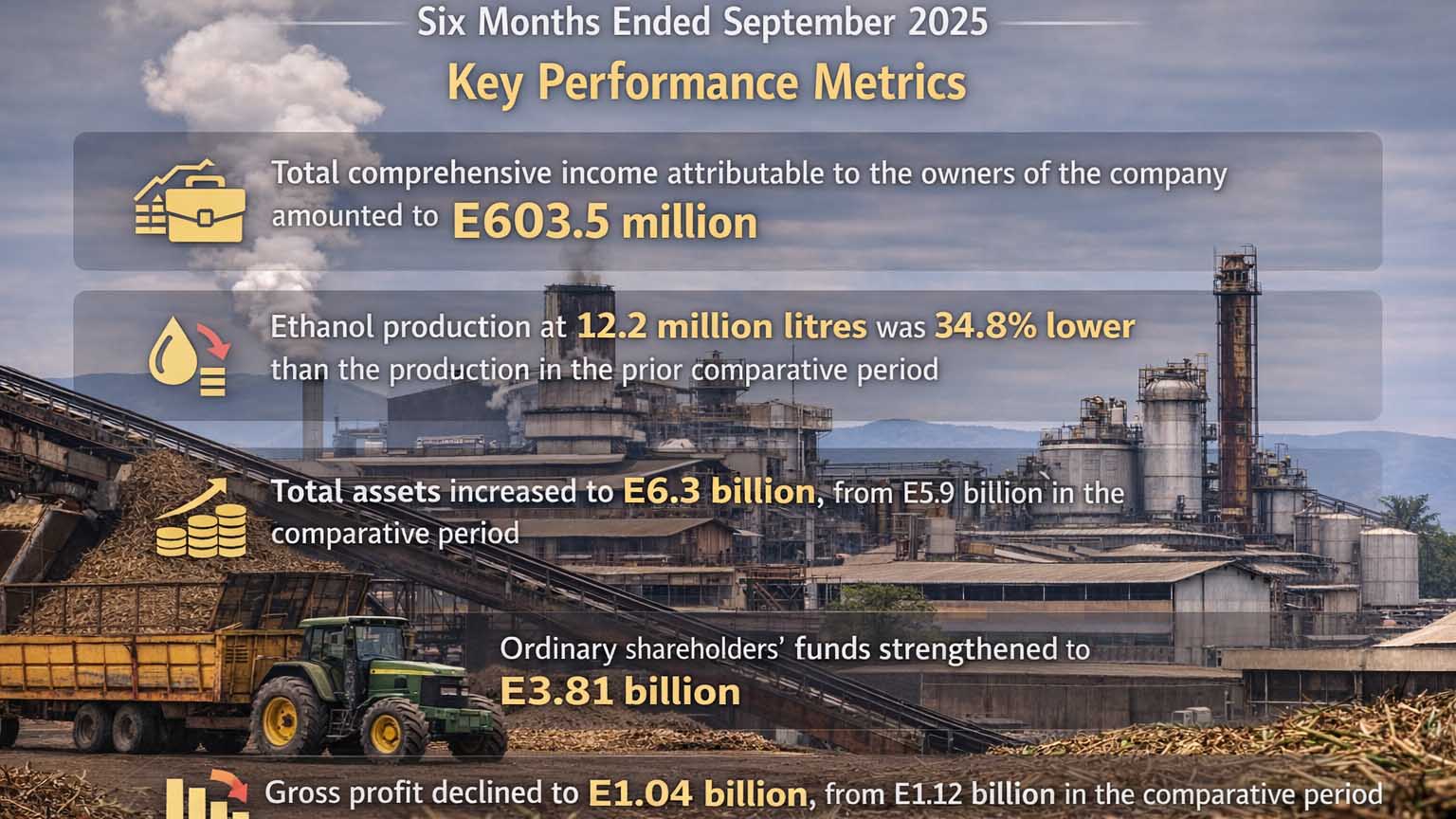
MBABANE – Results for the six months ended on September 30, 2025, show that total comprehensive income attributable to the owners of the Royal Eswatini Sugar Corporation (RESCorp) amounted to E603.5 million.
This marked an 8.3 per cent decline from the results achieved during the same period last year.
This softer performance is evident from the onset of the group’s condensed interim financial, reflecting a combination of production timing, pricing pressures and rising input costs.
Management emphasised that the interim outcome must be viewed within the context of the seasonal nature of the sugar business, where the crushing season typically ends in December.
As a result, the second half of the financial year is historically significantly weaker than the first, meaning the reported interim figures represent the stronger earnings phase of the group’s annual operating cycle.
Operationally, the group delivered a relatively stable sugar performance despite weather-related and timing challenges. While total sucrose production declined by 1.8 per cent, sugar production itself fell by only 0.4 per cent to 317,947 tonnes of 96° pol sugar, compared to 319 182 tonnes produced in the same period last year.
RESCorp attributed this resilience to improved sugar recoveries achieved across its regional top-performing mills, which helped offset lower cane throughput.
The marginal decline in sugar output highlights the effectiveness of operational efficiencies implemented at the milling level during the period.
Cane crushed during the six months amounted to 2.3 million tonnes, representing a 4.3 per cent decrease year-on-year. The reduction was largely due to the current crushing season starting a week later than in the previous year, following persistent rainfall in April 2025.
Estate cane crushed was 9.3 per cent lower, consistent with a reduced area harvested during the period.
Encouragingly, estate productivity improved markedly. Estate sucrose yield increased by 8.5 per cent to 13.77 tonnes per hectare, up from 12.51 tonnes per hectare in the prior comparative period. Management noted that last year’s yields had been negatively impacted by storm damage in March 2024, which adversely affected cane quality, making the current improvement particularly notable.
Group revenue declined by 2.1 per cent to E3.34 billion, reflecting lower sugar and ethanol volumes as well as weaker pricing conditions. The average sugar price fell by 1.1 per cent, a decline well below prevailing inflation levels, underscoring the intensity of competitive and market pressures facing the industry. The pricing environment remains challenging both locally and internationally, with excess supply and increased import competition within the Southern African Customs Union (SACU) market continuing to suppress domestic prices.
Despite lower volumes, the cost of sales rose by 4.3 per cent, driven primarily by cost inflation, which continues to affect agricultural inputs, logistics and energy-related expenses. This divergence between revenue and costs placed pressure on margins across the group’s operations.
The fair value adjustment of biological assets resulted in a reduction of E117.6 million, compared to a reduction of E196.2 million in the prior period. The smaller adjustment reflects higher sucrose content and older cane linked to delayed harvesting, although this benefit was partially diluted by lower sugar prices.
*…
Ethanol production declined sharply by 34.8 %
MBABANE – The ethanol business experienced a notably difficult six-month period.
Ethanol production declined sharply by 34.8 per cent to 12.2 million litres, largely due to a delayed start to the 2025/26 production season, which only commenced later in June.
The delay stemmed from the need to accumulate sufficient molasses from sugar production, compounded by a temporary power supply interruption caused by an early-season fault on the 30-megawatt turbo alternator at the Simunye Mill.
Production throughput was further constrained by storage limitations amid weak market demand. To manage these challenges, daily output was limited to one plant, compared to both plants operating in the prior period. Consequently, ethanol sales declined by 34.6 per cent to 7.7 million litres.
Management acknowledged that ethanol markets remain difficult but indicated that new export markets are being negotiated, with sales volumes expected to improve as the financial year progresses.
*..
Strong balance sheet maintained with assets at E6.3bn
MBABANE – RESCorp continued to display a robust financial position.
The company’s total assets increased to E6.3 billion, from E5.9 billion in the comparative period, while ordinary shareholders’ funds strengthened to E3.81 billion.
Gearing levels remained low, with a debt-to-equity ratio of 5.8 per cent, providing the group with financial flexibility in a volatile operating environment.
In line with its dividend policy and cash flow position, the Board declared a first interim dividend of 58.50 cents per share, which was paid in November 2025. While lower than the prior year, the dividend reflects a cautious, but continued commitment to shareholder returns amid tightening market conditions.
Looking ahead, RESCorp expects sugar production for the full financial year to be approximately 8 per cent higher than the previous year, supported by improved climatic conditions and better cane quality.
However, the market outlook remains challenging. The average world sugar price to date is 20.4 per cent lower than in the comparative period, while currency movements have made imports more competitive within SACU, further pressuring local prices.
*Full article available in our publication



















Leave a comment