Home Business Personal loans surge by 5.9% to E3.8bn in Dec 2025
Business

Personal loans surge by 5.9% to E3.8bn in Dec 2025

Share
Personal loans recorded the strongest growth in December 2025.
Share

MBABANE – Personal loans recorded the strongest growth in December 2025, rising by 5.9 per cent to E3.8 billion, signalling increased appetite for short-term, consumption-driven credit among households.

This is according to the Central Bank of Eswatini’s (CBE) latest Monthly Statistical Release for December 2025/January 2026, which shows that credit extended to households and non-profit institutions serving households (NPISH) continued to gain momentum during the festive season.

Overall, credit extended to the private sector rose to E22.4 billion in December 2025, reflecting a 2.1 per cent month-on-month increase and a 9.8 per cent year-on-year expansion.

The growth was largely supported by increased borrowing by both households and businesses.

Credit extended to households and NPISH grew by 3.2 per cent month-on-month and 8.9 per cent year-on-year to reach E9.4 billion in December 2025.

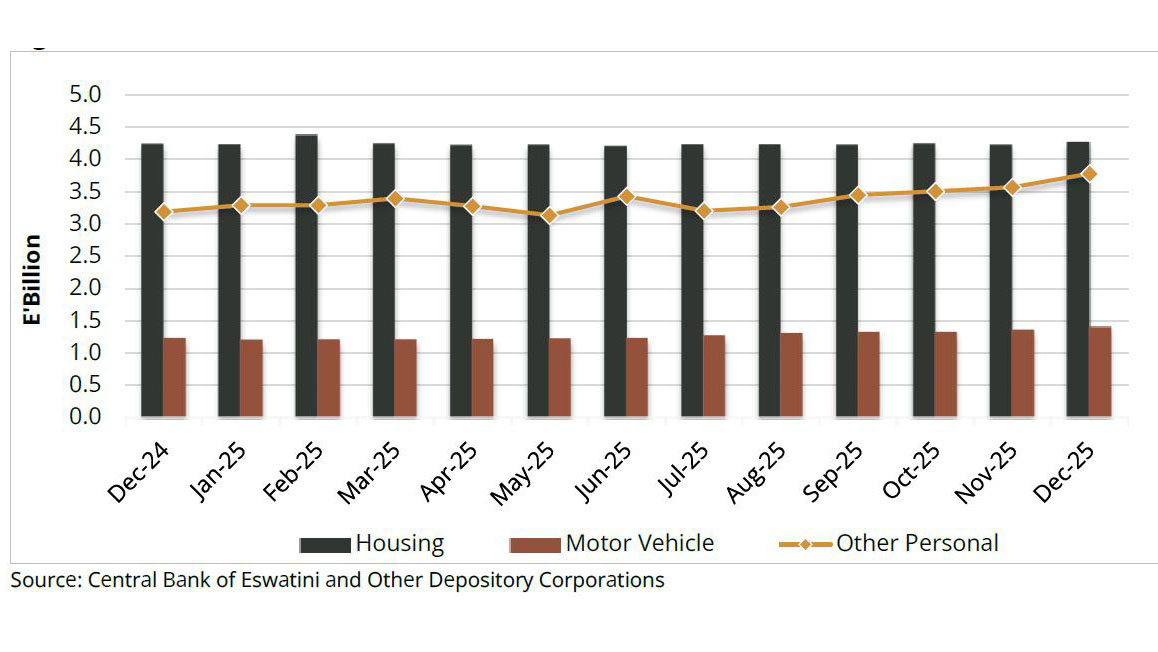
The expansion was broad-based across the major lending categories – housing, motor vehicle and other personal loans – but unsecured personal loans registered the fastest pace of growth.

The CBE noted that ‘other (unsecured) personal loans registered the strongest growth of 5.9 per cent to E3.8 billion, indicative of higher demand for short-term consumption-oriented credit’.

This suggests that households increasingly relied on unsecured borrowing to finance immediate consumption needs, particularly during the festive period when spending traditionally spikes.

Motor vehicle loans also increased by 2.8 per cent to E1.4 billion, while housing loans recorded slower growth of 0.9 per cent to close at E4.3 billion.

The relatively modest growth in housing loans compared to personal loans points to a preference for short-term liquidity over long-term asset acquisition during the review period.

The December data reflects seasonal patterns typically associated with heightened consumer activity. Increased household expenditure on goods, travel, school-related costs and social commitments often translates into higher demand for unsecured lending.

*Full article available on Pressreader*

Share
Written by
Nhlanganiso Mkhonta

Nhlanganiso Mkhonta serves as Business Editor at the Times of Eswatini. He reports on business, economics, finance, investment, entrepreneurship and public policy, producing insightful coverage and analysis of the issues driving Eswatini’s economy and the wider African business environment.

Leave a comment

Leave a Reply

Your email address will not be published. Required fields are marked *

Don't Miss

Customary marriages declared in community of property

MBABANE – The High Court has declared the long-standing practice of treating marriages under Eswatini Law and Custom as being out of community...

Inyatsi Construction building foundations of First World future

For more than four decades, Eswatini has witnessed one of the most significant periods of infrastructure development in its history. Under the leadership...

No more USA Visa processing in Eswatini

MBABANE – In a move that will significantly alter travel logistics for Eswatini nationals, the United States Embassy in Mbabane will cease accepting...

King moves to save Ncangosini residents from eviction

KONTSHINGILA – Hundreds of residents living on a privately owned farm at Ncangosini, Kontshingila, are set to be spared from eviction after an...

Each MP set for E1m handshake

MBABANE – When the 12th Parliament assumed office in 2023, an ordinary Member of Parliament (MP) was earning a basic monthly salary of...

Related Articles

Eswatini among southern Africa’s fastest-growing economies

MBABANE – Eswatini is expected to remain among Southern Africa’s strongest-performing economies...

ERS coming for high-net-worth individuals

MBABANE – Eswatini Revenue Service (ERS) is seeking to ensure wealthy individuals...

SA economic woes cast shadow on Eswatini 

MBABANE – Eswatini remains one of Southern Africa’s stronger fiscal performers, although...

SADC banks resilient despite global economic pressures

EZULWINI – Regional banking systems have remained sound and well-capitalised despite mounting...