

MBABANE – Eswatini’s sugar industry delivered a major boost to the country’s external trade performance in April 2026.
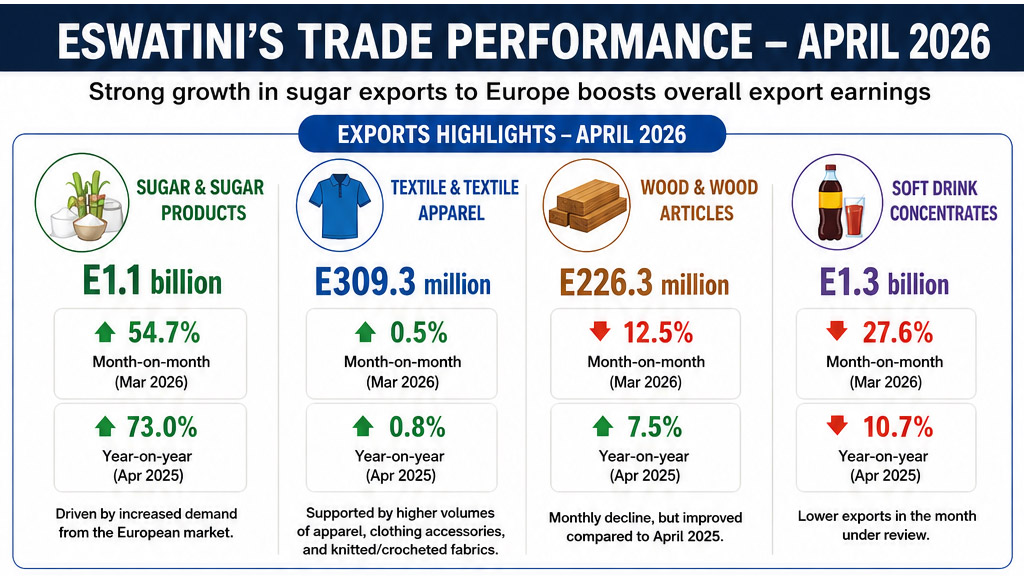
The country’s exports of sugar and sugar products totalled E1.1 billion, a substantial 54.7 per cent increase compared to March 2026, due to an increase of exports to the European market.
According to the Central Bank of Eswatini’s Recent Economic Developments (RED) report for March/April 2026, sugar exports increased substantially by 54.7 per cent compared to March 2026, highlighting the continued importance of the European market to the country’s export sector.
The report further showed that, on a year-on-year basis, sugar and sugar product exports were significantly higher by 73.0 per cent, again supported by increased demand from Europe.
The latest figures reinforce the critical role played by the sugar industry in supporting Eswatini’s foreign exchange earnings, agricultural production, employment and overall economic activity.
The sugar sector remains one of the country’s largest export earners and among the most strategically important industries within the economy.
Economists say the sharp increase in exports demonstrates the benefits of strong international demand and favourable access to premium overseas markets, particularly within Europe.
The growth also comes at a time when global commodity markets continue to face uncertainty due to fluctuating prices, supply chain disruptions and changing international trade conditions.
The Central Bank report showed that despite strong sugar exports, performance across other export categories remained mixed during the review month.
Exports of textile and textile apparel grew to E309.3 million in April 2026, reflecting a marginal 0.5 per cent increase from the preceding month.
The improvement was supported by increased export volumes of articles of apparel and clothing accessories, as well as knitted and crocheted fabrics.
Compared to April 2025, textile exports increased slightly by 0.8 per cent.
The textile and apparel sector also continues to play a significant role in the country’s manufacturing industry, particularly in employment creation and industrial activity.
Meanwhile, exports of wood and wood articles weakened during the review period.
The category declined by 12.5 per cent month-on-month to E226.3 million in April 2026.
However, compared to April 2025, exports of wood and wood articles improved by 7.5 per cent.
The sector continues to benefit from regional demand for timber and construction-related products, although export volumes remain vulnerable to fluctuations in commodity markets and economic conditions in neighbouring countries.
On the other hand, soft drink concentrates, which remain one of Eswatini’s leading export products, generated E1.3 billion during April 2026.
*Full article available on Pressreader*



















Leave a comment