

MBABANE – Eswatini has entered the list of the 10 African countries with the highest diesel prices.
These highlights growing fuel-cost pressures that could ripple through the economy and raise concerns for businesses, farmers and consumers alike.
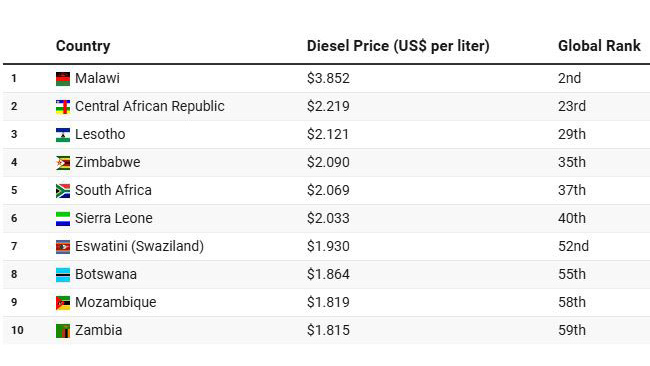
According to the latest fuel price analysis published by BusinessTech, Eswatini ranked seventh among African countries with the highest diesel prices in May 2026, with motorists paying approximately US$1.93 per litre, equivalent to about E31.60 per litre using an exchange rate of roughly R16.25 to the US Dollar.
The development marks Eswatini’s entry into the continent’s top 10 list, alongside neighbouring Mozambique, while Mali and Liberia dropped out of the ranking.
The latest figures show that diesel prices across the globe eased slightly during the month, with the global average declining from US$1.60 (about E26.00) per litre to US$1.58 (about E25.68) per litre. Despite this global decline, several Southern African countries experienced increases, underscoring the region’s vulnerability to international oil market fluctuations.
Malawi remains Africa’s most expensive country for diesel, with prices reaching US$3.852 per litre, equivalent to approximately E62.59 per litre. It is followed by the Central African Republic at R36.06, Lesotho at E34.47, Zimbabwe at E33.96, South Africa at R33.62, Sierra Leone at R33.04, and Eswatini at E31.60 per litre. Botswana, Mozambique and Zambia round out the top 10 with diesel prices ranging between E29.49 and E30.29 per litre.
A notable feature of the May rankings is the dominance of Southern African countries. Seven of the 10 countries on the list are from the region, reflecting the common challenges faced by economies heavily dependent on imported petroleum products.
Apart from Zimbabwe, which recorded a decrease in diesel prices, all Southern African countries featured on the list experienced increases compared to April.
The trend comes at a time when businesses across the region are already grappling with rising operational costs, weak consumer spending and ongoing global economic uncertainty.
For Eswatini, the implications are particularly significant given the country’s dependence on road freight transport and imported goods.
Diesel remains one of the most important fuels for economic activity.
It powers long-haul trucks transporting goods across borders, agricultural machinery, mining equipment, construction vehicles and backup generators used by businesses during electricity disruptions.
*Full article available on Pressreader*


















Leave a comment