

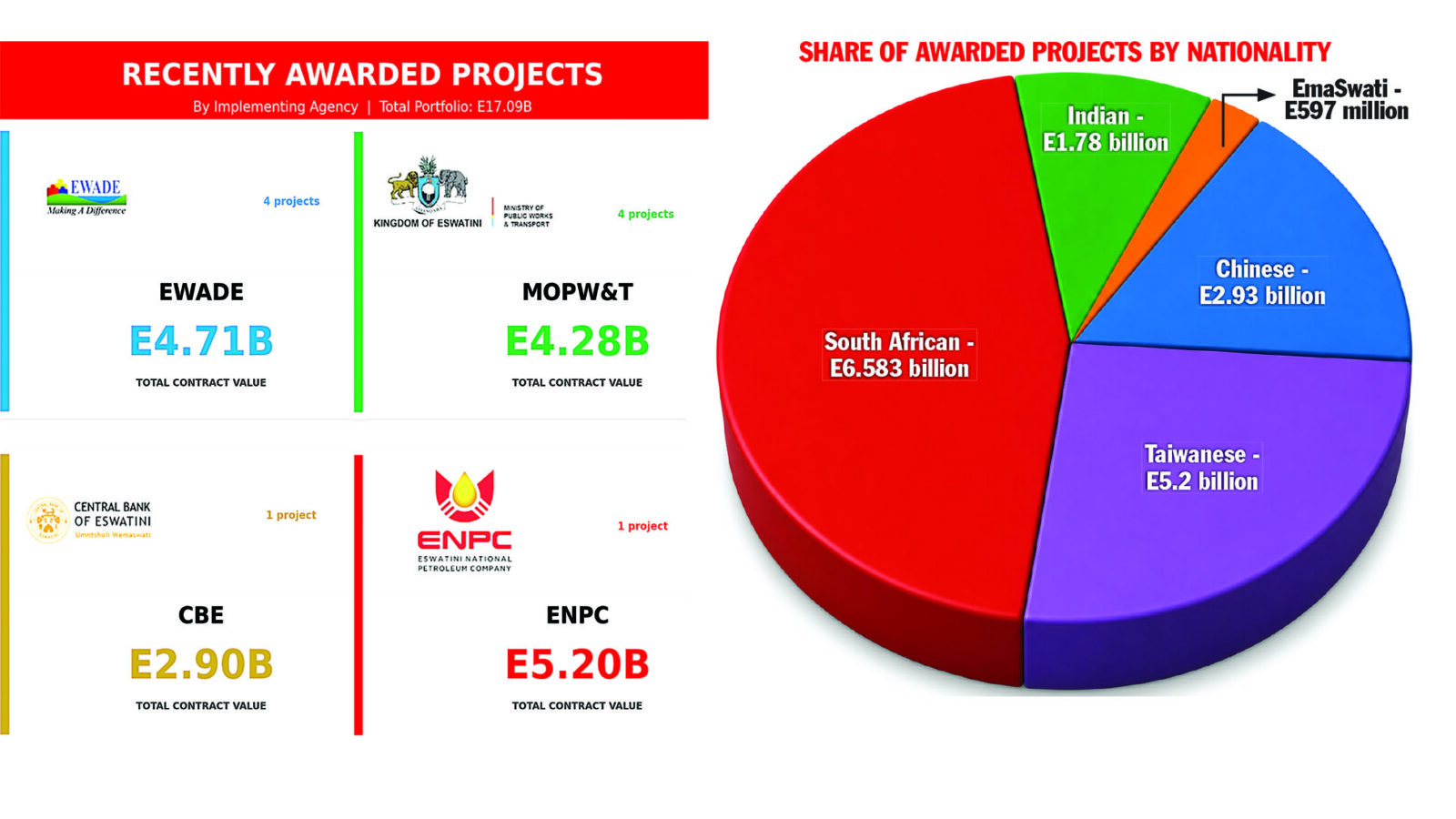
MBABANE – Business leaders and unemployed graduates have demanded greater local participation in public projects after foreign firms secured contracts worth more than E17 billion.
What began as concern over government procurement has rapidly evolved into a broader debate about who truly benefits from public spending in Eswatini.
This publication yesterday reported that reports emerging from procurement regulators indicate that most major infrastructure and development projects, either underway or recently tendered, have largely been awarded to foreign companies.
The total value of these contracts is estimated at about E17.09 billion. The projects include:
- Sakhalive JV – E2.6 billion (construction of Mpakeni Dam).
- Stefanutti Stocks/WBHO – E2.6 billion (MR 14 and 21 Road)
- GVPR Engineers – E1.78 billion (Mkhondvo-Ngwavuma Water Augmentation Project, Phase 1B Main Conveyance Pipeline)
- Stefanutti Stocks – E400 million (construction of D29 – Luve-Lugaganeni Road)
- Stefanutti Stocks – E683 million (MR25 Road – Hlatikhulu-Sithobela).
Following the enlightenment of emaSwati on how local firms were missing out on business opportunities, the Federation of Eswatini Business Community (FESBC) and the Swaziland Unemployed People’s Movement (SUPMO) have both questioned the economic impact of major infrastructure contracts being awarded predominantly to foreign companies, arguing that the trend risks excluding local businesses, graduates and workers from opportunities funded by taxpayers.
While acknowledging the role foreign investment and international expertise can play in national development, FESBC warned that limited local participation in large-scale projects could weaken efforts to build a strong and sustainable domestic economy.
According to FESBC’s Office of the President and National Executive Council, when major contracts are awarded primarily to foreign firms, opportunities for local business growth, employment creation, skills transfer and industrial development are reduced, while a significant portion of project profits ultimately leaves the country.
FESBC said the issue was particularly concerning at a time when government is pursuing youth employment, economic empowerment and inclusive growth.
The business federation further argued that the aspirations of the Citizens Economic Empowerment Act, 2025, would be difficult to achieve if local enterprises continued to be excluded from major economic opportunities.
“The success of empowerment initiatives will largely depend on the existence of strong, competitive and sustainable local enterprises,” the organisation stated.
The business body has called for a review of public procurement policies, the introduction of local-content requirements, mandatory joint ventures between local and international companies and accelerated implementation of the Citizens Economic Empowerment Act.
FESBC said when large-scale projects are awarded primarily to foreign companies: “A significant portion of project profits leaves the country. Opportunities for local business growth and industrial development are reduced. Employment creation for emaSwati is limited. Skills and technology transfer opportunities are diminished. The local tax base and economic multiplier effects are weakened.”
Conversely, Chairperson of the organisation representing unemployed people, Lucky Dlamini, echoed similar concerns, saying the issue went beyond contracts and touched directly on the prospects of thousands of unemployed graduates and jobseekers.
Dlamini argued that government’s investment in education would yield limited returns if major projects continued to create opportunities primarily for foreign companies and personnel.
According to Dlmaini, taxpayers have a right to question why public funds are leaving the country when local businesses and graduates continue to struggle for opportunities.
*Full article available on Pressreader*


















Leave a comment