

MBABANE – Credit extended to Eswatini’s private sector continued its upward trajectory in April 2026.
This showed a sustained demand for financing by households and businesses, even as the country’s foreign reserves and banking sector liquidity came under pressure.
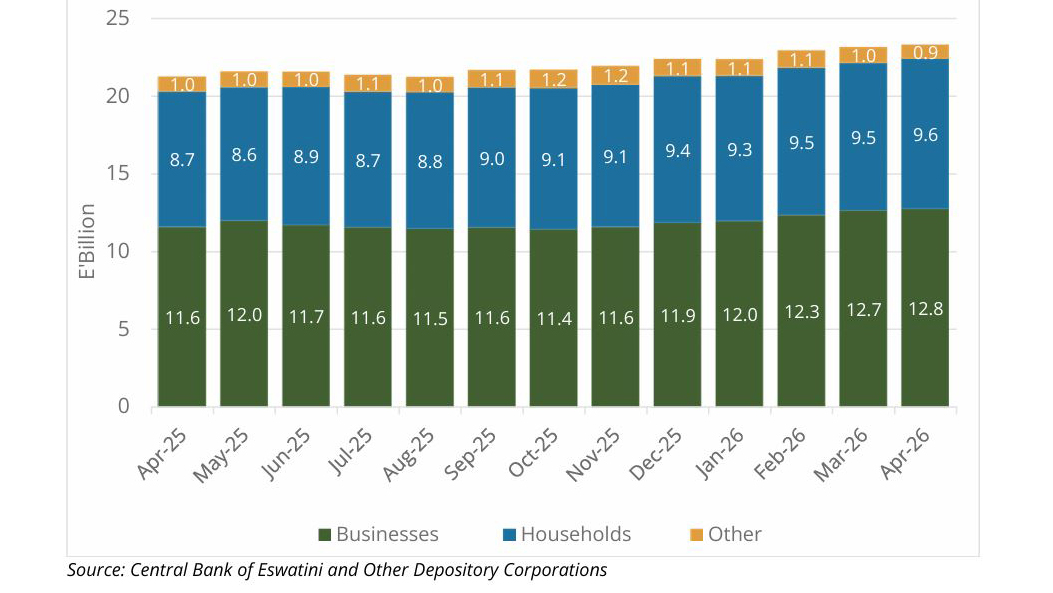
The latest Monthly Statistical Release issued by the Central Bank of Eswatini (CBE) shows that credit extended to the private sector rose to E23.3 billion at the end of April 2026, representing growth of 0.7 per cent month-on-month and 9.5 per cent year-on-year.The increase was largely driven by stronger borrowing from households and businesses, reflecting continued economic activity across key sectors of the economy. The report indicates that credit extended to households and non-profit institutions serving households (NPISH) increased by 1.7 per cent during the month to E9.6 billion, while business sector lending expanded by 0.7 per cent to E12.8 billion. The growth in household borrowing was mainly supported by increased demand for unsecured personal loans and housing loans. Other personal loans rose by 2.5 per cent to E3.9 billion, while housing loans increased by 2 per cent to E4.3 billion. In contrast, motor vehicle loans declined by 1.1 per cent to E1.4 billion.
The continued rise in household credit suggests that consumers remain confident enough to borrow despite lingering economic uncertainties and elevated living costs. Business lending also recorded broad-based growth across most sectors of the economy, underlining improving investment appetite among companies. The strongest increase was recorded in the mining and quarrying sector, where credit surged by 31.1 per cent during the month. Manufacturing followed with an 8.4 per cent increase, while agriculture and forestry recorded growth of 6.1 per cent. Transport and communications expanded by 1.2 per cent, community, social and personal services rose by 0.5 per cent, while real estate registered a marginal increase of 0.1 per cent. However, not all sectors shared in the gains. Credit to the distribution and tourism sector fell by 9.8 per cent, while lending to the construction industry declined by 0.9 per cent. The figures also reveal encouraging growth in lending to small and medium enterprises (SMEs), a segment widely regarded as a critical driver of employment and economic growth.
Credit extended to SMEs increased by 2.0 per cent month-on-month and 17.8 per cent year-on-year to reach E4.4 billion. SMEs accounted for 34.1 per cent of total business credit, while large enterprises represented the remaining 65.9 per cent. The report further highlights improvements in government’s financial position. Net claims on government declined by 46.8 per cent month-on-month and 10.3 per cent year-on-year to E1 billion. According to the Central Bank, this was largely driven by a reduction in claims on government following the repayment of a Central Bank advance. While credit growth remained positive, developments in the country’s monetary aggregates painted a mixed picture. Broad money supply (M2) contracted by 3.8 per cent during April to E26.7 billion, although it remained 12.8 per cent higher than the level recorded a year earlier.
The monthly decline was mainly attributed to a reduction in quasi-money balances, particularly time deposits, which fell by 10.4 per cent to E14.2 billion. In contrast, narrow money supply (M1), which includes cash and demand deposits, increased by 5.8 per cent month-on-month and 7.5 per cent year-on-year to E10.2 billion. The increase was driven by stronger growth in transferable deposits, which rose by 6.2 per cent to E9.3 billion, while currency in circulation increased by 1.6 per cent to E929.8 million.




















Leave a comment