

MBABANE – The latest official trade data has revealed a significant contraction in the commercial relationship between Eswatini and the United Kingdom.
According to the statistical document titled ‘Eswatini-trade-and-investment-factsheet, published by the UK Department for Business and Trade, bilateral economic exchanges between the two nations have decreased sharply across major categories over the recent annual reporting period.
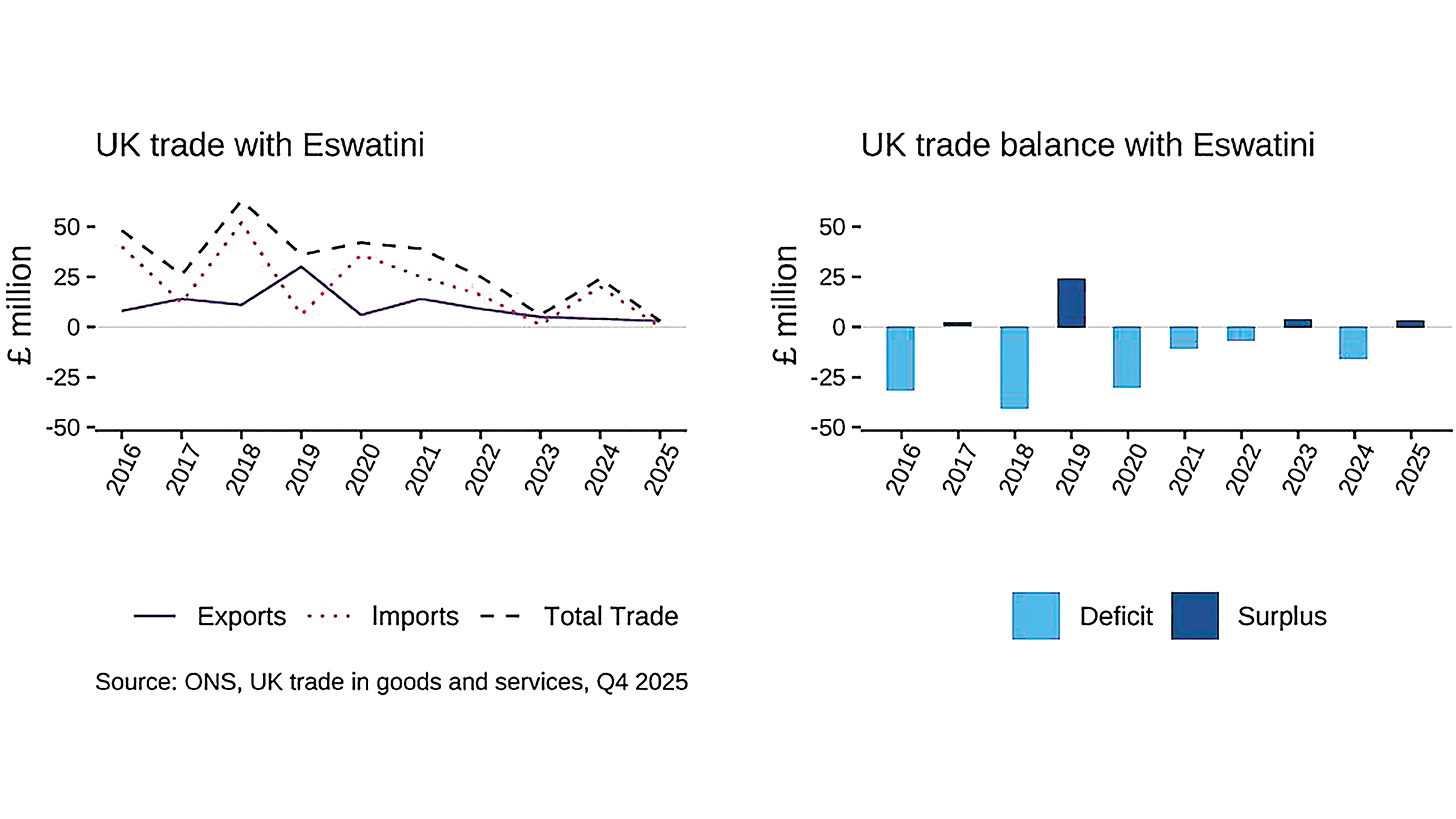
Total trade in goods and services (exports plus imports) between the UK and Eswatini reached a value of £3 million (approximately E65.1 million) in the four quarters to the end of Q4 2025.
The four quarters to the end of Q4 2025’ refers to the 12 months to the end of December 2025.
This represents an 87.5 per cent drop, which translates to a total decrease of £21 million (E455.7 million) in current prices compared to the four quarters to the end of Q4 2024.
The primary mathematical component driving this overall drop in bilateral trade is the performance of Eswatini’s exports to the UK, which are recorded in the factsheet as total UK imports from Eswatini.
For the 12 months ending December 2025, total UK imports from Eswatini dropped to less than £1 million (less than E21.7 million). This performance constitutes a 100 per cent decrease, marking a net drop of £20 million (E434 million) in current prices relative to the previous year’s four quarters.
The commodity breakdown shows how specific sectoral exports changed between the two periods:
Vegetables and fruit: Imports of these commodities by the UK from Eswatini dropped by 98.0 per cent to a final value of £660 thousand (E14.3 million) in the four quarters to the end of Q4 2025.
Sugar: This category was recorded at a value of £410 thousand (E8.9 million).
Clothing: Total clothing imports by the UK from Eswatini decreased by 61.5 per cent to settle at £200 thousand (E4.3 million).
Aircraft: This specific export commodity was valued at £110 thousand (E2.4 million).
Beverages and tobacco: This category showed a directional increase of 14.3 per cent, reaching a final reported value of £80 thousand (E1.7 million).
As a consequence of these recorded changes, Eswatini’s statistical position among UK trading partners shifted, placing the country as the UK’s 223rd largest import market for the period.
On the reverse side of the ledger, total UK exports to Eswatini accounted for the entire £3 million (E65.1 million) of total trade recorded between the two partners. Despite comprising the entirety of the bilateral trade value, this figure represents a 25.0 per cent contraction, which equals a net decrease of £1 million (E21.7 million) in current prices when compared to the four quarters to the end of Q4 2024.
The structural composition of UK exports to Eswatini is heavily weighted towards the service sector, broken down as follows:
Service vs goods balance: Out of the total £3 million in UK exports, goods exports accounted for less than £1 million (less than 0.1 per cent of the total), whereas service exports accounted for £3 million (almost 100 per cent of the total).
The top five goods commodities exported from the UK to Eswatini during the four quarters to the end of Q4 2025 include:
Beverages and tobacco: Valued at £850 thousand (E18.4 million), reflecting an increase of 7.6 per cent compared to the prior period.
Toilet and cleansing preparations: Valued at £180 thousand (E3.9 million).
Dyeing, tanning and colouring materials: Valued at £170 thousand (E3.7 million), registering a decrease of 22.7 per cent.
Mechanical power generators (intermediate): Valued at £160 thousand (E3.5 million).
Scientific Instruments (Capital): Valued at £150 thousand (E3.3 million), which is a decrease of 21.1 per cent.
Due to the value of imports from Eswatini being dropped at a faster rate than exports from the UK, the net trade balance reversed direction.
For the four quarters to the end of Q4 2025, the UK reported a total trade surplus of £3 million (E65.1 million) with Eswatini. This contrasts with the previous year, where the UK recorded a total trade deficit of £16 million (E347.2 million) with Eswatini.
Statistical changes in foreign direct investment
MBABANE – In contrast to the physical trade in goods and services, the data for long-term capital investment moved in a different direction.
According to the statistics, the stock of foreign direct investment (FDI) from the UK in Eswatini stood at £18 million (approximately E390.6 million) at the end of 2024.
This represents an increase of 50.0 per cent or an absolute rise of £6 million (E130.2 million) from the total investment stock recorded at the end of 2023.
At this level, Eswatini accounts for less than 0.1 per cent of the total UK outward FDI stock.
Conversely, reciprocal capital flows remain low. At the end of 2024, the recorded stock of inward FDI from Eswatini to the United Kingdom was less than £500 000 (under E10.9 million).
The report also presents historical domestic data and macroeconomic projections for Eswatini sourced from the International Monetary Fund (IMF) World Economic Outlook.
The IMF projections indicate that Eswatini’s global GDP ranking by current prices is forecast to improve from 161st in 2025 to 158th in 2026, alongside an increase in real GDP growth to 4.0 per cent.
Concurrently, general government gross debt as a percentage of national GDP is projected to rise from 44.9 per cent in 2025 to 50 per cent in 2026 and further to 52.7 per cent by 2027.
Total investment as a percentage of GDP is forecast at 14.5 per cent for 2026, down from 15 per cent in 2025.



















Leave a comment