

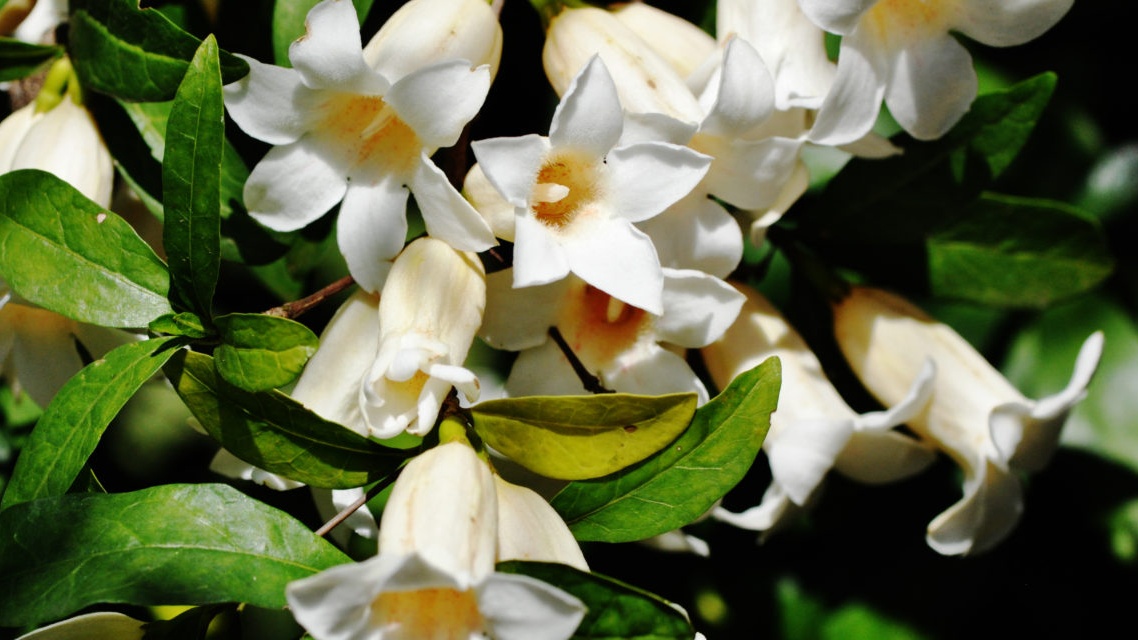
1. September Bell
Scientific name: Rothmannia globosa
SiSwati name: sikoba
These scented, bell-shaped flowers are creamy white, often with pink speckles in the throat.
They appear singly or in clusters of two to four on short side branches, measuring about 25mm long and 35mm wide.
Almost stalkless, they bloom in spring and early summer, from August to November. The trees are usually in full bloom in September, which explains the common name.
Ecology
Monkeys, baboons and birds feed on the fruit of the bell gardenia, while carpenter bees visit the flowers.
Uses
In some parts of southern Africa powdered roots are rubbed into incisions to treat leprosy.
Mpondo men once used the shells of the fruit as clothing. The fruits are recorded as edible and the dried fruits are strung into necklaces.
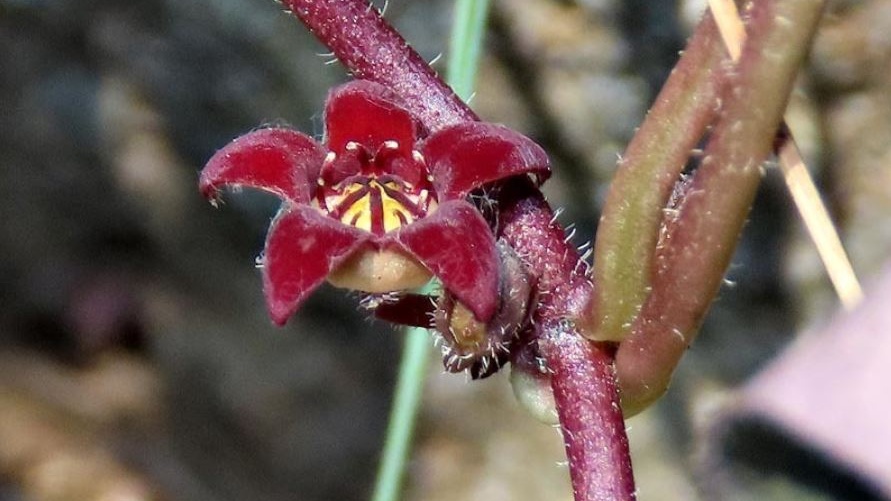
2. Brachystelma swazicum
Brachystelma swazicum is a prostrate herb in the dogbane family (Apocynaceae). It grows from an underground tuber, producing short reddish stems and ovate, opposite leaves on dark red petioles.
Native to the Barberton mountains region of South Africa and Eswatini, the plant belongs to the stapeliads, a group known for their fleshy, star-shaped flowers.
Uses
The tuber is eaten as a food supplement and has long been a daily meal for communities such as the San and Ndebele. It is also used in traditional medicine to treat colds and headaches. In addition, it is cultivated as an ornamental to help reduce pressure on wild populations.
3. Orchid
Scientific name: Eulophia clavicornis
This orchid has a rhizome with a series of hard, round pseudobulbs.
Its inflorescence, 15 to 30cm or more in length, bears few clasping bracts that are spaced out or just overlapping.
Leaves are slender, rather stiff and up to 45cm long, though often only partly developed at flowering time. Flowers are few, loosely set and horizontal.
The perianth is usually dull purple or brownish, sometimes with greenish sepals, while petals are white with mauve edges.
Segments measure about 1.3cm long, with blunt petals and a well-developed spur up to 1cm long, often curved and slightly enlarged at the tip.
Two variants occur:
Var. clavicornis – shorter, one of the earliest spring flowers.
Var. nutans – taller, found in moister habitats.



















Leave a comment