

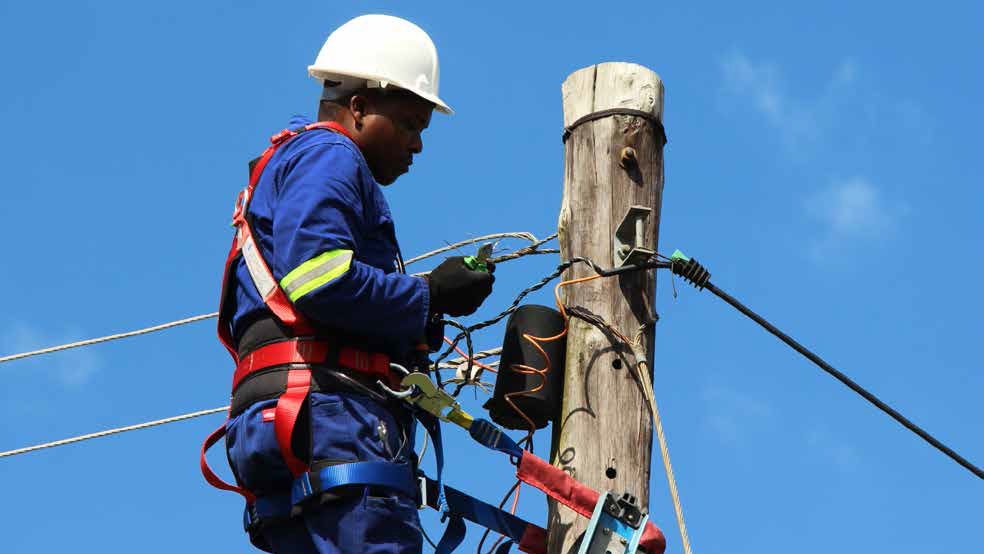
The Eswatini Electricity Company of (EEC) introduced a service connection standard pamphlet aimed at improving safety, consistency and quality in electrical installations across the country.
The standard serves as a practical guide for homeowners, trade-tested electrical wiremen, EEC customers and operational staff involved in service connections and commissioning.
Purpose of the Service Connection Standard
This is designed to achieve three key objectives:
- Provide clear guidelines for approved house and infrastructure wiring standards as set by EEC.
- Create a common reference document for electrical wiremen, customer and EEC staff during service commissioning.
- Promote uniformity and best practice in electrical installations nationwide.
The standard applies to both overhead and underground service connections and outlines approved minimum cable sizes, colour codes, breaker sizes and required electrical wiring materials.
Revised standard: Outdoor panel requirements
1. Service tensioning and mounting:
- The service connection must be supported using approved fittings such as a tensioning bracket, pigtail or D-shackle.
- A minimum 2.5-metre ground clearance is required for overhead connections, or an approved underground cable connection may be used.
- The bracket must be mounted through the wall and securely screwed from inside the house.
- Installation may also be done on a rafter (likabha).
2. Service conduit:
- A 25mm PVC conduit is required to receive the aidec cable from the service pole.
- The conduit must bend downward and enter the meter box from below.
- A minimum 30cm spacing between the receiving conduit and the meter box is required to allow a smooth bend.
3. Meter box installation:
- The meter box must be metallic, lockable and either installed into the wall or firmly mounted on it.
- A minimum 1.5-metre ground clearance is required.
- For non-concrete houses, both the meter box and distribution board (DB) must be installed into concrete.
4. Earthing requirements: Proper earthing is mandatory to ensure safety:
- The earthing trench must be 50cm deep and extend at least 1 metre from the wall.
- The earth spike must be driven 1 metre into the ground.
- Earth resistivity must not exceed 10 Ohms.
- Where resistivity is high, improvements may include:
- Use of conductive cement
- Crowfoot earthing
- Importing and compacting suitable soil
A 16mm bare earth cable must be used, with all connections properly lugged. All non-electrical metallic components such as corrugated iron and plumbing must also be bonded to the earthing point.
5. Mains and communication conduits: 20mm conduits must be installed underneath the meter box and routed into the house.
Revised standard: Indoor panel requirements
1. Distribution board (DB):
- The DB must be installed at a 1.6-metre ground clearance.
- It should be easily accessible, such as in a passage or kitchen.
2. Minimum breaker sizes – The following breaker sizes are required:
- 63A Earth leakage (mains)
- 63A Stove
- 40A Geyser
- 30A Plug circuits
- 20A Lighting circuits
- 10A auxiliary circuits
3. Minimum wiring cable sizes
Approved minimum cable sizes include:
- Earth (bare): 16mm
- Mains: 10mm
- Stove: 6mm
- Geyser: 4mm
- Plugs: 2.5mm
- Lights: 1.5mm
- Jumpers: 10mm
4. Plug and socket heights:
- Plugs must be installed at least 30cm above the floor.
- Stove isolators require a minimum 1-metre ground clearance.
5. Switch placement:
Switches must be installed at a 1.5-metre ground clearance.
They should not be positioned behind doors when opened.
Renovations and house extensions
Homeowners are advised to consult EEC before making changes:
Planned renovations: Consult EEC, pay a re-test fee and submit the required yellow form.
Extensions: A re-test is required when adding new circuits.
Unplanned faults: These must be reported to EEC for guidance.
Change of service type
For changes between overhead and underground service connections, customers must approach EEC for the relevant guidelines.

















Leave a comment