

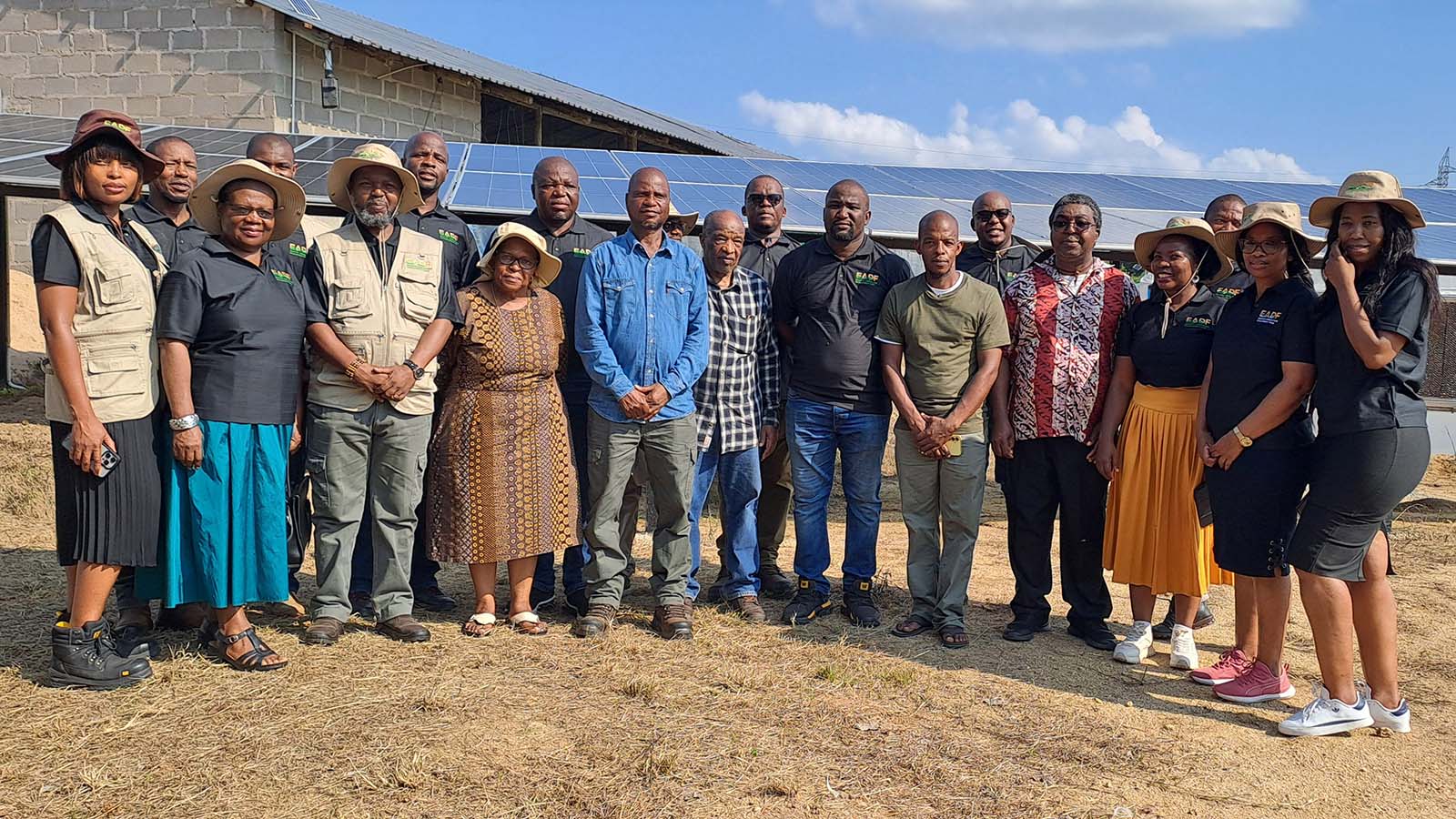
The Eswatini Agricultural Development Fund (EADF) continues to make meaningful strides in transforming the country’s agricultural landscape, as revealed during a project progress workshop, which was held on Thursday, March 26, 2026, followed by a site visit to beneficiary farmers on Friday, March 27, 2026.
Senior Economist at the Ministry of Agriculture and Chairperson of the Technical Committee, Henry Mndawe, explained that the Technical Committee comprises representatives from across the agricultural value chain, including livestock, horticulture, grains and financial institutions such as banks.
The committee also includes key figures such as the Director of Veterinary Services and the Director of Farmer Extension. He noted that the committee plays a critical role in assessing applications, making the Steering Committee’s work more efficient.
Building Agri-preneurs
Chairperson of the Steering Committee and Principal Secretary in the ministry, Sydney Simelane, emphasised that the fund was designed to support emerging farmers. “We started with small amounts because these are farmers who are just starting out, with EswatiniBank providing financial backing through surety,” he said.
He added that the fund addresses critical gaps such as infrastructure, with investments in state-of-the-art facilities, including automated feeding and watering systems that improve efficiency. Simelane noted that funding is structured across short-, medium- and long-term cycles, all aimed at building a new generation of agripreneurs.
Over E42 million disbursed
Minister for Agriculture, Mandla Tshawuka, revealed that over E42 million has been disbursed to 64 emaSwati, significantly boosting agricultural production and livelihoods.
He also announced a new Mechanisation Programme aimed at addressing the shortage of farming equipment. The initiative, in partnership with international and financial stakeholders, is expected to deliver 250 tractors and implements over five years. The National Maize Corporation (NMC) will also benefit by acquiring its own fleet, including heavy machinery such as harvesters.
The minister reiterated government’s intention to eventually elevate EADF into a parastatal, enabling it to independently mobilise funding and expand its reach.
Parliamentary support
Portfolio Committee Chairperson Bonginkosi Dlamini commended the fund’s impact, noting that the E42 million injected into the sector is already creating employment opportunities.
While acknowledging budget constraints in the current financial year, he assured that efforts are underway to secure increased funding in the near future.
Key milestones and impact
- In a detailed presentation, EADF Director Nokwazi Hlophe outlined the Fund’s milestones since its launch:
- Loan funding opened to the public on November 28, 2024
- 64 direct loans issued, benefiting 79 emaSwati
- Total disbursement of E42.7 million, including fees and guarantees covered by the Fund
- 75 beneficiaries supported under the Hamba Ubuye programme with E5 million, enabling cultivation of 487.24 hectares
- E1.4 million invested in National Maize Corporation projects, supporting 116 hectares
- Loan repayments totalling over E1.3 million to date, with one farmer having fully repaid their loan
- Interest rates kept below 9 per cent through EswatiniBank
Additionally, the fund has absorbed initiation fees and management charges amounting to nearly E4.9 million, easing the financial burden on farmers.
Wide-ranging agricultural investments
EADF-funded projects span multiple areas, including crop production sites at Nsingweni and Gundvwini, greenhouse development, irrigation systems, shade nets, fencing, livestock production, artificial insemination, abattoir equipment, mechanisation, poultry automation and water infrastructure.
The fund has also introduced innovative risk-sharing facilities, such as the horticulture input subsidy scheme in partnership with NAMBoard, as well as a mechanisation programme involving EADF, Standard Bank and John Deere.
Job creation
The fund has significantly contributed to employment creation across sectors:
Livestock: 18 beneficiaries employing 85 people
Horticulture: 18 beneficiaries employing 98 people
Grains: 28 beneficiaries employing 446 people
Beneficiaries reap the rewards
On Friday, stakeholders visited several beneficiary projects, witnessing first-hand the impact of the fund:
Sifiso Myeni (Khuphuka): Installation of shade nets, drip irrigation systems, solar pumps and water tanks across 3.5 hectares
SKN Capital (Dwaleni): Development of multi-span tunnels, irrigation systems and operational support
Agro Acres Investment (Sicunusa): Acquisition of a new tractor, disc harrow and production inputs
Professor Nxumalo (Lwandle): Expansion of pig sty facilities, additional livestock, and borehole development
Enaleni Investment (Gundvwini): Establishment of greenhouses, irrigation systems and solar-powered water solutions
Zweli Nkentshane (Njojane): Expansion of poultry housing and procurement of equipment and stock.
















Leave a comment