

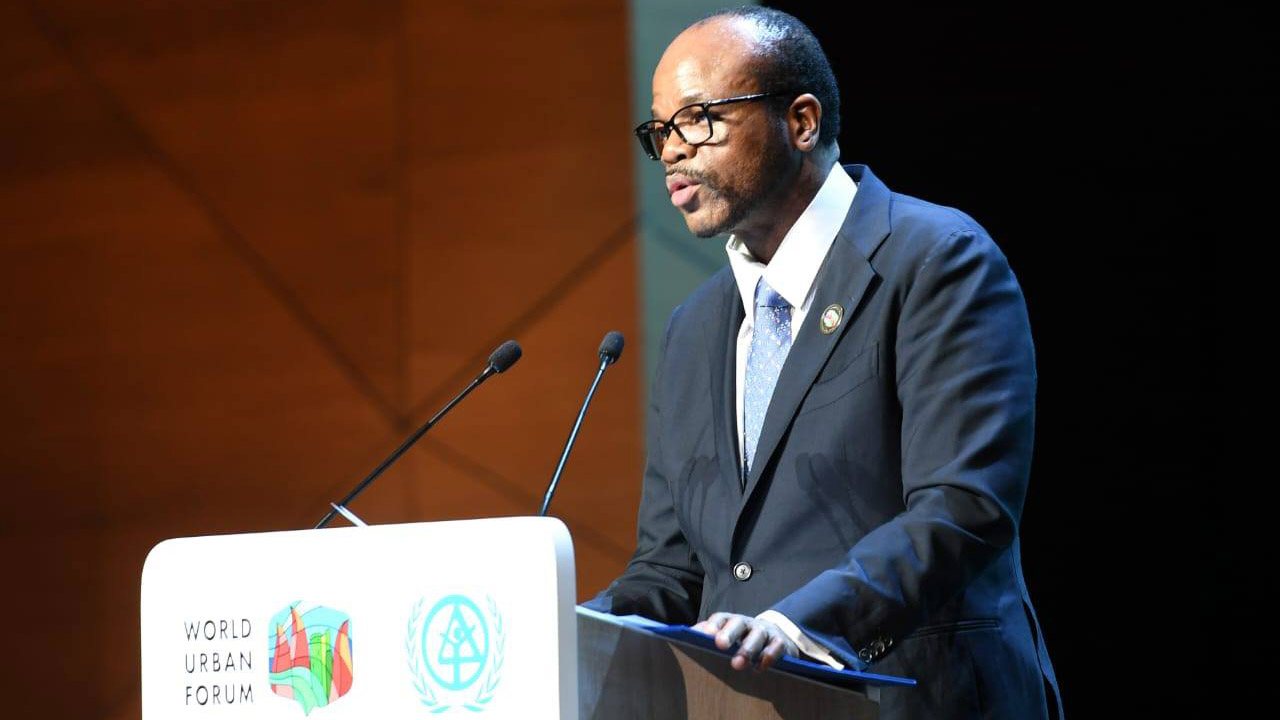
Eswatini joined global leaders, policymakers, urban planners and development stakeholders at the 13th World Urban Forum (WUF13) in Baku, Azerbaijan, where discussions focused on the future of housing, sustainable urbanisation and resilient communities.
The Eswatini delegation, led by the Ministry of Housing and Urban Development alongside local government leaders and other stakeholders, participated in high-level engagements that explored solutions to some of the world’s most pressing urban challenges. Central to the discussions were housing delivery, infrastructure development, climate resilience, smart cities and inclusive urban planning under the theme: ‘Housing the World: Safe and Resilient Cities and Communities’.
Director of Housing and Human Settlements in the Ministry of Housing and Urban Development, Bhekithemba Matsebula, said one of the most significant highlights for the Eswatini delegation was the strong inclusion of young people in global housing and urbanisation conversations. “What stood out for the Eswatini delegation is the involvement of the youth as part of the discussions that ensued,” said Matsebula.
He explained that the forum repeatedly referenced the continued implementation of the New Urban Agenda (NUA), which was adopted during Habitat III in Quito, Ecuador in 2016.
For Eswatini, one of the defining moments of the conference was the participation of His Majesty King Mswati III, who delivered the kingdom’s national statement during the opening ceremony. “What made WUF13 special was not only His Majesty’s address to the delegates, but his presence in the conference, which was the first of its kind,” Matsebula said.
“The array of dialogues, special sessions and roundtables kept us motivated throughout the conference.”
In his address, His Majesty highlighted Eswatini’s commitment to people-centred development through the Tinkhundla System of Governance. The King emphasised the importance of affordable housing, quality infrastructure, integrated spatial planning and environmental sustainability for both urban and rural communities.
Matsebula said the King’s message reinforced government’s determination to ensure inclusive development for all emaSwati.
“He emphasised that Tinkhundla System of Governance ‘ensures development priorities emerge from the communities themselves and that no women, youth, the elderly, persons with disabilities or marginalised groups are left behind’,” he said.
The forum also provided an opportunity for delegates to exchange ideas and learn from global best practices in housing and urban development. However, Matsebula acknowledged that housing challenges remain complex and constantly evolving.
“Unfortunately, in the housing domain, there is no ‘one size fits all’ solution. As you solve one problem, another emerges. What this means is that challenges associated with housing are dynamic,” he explained.
Among the emerging ideas from the conference was the growing recognition that housing should not be viewed in isolation.
“From the youth’s perspective, for instance, it emerged that ‘housing should include transportation’,” said Matsebula.
He added that global leaders increasingly regard housing as both an investment and a human right. According to discussions presented during the forum, more than 300 million people worldwide are homeless, while 2.9 billion people still lack adequate housing.
UN-Habitat Executive Director Anaclaudia Rossbach also highlighted that social housing initiatives are gaining traction globally and warned that insecure land tenure continues to make many people vulnerable.
The Eswatini delegation identified several possible solutions discussed during the conference, including integrating housing policy with land policy and planning, improving access to decent housing, promoting community-led housing initiatives and strengthening security of tenure management systems.
“The delegation also learnt that housing is about dignity,” Matsebula noted.
As urbanisation continues to grow in Eswatini, the ministry believes the knowledge and partnerships gained from WUF13 will play an important role in shaping future housing delivery and urban planning strategies.
Matsebula said collaboration between the ministry and UN-Habitat continues to strengthen, resulting in several important initiatives.
“This partnership has also resulted in the ministry offering technical expertise to UN Habitat as they conduct the Ngwavuma-Mkhondvo Eco City project,” he said.
He further revealed that cooperation with UN-Habitat has contributed to the formulation of Eswatini’s first National Urban Agenda report, which was presented during the African Urban Forum in Nairobi, Kenya, before WUF13.
In addition, Eswatini recently hosted its first-ever local Urban Forum, with plans already underway to hold the event every two years.
The ministry is also exploring potential cooperation opportunities with the African Development Bank (AfDB) to secure financial support for key housing and urban development projects.
“Although at an embryonic stage, we are hopeful that this initiative will be successful,” Matsebula said.
Looking ahead, Matsebula said the ministry remains focused on creating the right policy and legislative environment to improve service delivery and urban development across the country.
“The ministry is all about excellence as it tackles its many housing and human settlements challenges,” he said
He added that government is now extending spatial planning initiatives beyond urban centres to rural communities through collaboration with the Ministry of Tinkhundla Administration and Development. “Not only that, but the formulation of Regional Physical Plans and the National Physical Development Plans (NPDP),” Matsebula concluded.




















Leave a comment