MBABANE- Eswatini’s exports have declined for the third consecutive month in June.
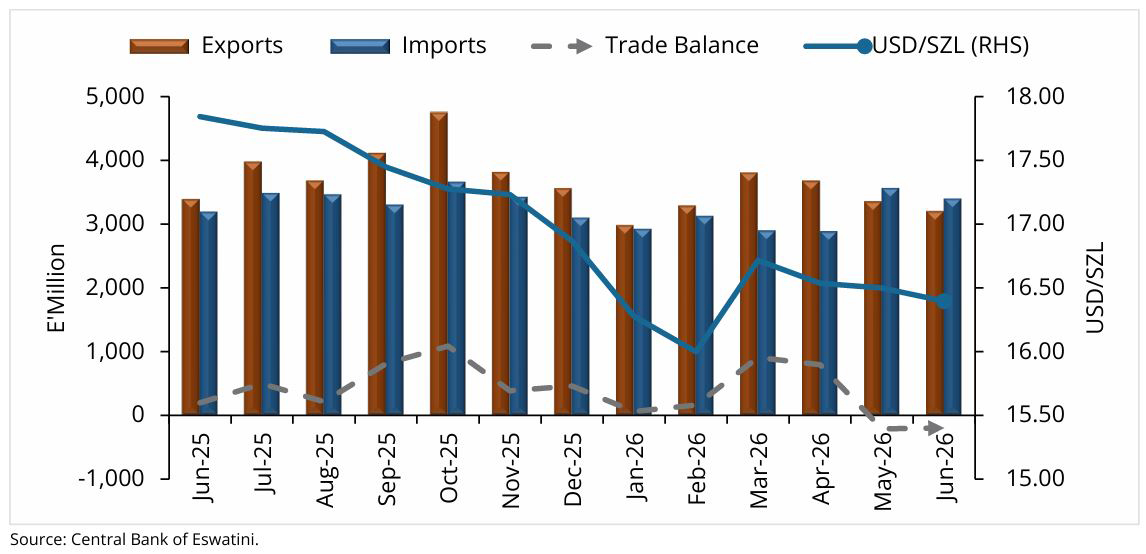
Eswatini’s trade deficit narrowed slightly in June despite the exports falling for a third consecutive month, as subdued import demand offset weaker export earnings amid persistently low global sugar prices.
The country’s trade deficit narrowed to E198.8 million in June 2026 from E211.4 million recorded in May, according to the latest Recent Economic Developments (RED) report released by the Central Bank of Eswatini.
The report shows that exports declined by 4.6 per cent month-on-month to E3.2 billion in June, representing a 5.6 per cent decrease compared with the corresponding month last year.
The Central Bank attributed the continued decline largely to persistently weak international sugar prices, which have continued to weigh on the country’s export earnings despite improvements in export volumes.
Imports also weakened during the month, falling by 4.6 per cent to E3.4 billion, reflecting the traditionally lower production activity experienced during June. However, imports remained 6.5 per cent higher than those recorded in June 2025.
After seasonal adjustments, Eswatini recorded a trade surplus of E309.1 million, with adjusted exports amounting to E3.7 billion while seasonally adjusted imports stood at E3.4 billion.
Soft drink concentrates remain biggest export
MBABANE – Soft drink concentrates remained Eswatini’s leading export product, generating E1.3 billion during June despite declining 5.6 per cent from the previous month.
The Central Bank said manufacturers adopted a more conservative production approach in response to softening international demand and changing market conditions. Compared with June 2025, however, exports of soft drink concentrates increased by 4.5 per cent. Sugar and sugar products generated E724.8 million, rising 6.8 per cent month-on-month and 2.7 per cent year-on-year.
According to the report, the improvement was mainly supported by stronger export volumes destined for Botswana and the European Union.
Exports of textiles and apparel fell sharply by 27.2 per cent, largely due to reduced knitwear consignments to South Africa. Despite the monthly decline, textile exports remained 2.9 per cent above levels recorded during the same month last year.
Meanwhile, exports of wood and wood products totalled E256.5 million, declining 2.3 per cent from May and 1.4 per cent compared with June 2025. South Africa continued to dominate as Eswatini’s largest export destination, accounting for 70.6 per cent of all exports during June.
Other major export markets included Mozambique (5.1 per cent), Kenya (4.5 per cent), Zimbabwe (3.9 per cent), Nigeria (2.2 per cent) and Uganda (1.7 per cent).
On the import side, energy products declined by 8.0 per cent, mainly reflecting lower diesel imports during the month.
Despite the monthly decrease, energy imports remained 14.9 per cent higher than in June 2025.
Imports of machinery and electrical equipment rose to E361.3 million, increasing 13.8 per cent month-on-month and 2.9 per cent year-on-year.
The increase was attributed to manufacturers and wholesalers importing additional equipment to modernise production facilities and meet customer orders. Imports of unprocessed food declined significantly to E282.1 million, representing a 20.9 per cent monthly decline and a 13.3 per cent annual decrease.
The Central Bank attributed the decline mainly to reduced imports of cereals, particularly maize and soya beans. Textile and apparel imports also fell from E263 million in May to E233.8 million in June, although they remained 9.1 per cent above the level recorded a year earlier. Vehicle imports increased by 6.2 per cent month-on-month and 4.0 per cent year-on-year to E207.1 million.
South Africa remained Eswatini’s largest source of imports, supplying 68.4 per cent of all imported goods. Other leading suppliers included China (8.8 per cent), Ireland (4.0 per cent), India (2.2 per cent), Oman (1.4 per cent) and the United Kingdom (1.3 per cent).