
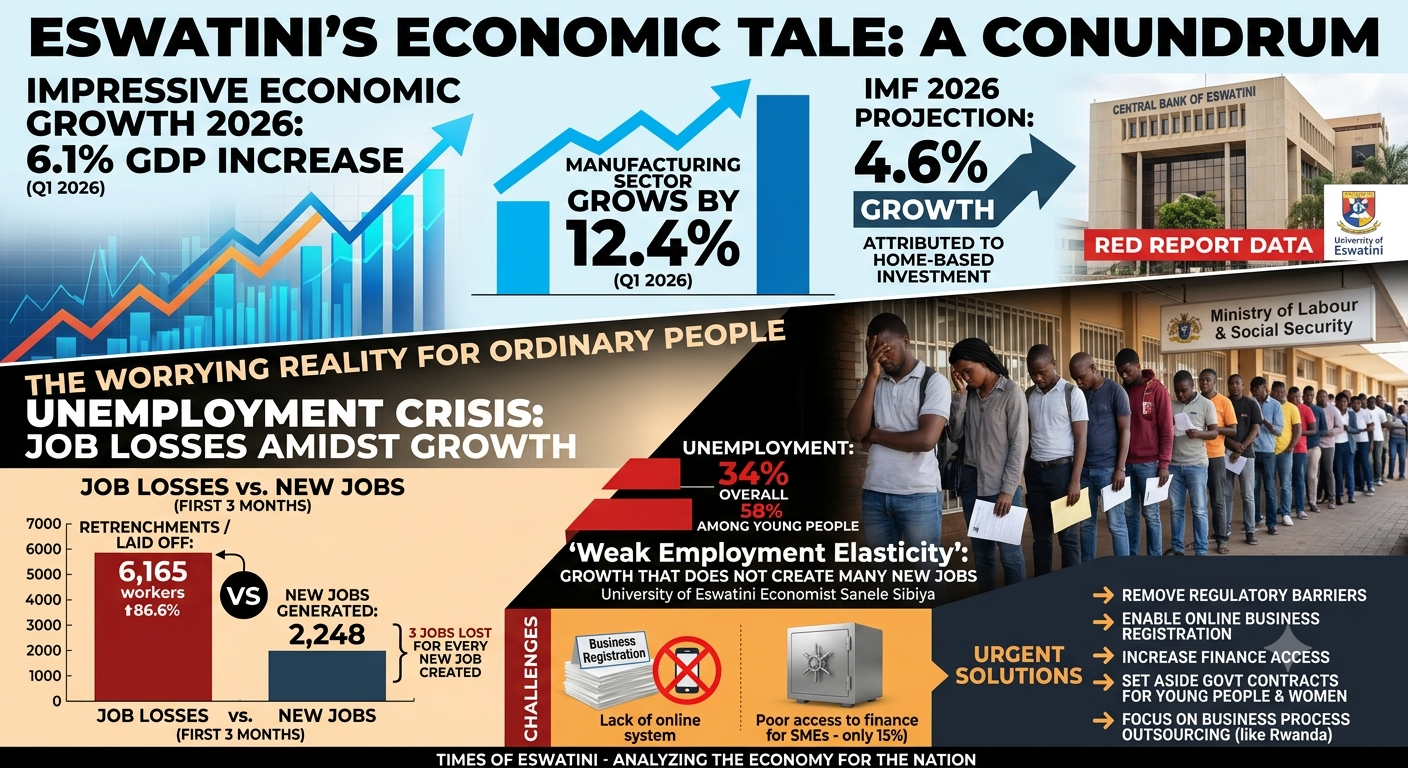
The latest economic growth figures are telling a story we are excited to hear. The economy grew by an impressive 6.1 per cent in the first quarter of 2026, driven by a 12.4 per cent increase in the manufacturing sector. This is according to the Central Bank of Eswatini’s latest Recent Economic Developments (RED) report.
We expect this growth to continue for the rest of the year, although it may be at a slightly lower rate, according to the International Monetary Fund (IMF), which projects that we will see a 4.6 per cent growth this year, which will largely be attributed to a lot of home-based investment.
However, there is a worrying contrast to this positive news. It appears the ordinary people are seeing the opposite. Job losses are worsening, even though the economy is growing.
The recent quarterly performance report from the Ministry of Labour and Social Security has revealed how the job industry retrenched or laid off 6 165 workers in the first three months of this financial year. This is an increase of 86.6 per cent compared to the same period last year.
Government and business programmes, on the other hand, have generated only 2 248 new jobs. To put it in context, nearly three jobs were lost for every new job created.
In an effort to make sense of this conundrum, the Times of Eswatini spoke to University of Eswatini economist Sanele Sibiya, who described it as ‘weak employment elasticity’.
He said it is a type of growth that does not create many new jobs for people. Even as manufacturing is growing, it is not big enough to absorb all the new workers entering the job market.
The latest updates from the IMF and World Bank have brought a mixture of positive news and serious concerns. The good news is that they think the economy will improve soon. But they also warn that if we do not make some significant changes to how things work, growth will slow to just 2.8 per cent in a few years. This will not make a real difference to unemployment, poverty and inequality. Unemployment is currently at 34 per cent overall and 58 per cent among young people.
The World Bank says it is still much more difficult and expensive to start a business in Eswatini than in similar economies in the region. One of the biggest problems is the lack of an online system to register businesses, which would enable entrepreneurs to register easily with their mobile phones. This is a pretty basic tool that many other places already have.
Another problem is that very few small and medium-sized businesses can get loans from formal banks. The World Bank says only about 15 per cent have access to such financing.
So, what is the solution? First things first, we obviously need to eliminate the things that keep our best and brightest young people from turning their ideas into real jobs.
Our growth strategy for the economy has to be flexible enough to respond to changing challenges exacerbated by external forces.
The Central Bank recently said these forces have caused our exports to fall for three consecutive months, mainly on account of low global sugar prices. We are overly dependent on money from the Southern African Customs Union (SACU), which comprises more than 40 per cent of government revenue. The World Bank estimates that our budget deficit will hit 6.3 per cent of GDP by 2026, placing us among the top 10 countries in Africa with the largest budget deficits.
We should follow the example of Rwanda in dealing with a similar problem. In addressing unemployment, they focused on the business process outsourcing industry. They removed the regulations that made it difficult, created a pool of talented workers and offered special incentives to attract businesses to come and make it work.
Rwanda’s economy has created some 4 000 beneficial jobs in just two years, data from different sources shows. These jobs are with the best companies that are now some of the largest employers in the country.
So, lakhaya, we need a bold and innovative approach that puts job creation at the centre and gets rid of costly fees for registering businesses so more people can register their companies online and increase access to finance by using modern systems to secure loans. We should also set aside a portion of government contracts for young people and women to provide them a fair chance to participate. In this way, we can generate more opportunities for all and spur growth. As Daron Acemoglu and James Robinson warn in their book ‘Why Nations Fail’: “Nations fail today because their extractive economic institutions do not create the incentives for people to save, invest and innovate.”
There is no doubt that the above five per cent growth is an indication that our economy is growing, which means we are still a favourable place for investors. But if this growth does not really benefit our people, then it is really just a numbers game. We need to be innovative and agile to sustain this growth by creating real opportunities for the many who find it hard to feel the growth in their pockets.