MBABANE – During this year’s Speech from the Throne, His Majesty the King said the nation was looking forward to the start of construction on the new Parliament building.
Officially opening the third session of the 12th Parliament, the Head of State said the current building has served its purpose. He noted that Parliament now needs a structure that is fit for modern use.
His Majesty expressed disappointment that the project is behind schedule. He urged government to go back to the drawing board and figure out how to make the parliamentary campus a reality.
“The work of our parliamentarians requires long hours, meaning they need to be close to Parliament. This ensures quick decision-making and meets our expectations for fast implementation,” the King said in his speech on February 20, 2026.
The new building will mainly provide two chambers. These are the House of Assembly and Senate.
The 15-hectare site is located at Lobamba.
Is government doing enough to make sure this royal directive is carried out?
In a report, Dr Thambo Gina, the Minister for Economic Planning and Development, seemed unsure about the project’s timeline.
This is because the bank has not replied to the government since the Detailed Project Report (DPR) was submitted in 2024.
The minister is at sixes and sevens because the bank has not confirmed if the project can still go ahead using the agreed loan. As a result, he stated: “Because of this uncertainty, there is a need to look for alternative financing.”
However, he noted that the installation of bulk water and electricity supplies is almost complete. His ministry reported that the only remaining task is installing the electricity transformer. The main construction has been on hold since 2024, following the completion of the DPR.
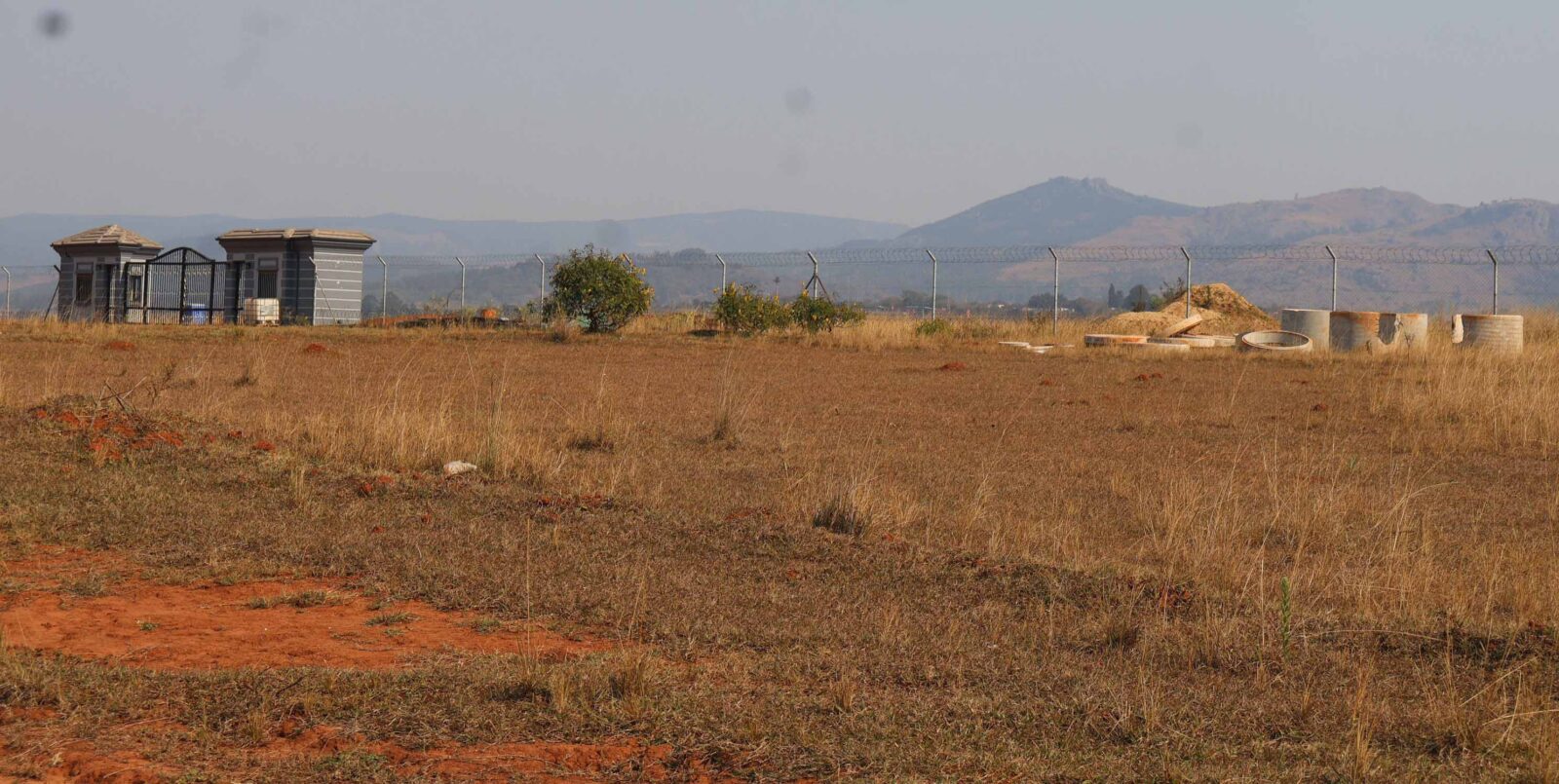
When this newspaper visited the site on Wednesday, there was no visible activity or any sign of installation work.
If government looks for a new financier, it is believed the new funding model could open doors for local contractors.
Local companies were left out of the initial tender because the loan conditions stated that the main contractor had to come from India, the country providing the loan.
The project is expected to cost E1.83 billion. Even though construction has not started, government has already spent E37.205 million. For this financial year, E46.55 million has been allocated from local funds.

This money will be used to pay outstanding fees for the building’s design and to pay a private security company hired to guard the site.
The consultancy work was awarded to Voyants, an Indian company. The tender was advertised in India by the Export-Import Bank of India (Exim Bank) on behalf of Eswatini.
India is funding the project through an Exim Bank line of credit worth US$108.28 million (about E1.8 billion at the current exchange rate).
The current Parliament building was built in 1967 for a much smaller number of politicians. It is said that its design does not allow for future expansion, meaning that while parliamentary operations have grown over the years, the building has not.
Following parliamentary reforms in 1978, 1992, 2005, 2013 and 2018, a new building became necessary to house an expected increase in House of Assembly members.
Furthermore, Section 251 of the Constitution Act No. 01 of 2005 provides for a Council of Chiefs made up of 12 traditional leaders from the four regions.
Currently, there are 103 parliamentarians between the Senate and the House of Assembly. If the yet-to-be-appointed Council of Chiefs is also accommodated in the new building, that number will rise to 115. Sources say the new structure will also cater for future developments, such as the creation of more tinkhundla centres.
The site at in Lobamba is still largely undeveloped. It is bordered by the Lusushwana River to the north-east and a road connecting the MR3 and MR103 to the south. The location offers a grand view of the mountains in the Hhohho region to the north-east and the Manzini region to the south-west.
On its website, Voyants states that Eswatini awarded it the contract to prepare the DPR and provide project management consultancy (PMC). As the PMC, Voyants was expected to play a vital role in managing the construction using its experience and skills.
A project report generally includes progress updates, cost-benefit analyses and risk assessments. Therefore, Voyants was expected to handle various challenges, such as safety issues, engineering problems and coordinating between different contractors.
This newspaper investigated the company to check if it could have handled a project of this size, especially since Eswatini has its own highly capable project management consultancies.
It has been established that Voyants Solutions Private Limited is one of India’s fastest-growing infrastructure firms, operating across the globe. It offers end-to-end services, from planning and design to construction supervision and maintenance.
With a team of 1 500 professionals, it has delivered projects in 200 cities across 33 countries in Asia, Africa and Europe.
Some of Voyants’ notable past projects include the Naval Headquarters in Delhi and the Police Headquarters in Hyderabad.
It has also designed the Carnegie Mellon University Africa Campus in Rwanda (funded by the African Development Bank) and won the Bentley Infrastructure Award in 2019 and 2020 for 12 IT Parks funded by Exim Bank.
Other major projects by the company include:
Winning the international design competition for two railway redevelopment projects in Bangalore and Gwalior.
Providing project management services for the upgrading of major railway stations in 11 Indian cities.
Managing the construction of a Gems and Jewellery Park in Navi Mumbai.
Providing design consultancy for a Medical Device Technology Park.
Meanwhile, the financier, Exim Bank, was set up by the Indian government in 1981 to support exports. It acts as a growth engine for businesses by offering products like import and export technology, product development and foreign investment.
The bank provides lines of credit to foreign governments and institutions so they can buy Indian goods and services on deferred credit terms.
Back home, the new Parliament project is being supervised by the Millennium Project Management Unit (PMU).
This unit is responsible for planning and managing strategic development projects, including the International Convention Centre and Five-Star Hotel (FISH), the proposed national referral hospital and the building of villas.
The PMU’s goal is to drive economic growth and create jobs in line with the National Development Strategy (NDS) by attracting both local and international investment in infrastructure, tourism and general business.