

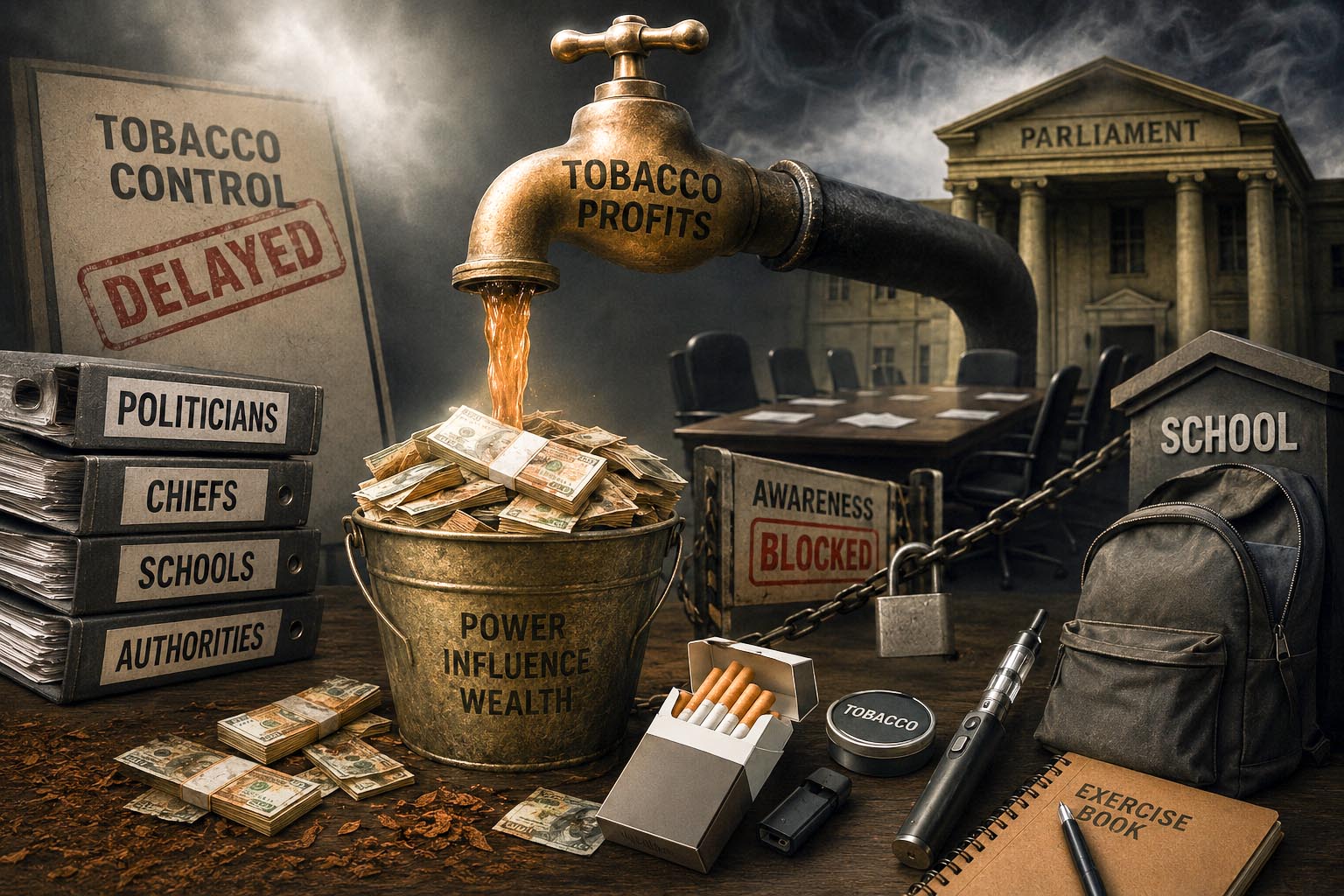
Let me get this straight. We are living in a country where the Ministry of Health is gearing up to go to war with big tobacco, and the front line isn’t some distant corporate office—it’s right here in Lobamba. Inside our own Parliament, where the people being asked to close the tobacco tap may be the same people standing next to the tap.
We are asking our honourable Members of Parliament to close a tap that may be filling their own buckets. Read that again. Slowly. That’s like asking a taxi owner to campaign for fewer passengers. Everybody claps. Everybody agrees. Then the taxi owner asks who will pay for the fuel. Independent News Editor-in-Chief Mfanasibili Sihlongonyane had to break it down plain for the ministry: “Look, you guys better bring some heavy-duty strength to Parliament, because your honorable members are out here getting that tobacco money.”
Picture the debate in the House of Assembly. One MP stands up, clearing his throat: “Mr Speaker, tobacco is destroying our children!” Another MP nods solemnly: “I couldn’t agree more, honourable colleague.” He then quietly checks his phone under the bench—not for the voting figures, but to check whether the harvest is having a better day than the debate. And it doesn’t end in Lobamba. Sihlongonyane brought up the traditional chiefs, too. You arrive at an inkhundla or royal kraal to discuss tobacco control, and suddenly everybody becomes an agricultural economist. How do you enforce a national health ban when the local bucopho and indvuna are treating the crop like a family business?
Then you’ve got the high school situation, which has completely spiralled out of control from Manzini to Pigg’s Peak. Sihlongonyane pointed out that school kids across Eswatini are walking around looking like small businessmen with briefcases full of smoke.
Why aren’t parents catching them?
Because parents are standing in a two-hour queue at Jet in January buying school shoes that cost half a month’s salary, while the child standing right behind them has a vape in his pocket that costs more than the shoes. Every January, parents inspect exercise books. Every Sunday night, they check uniforms. Nobody inspects the pens.
Imagine being a mother in Eswatini today. You see your Form III boy sitting at the kitchen table late at night, staring intensely at his books, chewing on a pen cap. You sigh, wipe a tear and think: “Look at my son, working so hard for his IGCSEs.”
No, babe. He’s not studying geography. He’s fighting an addiction disguised as stationery. His heartbeat is auditioning for a marathon. And what are the schools doing about it? That brings us to Phumlani Matsebula from SADAT, who has spent fifteen years walking dusty roads trying to get into schools to warn pupils about drugs and tshwala. Every time his outreach team pulls up to a gate, the headmaster turns them away. ‘Too busy.’ ‘Paperwork.’ That’s the whole excuse.
But Matsebula dropped an absolute nuclear bomb at the meeting: he alleged that some of these headmasters are blocking drug awareness teams because they are personally involved in the trade.Think about the absurdity of that allegation. Parents know every teacher who gave extra homework. They know every teacher who is strict about socks. But suddenly nobody knows what happens when the staffroom door closes.
“Good morning, pupils. Today’s assembly is brought to you by discipline, respect and high-grade nicotine. Open your textbooks to page 42, and don’t forget to buy your ‘stationery’ from my office during break.” The strange thing about syndicates is that they don’t always wear masks. Sometimes they wear suits. Sometimes they sit behind desks. Sometimes they write the rules. So, how is government planning to beat a multimillion-emalangeni industry that has politicians, local chiefs and alleged school authorities on the payroll? Editors Forum Chairperson Mbongeni Mbingo said we need to meet the youth on TikTok.
Visualise this. The same people who need three signatures to approve a printer cartridge are now being asked to create viral content. Somewhere in a government ministry in Mbabane right now, there is a Director who spent thirty-five years climbing the civil service ladder, only to discover his entire retirement legacy depends on learning dance choreography. Meanwhile, the ministry messenger is now the chief algorithm consultant, explaining why the undersecretary needs to do the ‘Water’ dance while holding an X-ray of a black lung.
Hey, if it keeps kids off the vapes, let’s do it.
To their credit, the Ministry of Health isn’t backing down. Legal Officer Behlule Ndlela admitted that the upcoming battle with the tobacco lobby is going to get dirty, but insisted government is ready. They’re merging outdated laws from 1933 and 2013 into one master Bill, establishing a Tobacco Control Fund and an official Board to enforce it all.
Ndlela says they still have backing from Cabinet and the Parliamentary Portfolio Committee. But the Bill still has to go back to Cabinet twice before it even touches the floor of Parliament. That’s two golden opportunities for a file to develop mysterious legs and disappear under a mountain of old reports.
We spent decades in this country telling our children, “Education is the key.” Now they’re walking into classrooms carrying a pen that unlocks an addiction.
Tonight, a parent will ask:
“Did you finish your homework?”
A child will hold up a pen.
The parent will smile.
The child will smile too.
One of them thinks it’s education.
The other knows it’s addiction.















Leave a comment