

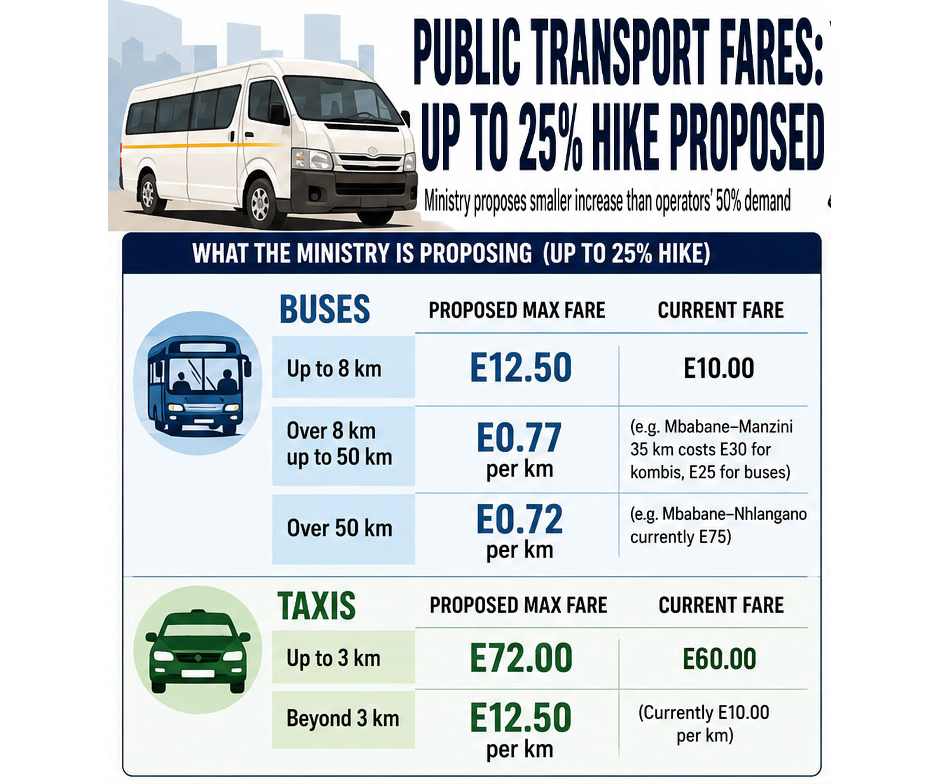
LOBAMBA – Public transport fares could increase by up to 25 per cent under a proposed adjustment by the Ministry of Public Works and Transport.
This is a major departure from the 50 per cent that was proposed by public transport operators represented by the National Road Transportation Council (NRTC).
The proposal is yet to be debated in Parliament, which has the prerogative to either pass, amend or dismiss the intended increase.
The new proposed Maximum Bus and Taxi Fare (Amendment) Regulations were tabled by the Acting Minister for Public Works and Transport, Savannah Maziya, at Senate yesterday. They will then be debated by the legislators at a date to be appointed.
The proposed increases are contained in a June 2026 report by the ministry.
Under the draft Maximum Bus and Taxi Fares (Amendment) Regulations, 2026, a passenger travelling by bus for up to eight kilometres would pay E12.50, up from the current E10. In practical terms, local distances less than eight kilometres are those generally between Matsapha and Manzini or Mbabane and Msunduza.
For trips exceeding eight kilometres but not 50 kilometres, the proposed maximum fare is E0.77 per kilometre. It must be noted that there are 35 kilometres between Mbabane and Manzini, and the current fare is E30 for kombis and E25 for buses.
Meanwhile, while distances exceeding 50 kilometres would attract E0.72 per kilometre. This includes trips from Manzini or Mbabane to Nhlangamo or Buhleni and further.
This is also a major reduction from that which was recommended by the NRTC, which had proposed that distances longer than eight kilometres (KM), such as that of Mbabane to Manzini, the fare would increase by 35 per cent from E30 to E40.50.
It had also proposed that distances longer than 50 kilometres, such as between Mbabane and Nhlangano would see an increase of 30 per cent from the currently charged E75 to E97.50.
The proposed regulations would amend the Maximum Bus and Taxi Fares (Amendment) Regulations of 2022.
The ministry’s report says the proposed increases were driven largely by changes in fuel prices.
It records that unleaded petrol (ULP) 95 had declined from 2 280 cents per litre to 1 945 cents by February 2026, while diesel had also declined from 2 240 cents to 1 985 cents during the same period.
However, fuel prices subsequently rose sharply.
On April 2, 2026, ULP 95 increased by 290 cents, from 1 945 cents to 2 235 cents per litre – an increase of 14.9 per cent.
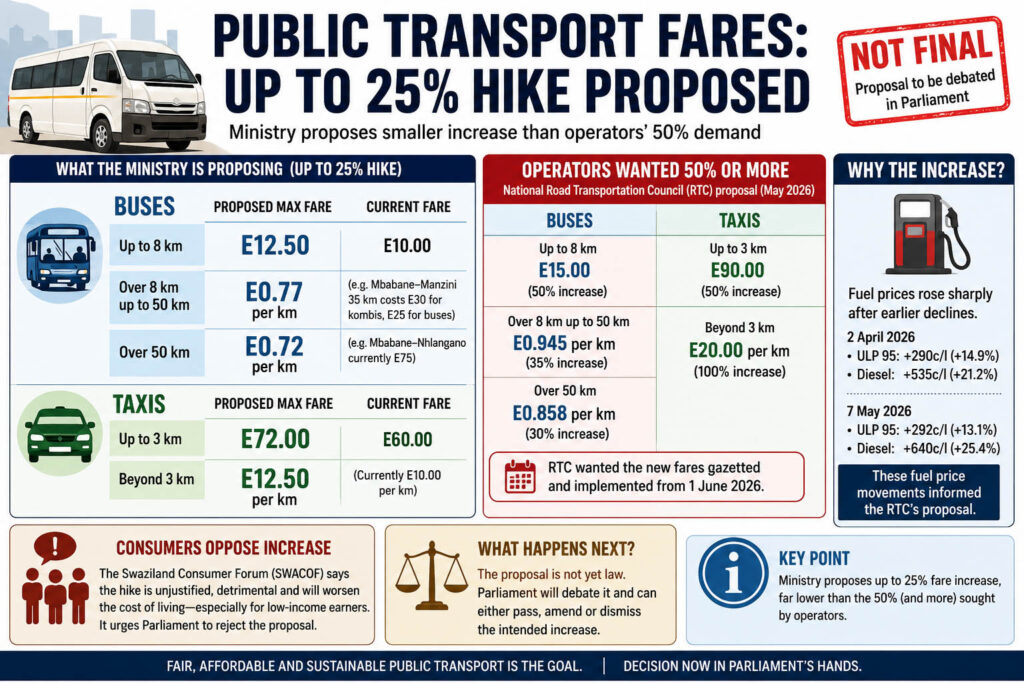
Diesel increased by 535 cents, from 1 985 cents to 2 520 cents, representing a 21.2 per cent increase. On May 7, ULP 95 increased by a further 292 cents to 2 527 cents per litre, an increase of 13.1 per cent.
Diesel increased by 640 cents to 3 160 cents per litre, representing a 25.4 per cent increase.
The ministry said these fuel price movements formed the basis for the Road Transport Council’s proposal to increase bus and taxi fares.
The ministry said it was not in agreement with the initial proposal as it would have been unaffordable for the commuters. The ministry then proposed that in the absence of any scientific method to calculate bus and taxi fares, let the historic trend be applied to the increments.
Meanwhile, taxi fares would see a bigger increase, with the charge for a journey of up to three kilometres proposed to rise from E60 to E72.












Let the price be fixed for all legally
Do school bus gazette